

What Is the Purpose of AI? A No-Fluff Ultimate Guide
Guess what? That’s a shocking figure: just 19.5% of U.S. businesses were actively using AI. In May 2026, according to Census Bureau data. Yet, look at everyone you know, and you’d imagine that everyone has already used a bot to take over 50% of their workforce. So what’s actually going on—and what is the purpose of AI, really, once you strip away the hype?
In plain terms, the AI’s purpose boils down to this. It’s meant to help machines do things that normally take human intelligence. Spotting patterns, making predictions, and understanding language. And to do it at a speed and scale no person could match on their own. It’s about empowering individuals with superpowers as opposed to people getting replaced for the tedious, repetitive, or overwhelming aspects of a role.
In this guide, you’ll learn what AI is (without the jargon), the core reasons it exists, the different types of AI you’ll hear about, and real AI purpose examples across industries. And the everyday uses of AI, how AI’s purpose in business is actually playing out in 2026, and the honest advantages of AI. And how to figure out if any of this applies to you. Let’s get into it.
Table of Contents
- What Is AI, Really?
- Why Does AI Exist? The Core Purpose Behind It
- Types of AI: What You’ll Actually Run Into
- AI Purpose Examples You’ll Recognize From Everyday Life
- AI Purpose in Business: What’s Real and What’s Hype
- The Real Advantages of AI (and Where It Falls Short)
- AI vs. Regular Software: What’s the Difference, Anyway?
- So, Should You Actually Use AI? Getting Started
- FAQ: Quick Answers to Common AI Questions
- Final Thoughts
What Is AI, Really?
Let’s get past the word salad. If you ask people about “what is AI,” they’re typically envisioning something from a sci-fi film—something that thinks like a human. Most of the AI you use every day isn’t what that is.
The best definition of artificial intelligence, at least the one that’s actually useful, is this: AI is software that learns from data and gets better at a task over time, instead of just following a fixed script someone wrote line by line. All normal apps perform exactly the same action as per their code every time. An AI system sees examples, draws out patterns from them, and applies them to something that it did not see before, making a decision.
Learning versus instructions—that’s the game.
The Technology Doing the Heavy Lifting
Although no computer science degree is required to follow this, it is advantageous to know the vocabulary:
- Machine learning is where the software learns from the data and self-determines patterns. Without having to be programmed by hand, which is difficult and time-consuming.
- The more sophisticated form of machine learning is called “deep learning.” And involves “neural networks,” a series of “layers” inspired by the way brain cells connect to solve fuzzier problems, such as identifying a face in a blurry photo.
- The machine uses natural language processing (NLP) to read your sentence, correctly interpret its meaning, and respond in a similar manner. It’s the lifeblood of any chatbot and voice assistant.
- Computer vision enables machines to “see”—to interpret photos and video, like a self-driving car does when it sees a stop sign or a factory camera does when it discovers a defect in a part.
Why This Definition Actually Matters
If you can get past the notion that this is a learning tool rather than one that follows commands, everything starts to make sense. It’s there to deal with the unruly, unpredictable, data-intensive business that rigid, rules-based software has never successfully managed.
Why Does AI Exist? The Core AI Purpose Behind It
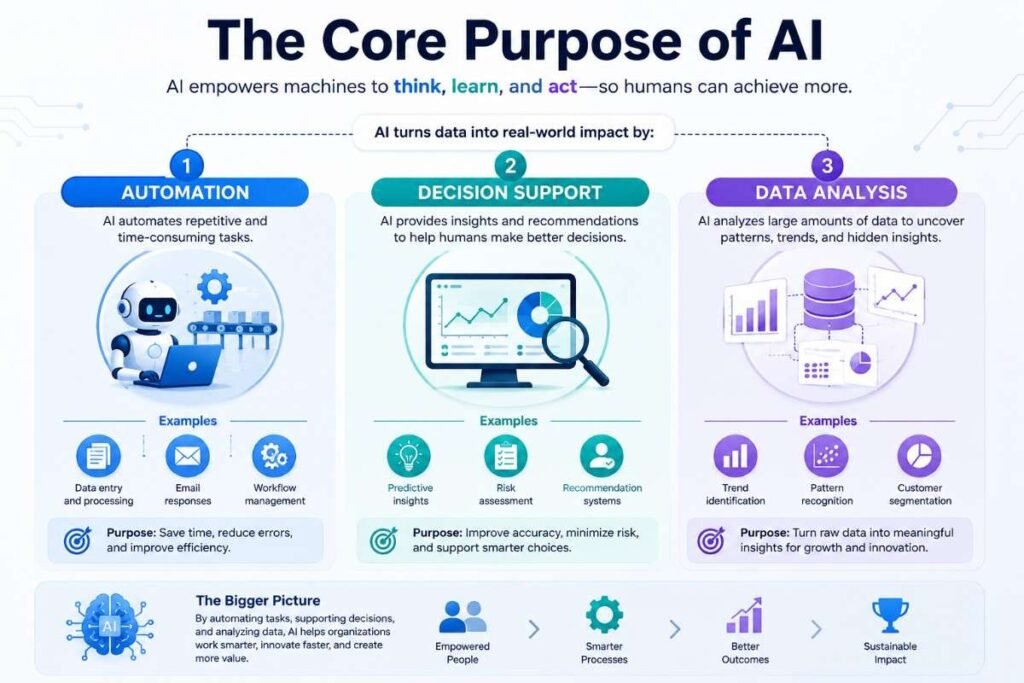
The goals of AI have changed over time and are not the same as when it was first introduced at Dartmouth College in 1956. AI was never created for a single purpose. Instead, its role has evolved over the past seventy years. Despite these changes, four core purposes of AI have remained consistent and continue to shape its development today.
1. Taking Repetitive Work Off Your Plate
This is the most traditional use of AI and likely the most used one. Data entry, scheduling, sorting e-mails, answering the same customer question for the hundredth time — these kinds of repetitive tasks are done by AI, allowing individuals to concentrate on the human task of making use of their brain.
2. Making Human Decisions Sharper, Not Obsolete
A lot of the “AI is going to steal your job” fear gets the wrong end of the stick. The reality of the world is that most AI applications do not make decisions for themselves; they are designed to assist in a decision. Even the AI does not take the place of the doctor but rather flags the area that needs a second look. The AI doesn’t decide the loan; the loan officer does, just faster at crunching the risk numbers.
3. Making Sense of an Absurd Amount of Data
Today, we generate data that exceeds the amount of data produced by humans in all of history prior to the 2000s. No one is reading that all manually. Part of AI’s purpose is simply digesting datasets too massive for any team of humans to review—millions of transactions, years of medical records, entire archives of satellite images.
4. Solving Problems Where Speed Is the Whole Point
Some challenges need to be solved very quickly. For example, predicting a storm before it happens or changing delivery routes during traffic. Or analyzing thousands of chemical compounds to discover new medicine. AI helps handle these tasks with speed and efficiency. This is something that AI can do, not a spreadsheet.
In summary, AI should not be used to think like a human. It’s designed to perform human-like activities at a scale and speed that humans cannot match—and still be under human control.
Types of AI: What You’ll Actually Run Into
Not every AI is the same, and with the knowledge of the types of AI, you’ll be able to distinguish between what’s reality and what’s sci-fi. There are two types of sorting AI: based on its capabilities and based on how it operates.
Sorted by Capability
Narrow AI (aka “Weak “AI”)—This encompasses all of the AI currently in the world. It’s designed to perform one thing properly: suggest a show, screen spam, or write a paragraph. Do anything outside its scope, and it comes undone. Whether you’re using ChatGPT, Google Search, or Spotify, all of these are what is called “narrow AI”—a term for AI that has been limited to specific tasks.
AGI (ALG), the Sci-Fi version—This is the version that can reason about anything like a human; it can solve a problem and then learn about a new one and solve it. It is not to be found today. It’s the long-term objective that most AI labs are aiming for, but yet no one has created it.
Superintelligent AI (ASI)—This is a purely theoretical construct and, as of yet, largely a topic of discussion and Silicon Valley opinion pieces.
Sorted by How They Function
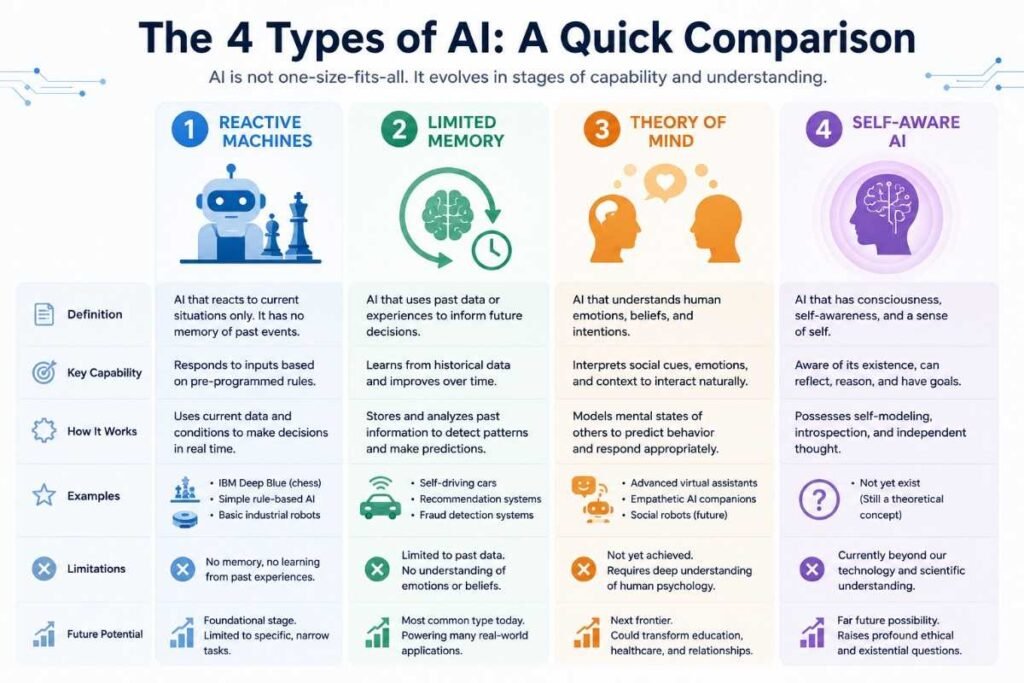
Reactive machines have no memory. They simply observe what is in front of them at this present time and react—no more. The classic case of IBM’s historical Deep Blue chess computer is the example.
Limited-memory AI is what most modern AI actually is. It relies on more recent data to make more accurate decisions—like a self-driving car that reads. what it’s seen in the past few seconds or a recommendation engine that looks at the past month of your web history.
Theory of mind AI would be able to comprehend emotions and intent as humans do. Researchers are working on it. Not commercial for now.
Self-aware AI — machine consciousness — remains entirely theoretical. When you see a headline that says otherwise, it’s very likely clickbait.
AI Purpose Examples You’ll Recognize From Everyday Life
This course introduces the concept of artificial intelligence’s purpose within the context of everyday life.
While theory is fine, AI-purpose examples are the ones that really make sense—and they are also some of the most common uses of AI you’ll encounter in your everyday life.
Healthcare
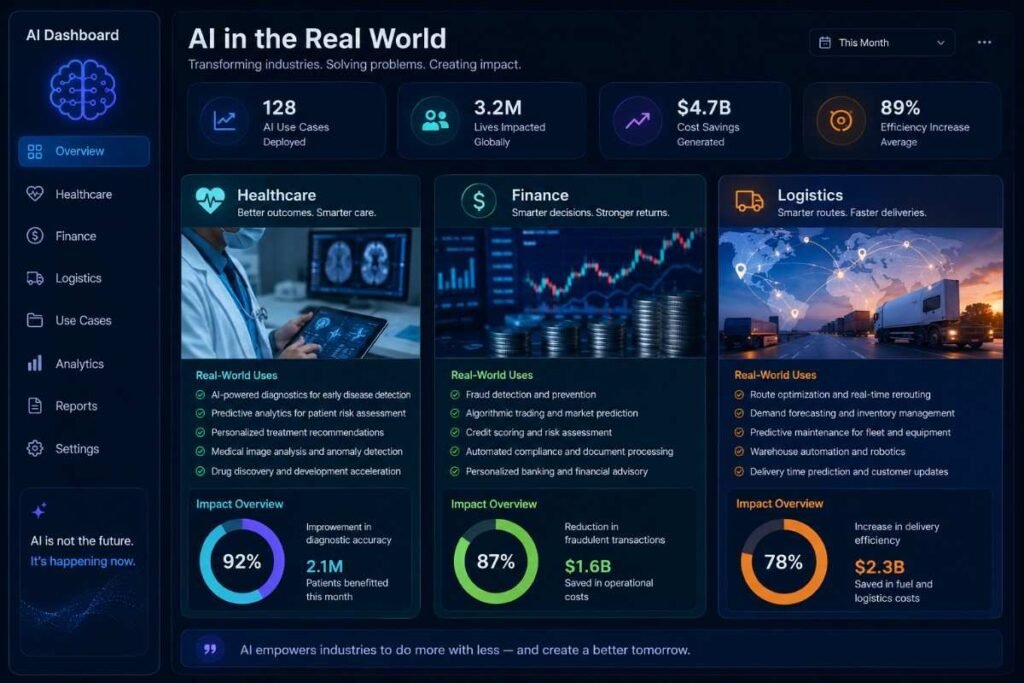
AI can pick up abnormalities in X-rays or MRIs before a tired radiologist could if they were going to be identified. Sometimes it’s able to detect it on scan number 40 of the day when a radiologist is already tired. It is also used for drug discovery pipelines and patient risk scoring. By 2025, 80% of healthcare professionals stated that AI has generated revenue for their organization, not just saved time.
Finance
Have you ever received a text asking, “Was this really you?” after a strange purchase? That’s AI at work. It spots unusual transactions, compares them with your normal spending habits, and detects possible fraud in just milliseconds. It is also used in powering algorithmic trading, credit scoring, and retirement-planning apps known as robo-advisors.
Retail and E-Commerce
AI is widely used for personalization and demand forecasting. It powers features like “customers also bought” suggestions, dynamic pricing based on demand, and chatbots that offer help. These tasks involve analyzing large amounts of data quickly. They are too complex to be handled manually by human teams alone.
Transportation and Logistics
AI helps delivery companies avoid traffic by finding faster routes in real time. It also predicts vehicle problems before they happen, reducing breakdowns, cutting costs, and ensuring deliveries arrive on time.
Manufacturing
A camera on the assembly line can identify faulty products much quicker and more reliably than a human inspector can, particularly in the 10th hour of the shift. Sensors can also detect when a machine is soon going to fail before it does.
Education
The adaptive learning platform tailors problem difficulty based upon actual performance, rather than off-the-shelf curriculum. AI tutoring tools are also meeting a genuine need for students needing tutoring after school.
Agriculture
AI-powered drones monitor crop health from the sky. They help farmers use the right amount of water and fertilizer, improving harvests while reducing waste.
Marketing and Creative Work
With generative AI, for instance, the first draft of your ad copy is now written; the video is edited; and which ads you are shown, compared to the person next to you, is now done in real time. The grunt work shifted, and the creative direction and final decision are still human.
AI Purpose in Business: What’s Real and What’s Hype
As a business owner, you may have heard various figures about AI’s purpose in business, but some of them don’t seem to align. It is not you that misunderstood or misinterpreted things; it is a true discrepancy that you need to understand.
The Confusing Truth About Adoption Numbers
Let’s take a look at those views about 2026, based on different surveys you can trust:
- Industry research (typically gleaned from the data of surveys by McKinsey or similar) estimates that global business AI usage is approximately 88–91% if we include any use of AI in any sort of function.
- According to the U.S. Census Bureau’s more conservative Business Trends and Outlook Survey, only 19.5% of U.S. businesses actively deployed AI in May 2026, while an additional 22.7% planned to do so in the next six months.
- According to a note from the Federal Reserve in April 2026, 78% of the U.S. labor force is employed at a company where AI has been integrated at some point, whereas 54% work at a company that uses large language models on a daily basis.
- The use of generative AI grew by more than 70% in 2024, up from approximately 33% of organizations in 2023, with one of the fastest tech adoption curves ever observed.
What does this really mean? Basically everyone’s poking around with AI. There are far fewer companies that are implementing it deeply in their businesses. Few people don’t try something new. So, the actual deployment in real, scaled fashion is still a minority.
Is the ROI Actually There?
The financial situation has been strong, even with a hodgepodge of adoption numbers. Businesses are reporting an average return of about 3.7 times per dollar on generative AI tools and that 92% of them will continue investing in the next three years. This is not a number to chase for the sake of it — it’s a number that is being backed up with real dollars and is working.
What Actually Trips Companies Up
The statistics of failures are just as significant as those of success:
- Poor data quality is the top issue — 56% of companies state that poor data quality is a significant obstacle to real-world AI adoption.
- It’s really difficult to deploy. While 31% of business leaders said AI adoption was easy, 76% of them experienced real challenges implementing AI in 2024, not due to the lack of the technology itself but because their own processes and skill sets fell short.
- Many projects simply fail to make it. A large percentage of the AI projects that are being announced but not well structured and prepared for artificial intelligence to be called “AI-ready” are likely to be quietly forgotten before ever getting to production, according to analysts.
The 10-20-70 Rule Worth Knowing
For good reason, the Boston Consulting Group framework for successful AI transformation has stuck with a lot of business leaders: 70% people and process, 20% technology and data infrastructure, and 10% algorithms. In other words, the model is not always the difficult component. Getting your team and your data ready for it is.

The Real Advantages of AI (and Where It Falls Short)
The only upside is the guide isn’t telling the truth. Here’s the honest version of the advantages of AI—and the trade-offs that come with them.
Where AI Genuinely Wins
It’s fast. What would take a person hours or days to accomplish is done in seconds—it’s not marketing spin, it’s math.
It’s consistent. AI doesn’t have an off day or fatigue with the tenth hour of the shift. Consistency is a big deal when working on quality control and compliance.
It can be cost-effective in the long term. When it works correctly, AI can reduce the costs of labor and expensive human error, albeit the setup price isn’t cheap.
Never logs off. Customer service bots, monitoring systems, and fraud alerts don’t get to take a break for lunch or the weekend.
It identifies things that the human eye cannot see. AI is designed to uncover these same kinds of connections in years of data, ones that a human analyst might spend weeks analyzing without success.
It customizes much more than humans do. Creating a customization experience for one customer is simple. Making it available to all 10 million customers at once is only possible with AI. Eight out of 10 small businesses employing AI say they have seen a true improvement in their operations’ efficiency.
Where AI Genuinely Falls Short
This one, too, is important, as are most articles that talk about the “top 10 benefits of AI.
- Bias is a danger that is very real. If the information an AI has been trained with includes bias — for example, if it has been trained on historical data from the hiring or lending process — the AI might also embody that bias, albeit on a larger scale and faster.
- Privacy becomes a complex matter quickly. The question of consent and security arises as AI systems may require significant personal data to function effectively. The need for extensive personal information for the effective operation of AI systems raises legitimate concerns about consent and security.
- Jobs do shift. AI takes care of some tasks and sometimes even roles that require specific tasks. And then new types of jobs appear as well, but it’s not a simple change for the people experiencing it.
- But actually, it is difficult to implement. Most companies still have a long way to go to make AI go beyond the pilot phase—it is not just a matter of “just buy the software.”
- It can be a “black box.” In some cases, complex AI models may not have a clear explanation for why they made a specific call, particularly the deep learning models. But in the sector where a regulation must be explained, such as healthcare or finance, it’s a real issue.
So, Should You Actually Use AI? Getting Started
Understanding what AI is for doesn’t matter much if you don’t know what to actually do with that information.
If You’re an Individual
Start small. For the mundane tasks, such as writing an email, summarizing a lengthy document, or finding out the meaning of something you don’t have time to research yourself, resort to a general AI chatbot. Know how to craft a clear prompt; it’s more important than you may think. Not only to know how to click buttons, but also to be literate in how these tools work.
If You’re Running a Business
Always check data first, then anything else. No, messy data is the one most significant reason that AI projects fail, so that is step one before deciding on a vendor or tool. Don’t start by attempting to transform everything all at once, but pick a small use case first, such as customer service automation or a search system within your organization, which is an area that is less risky and easier to get started in. Focus on the people side of the rollout and not only the tech side, as 10-20-70 dictates most of the work will be done there. Establish some basic governance early on: who is monitoring for bias, who is checking the AI decisions, etc. where a human still needs to sign off.
Frequently Asked Questions – Quick Answer for Common AI Questions
What’s the primary goal of AI?
AI’s primary role is to enable machines to learn from data, perform repetitive tasks, assist in making informed decisions, and handle vast amounts of data that are beyond human capacity. It’s designed to complement humans and not replace them.
What is the easiest way to explain what artificial intelligence is to someone that isn’t technical?
In simple terms, the best description of artificial intelligence is a software program that learns by looking at data and experience and can make predictions or decisions on its own, rather than just following the rules that were typed in by someone before it was built. It’s that learning ability that truly sets it apart from a regular computer program.
What are the 4 types of AI?
Sorted by how they function, the main types of AI are reactive machines, limited memory AI, theory of mind AI, and self-aware AI. Only the first two are actual and used today, while theory of mind and self-aware AI are just research ideas or theory.
What are the advantages of the most important things about artificial intelligence?
The key benefits of AI are that it is fast, consistent, always available, more data-driven, and more personal. Companies applying generative AI gain approximately 3.7 times their investment.
What is the relevance of AI for business?
AI applications in business range from detecting fraud and automating customer service to forecasting customer demand, creating personalized marketing strategies, and enabling predictive maintenance. That being said, approximately 34% of companies have transitioned AI beyond the pilot phase and are therefore using it across the entire organization and not just specific functions.
What is the difference between AI and machine learning?
Not quite—machine learning is one aspect of AI, that is, the ability to train an algorithm on the data to make predictions. The larger vector is AI, with natural language processing and computer vision being examples of its applications.
What are the industries at the forefront of utilizing AI currently?
At present, the best and most measurable results are seen in healthcare, finance, retail, manufacturing, and logistics. These sectors are often characterized by high data flows and decisions based on patterns. The sectors are usually ones that involve large amounts of data and repetitive, pattern-based decisions — AI’s forte.
Will AI take over human work?
AI is not taking over jobs; it’s taking over tasks in most cases. It is likely to change roles, bringing human participation into a new realm of judgment and oversight and generating new forms of labor, although not without difficulties and the constant problem of reskilling.
Final Thoughts
The purpose of AI is simple, although the technology used to create it may not be. It’s designed to relieve repetitive tasks from the human workload, sharpen human decision-making, and process more data than the human decision-maker could ever process on their own—without removing humans from the final decision-making equation.
Here are 3 points to keep in mind:
- The role of AI, however, is not to replace human judgment but to augment and automate, to analyze data at scales that are too vast for humans to handle, and to help humans make better decisions.
- What you will actually encounter is almost everything is narrow AI built for one job. Despite all the hype, general or superintelligent AI remains still a few years away.
- AI is only as useful as the data and people that are ready to use it—and its true value, from speed, consistency, and ROI to personalization, only comes after the data and its people are ready. The tech is rarely, if ever, the difficult part.
When you’re trying to determine how to incorporate the purpose of AI into your own work or business, it’s best to take small steps, prioritize your data, and involve humans in the process. It’s the distinction between businesses realizing the true potential of AI in 2026 and those who continue to tinker around with pilots.