
Why AI Transformation Is a Problem of Governance, Not Technology
A pilot works beautifully in the demo room. Everyone claps. Then the company-wide rollout quietly falls apart six months later. Why does that keep happening? Almost never because the model stopped working. In most cases, AI transformation is a problem of governance, not technology, and once you see that pattern, you start noticing it everywhere.
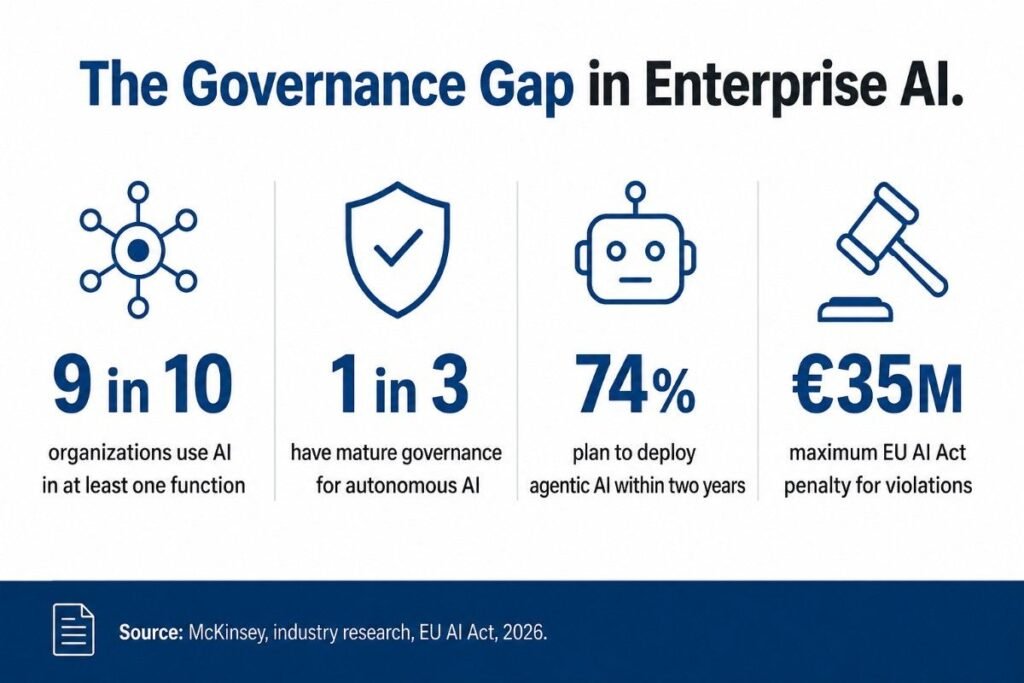
Executives approve the budget. Engineers ship a working prototype. The technology does exactly what it was built to do. Then legal flags something nobody thought to check, a team starts using a tool nobody approved, or a decision gets made that no one in the room can actually explain to a regulator. The initiative stalls, not because the AI failed, but because nothing was ever decided about who owns it. Research from McKinsey shows the vast majority of enterprises now use AI in at least one business function, yet only a small slice have it fully deployed across the organization. That gap is not a technology gap. It is a governance gap, and it is the reason this idea, that AI transformation is a problem of governance, keeps coming up in board meetings this year.
This guide walks through what AI governance actually means in practice, why technology so rarely turns out to be the real bottleneck, what weak governance costs a company in plain terms, and what a working governance framework looks like once you get past the buzzwords. There is also a look at agentic AI, which raises the stakes considerably, and a set of frequently asked questions at the end for anyone building this out for the first time.
What “AI Transformation Is a Problem of Governance” Really Means
AI transformation is a problem of governance because the models and infrastructure usually work as intended, while the failure point is almost always missing ownership, unclear accountability, or the absence of rules for how AI gets deployed, watched, and corrected. Capability rarely decides whether AI creates lasting value. Governance does.
Governance sounds like a compliance word, but in practice it behaves more like an operating system running underneath everything else. It answers a short list of questions every company deploying AI eventually has to face. Who owns this system? Who signs off before it touches a customer. What happens the moment it makes a mistake? Who is accountable when that mistake causes real harm?
When those questions have clear answers before launch, teams move fast, because they are not stopping every other week to relitigate the same argument. When they do not have answers, every new use case reopens the exact same fight between legal, IT, and whichever business unit wanted the tool in the first place.
If your organization cannot name who owns a specific AI system in under ten seconds, that system does not really have governance. It has hope.
Why Technology Is Rarely the Actual Bottleneck
It is tempting to treat every stalled AI project as a technical failure, a flawed model, a stray hallucination, a bug buried in the pipeline somewhere. Look closely at how these projects actually die and a different story shows up. The technology performed close to expectations. What was missing was the structure around it.
Picture the typical arc. A team builds a working proof of concept. Executives approve a full rollout. Then, partway through scaling, someone in legal notices the system was never assessed for data privacy exposure. IT discovers it was never mapped against existing security policy. Employees, tired of waiting, start quietly using unapproved consumer tools to get the same result anyway, a pattern people now call shadow AI.
None of that is a model performance problem. It is what happens when a company treats AI transformation like a software upgrade instead of the enterprise AI strategy decision it actually is, one that touches data, risk, and people all at once.
Recent industry research backs this up. Failures across AI pilots cluster overwhelmingly around governance, data readiness, and monitoring gaps rather than around the quality of the underlying model. Put plainly, the algorithms are mostly good enough already. The organizations around them are not yet built to run them responsibly at scale.
Treating an AI rollout purely as an IT project, without pulling in legal, risk, HR, and the affected business unit from day one, is one of the most common and most avoidable ways an AI transformation stalls out.
Real Cost of Weak AI Governance
Weak governance rarely announces itself with a dramatic failure on day one. It shows up quietly, and then it compounds.
The costs tend to show up in a few predictable places once you look for them:
- Financial exposure. Regulatory penalties are not theoretical anymore. Under the EU AI Act, penalties for the most serious violations can reach tens of millions of euros or a meaningful percentage of a company’s global annual turnover, whichever is higher. Multinationals now face overlapping compliance obligations across jurisdictions that a purely technical team simply cannot manage on its own.
- Stalled scaling. Roughly three in four organizations plan to deploy agentic AI within the next two years, yet only a minority currently have governance mature enough to support it. That mismatch explains why so many companies report heavy AI experimentation alongside very little of it actually reaching production.
- Erosion of trust. When an AI system produces a biased output, takes an action nobody authorized, or makes a call no one can explain, the damage rarely stays contained. Employees stop trusting the tools generally. Leaders get cautious about future investment in ways that outlast the original incident. Customers lose confidence in the company’s judgment.
- Shadow AI risk. When approved tools are slow to arrive or too restrictive to be useful, people do not stop wanting the productivity gain. They just route around the official channel using personal accounts and unmanaged tools, which recreates the exact kind of ungoverned exposure governance was supposed to prevent.
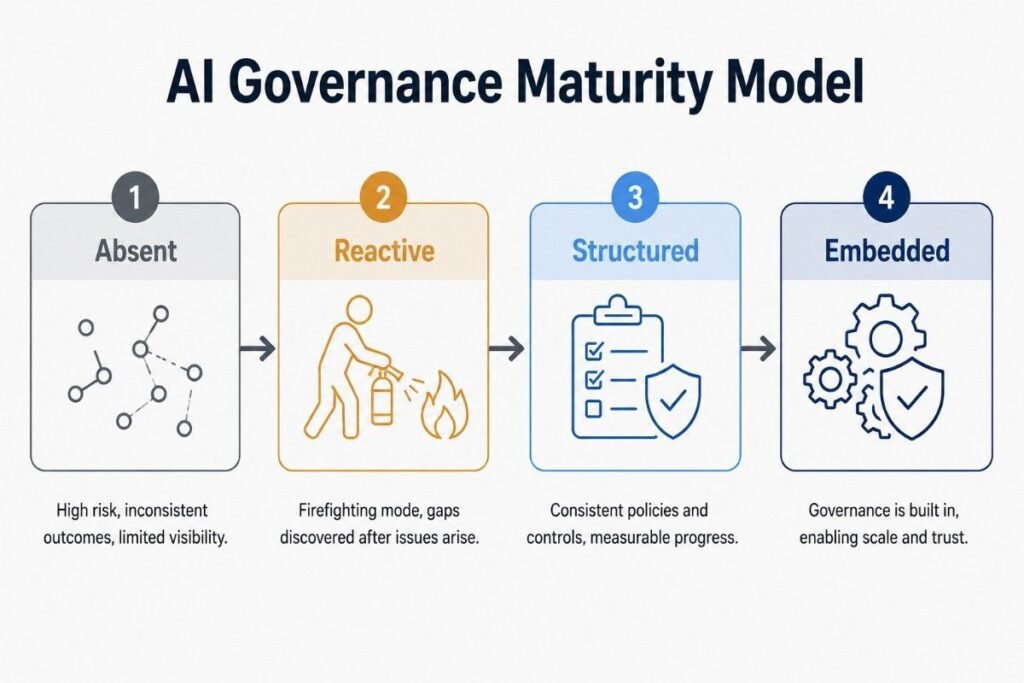
| Governance Maturity Level | Typical Behavior | Business Outcome |
|---|---|---|
| Absent | No defined ownership, approvals happen ad hoc, no risk tiers | Frequent shadow AI, frozen pilots, high regulatory exposure |
| Reactive | Governance only gets built after an incident forces it | Slow, inconsistent scaling, recurring firefighting |
| Structured | A named governance body, documented policy, risk tiers exist | Predictable scaling for low- and medium-risk use cases |
| Embedded | Governance built into the deployment pipeline from the start | Fast, confident scaling, agentic AI managed with real checkpoints |
Only a small minority of enterprises maintain a genuinely comprehensive AI governance framework, even though most of them already use AI somewhere in the business. That gap between usage and oversight is probably the clearest single predictor of which companies actually scale over the next two years and which ones keep restarting.
What a Strong AI Governance Framework Actually Includes
A few components show up again and again in the frameworks that actually hold up:
- Clear ownership and a governance council. Someone has to own AI outcomes the way a CFO owns financial outcomes. Companies that scale successfully tend to build a small, cross-functional governance council pulling in legal, security, data, and the business units actually using the tools day to day. That group does not need to approve every single prompt. It needs to own the policy, the risk tiers, and the escalation path when something goes wrong.
- Data handling rules. Governance turns a vague privacy intention into an enforceable protocol. It spells out who can use which data, in which systems, and under what conditions and keeps that rule consistent across every AI tool in use, not just the officially blessed ones.
- Human-in-the-loop checkpoints. As agentic AI takes on more autonomous, multi-step tasks, governance has to define exactly where a human reviewer is non-negotiable. That usually includes before any external communication, before anything irreversible, and before any decision with real legal or financial consequences for a customer.
- Documentation and audit trails. Regulators increasingly expect organizations to show their work. The NIST AI Risk Management Framework offers a widely used structure for documenting how an AI system was assessed, tested, and monitored, and plenty of enterprise governance programs use it as a starting point rather than building one from nothing.
Governance as Compliance Overlay versus Governance as Operating Infrastructure
| Approach | Governance as Compliance Overlay | Governance as Operating Infrastructure |
|---|---|---|
| When it gets applied | After deployment, once risk shows up | Before deployment, built into the pipeline |
| Ownership | Legal or compliance team alone | Cross-functional council with business input |
| Employee experience | Feels like friction and delay | Feels like a clear, fast path to approval |
| Typical outcome | Slower scaling and incidents keep repeating | Faster, steadier scaling over time |
Governance Maturity: Where Most Companies Really Stand
Broad AI usage is common now. Nearly nine in ten organizations say they use AI in at least one business function. Governed, scaled usage is a different story entirely. Independent research puts the share of enterprises with governance mature enough for autonomous AI systems at roughly one in three, meaning most companies are running capabilities their oversight structures were never built to manage.
This is not really a story about laggards refusing to adopt AI. If anything, it is the opposite problem. Enterprise AI adoption has outpaced governance capacity almost everywhere, which is exactly why this phrase, AI transformation is a problem of governance, keeps showing up across business and technology conversations this year. It names a frustration a lot of leaders have felt without having a clean way to describe it.
A large majority of AI pilots never reach production, and the failures cluster overwhelmingly around governance, data readiness, and monitoring gaps rather than model quality itself.
Agentic AI and the New Governance Stakes
Agentic AI, systems capable of executing multi-step tasks and triggering downstream actions without waiting for a human to sign off on every step, raise the governance stakes considerably. A chatbot giving a wrong answer is a bad customer interaction. An autonomous agent taking a wrong action, issuing a refund it should not have, sending a communication nobody approved, or changing a record it should not have touched has already caused the outcome before anyone even sees the log.
That is why governance for agentic systems has to be built differently than governance for simple generative tools. It needs defined kill switches, real-time monitoring, clear escalation triggers, and logging detailed enough that when an agent does something unexpected, the organization can actually reconstruct the decision chain that led there. That reconstruction is what turns an isolated incident into something the company can learn from, rather than an opaque failure nobody can explain to a regulator or a customer.
Before putting any autonomous agent into a customer-facing or financially consequential workflow, write down its “no go” actions first. Decide what it is never allowed to do alone before you decide what it is allowed to do.
How to Build AI Governance Without Slowing Innovation
The companies that get this right tend to treat governance less like a brake and more like steering. A few steps show up again and again across organizations that scale AI successfully.
Put simply, it usually comes down to five things:
- Map everything already in use, including tools employees adopted on their own without asking anyone. You cannot govern what you cannot see, and shadow AI usage is usually far more widespread than leadership assumes going in.
- Tier your use cases by risk. Not everything needs the same level of scrutiny. A tool that drafts internal meeting notes carries far less risk than one making an automated lending decision. A simple low, medium, or high tier lets the governance council apply proportionate oversight instead of treating every request the same way.
- Make oversight a prerequisite rather than an afterthought. Companies that consistently scale AI do one thing well. They build governance review directly into the deployment pipeline. Oversight happens before launch. Teams don’t bolt it on after something goes wrong.
- Train people, not just systems. Employees need to understand what the AI can and cannot be trusted to do, how to escalate a concerning output, and why the approved tool exists in the first place. Adoption tends to succeed when people understand the reasoning behind a guardrail, not just the guardrail itself.
- Measure governance the way you measure everything else that matters. Track time to approval, shadow AI incidents, audit readiness, and incident response time alongside the usual productivity numbers. A governance program that cannot show results of its own eventually loses executive support, no matter how sound the logic behind it.
Background research on the Wikipedia entry for AI governance notes that effective oversight frameworks typically combine technical standards, organizational policy, and legal accountability rather than leaning on any single mechanism alone. That combination is really what separates companies that scale AI from companies stuck restarting the same pilot every year.
None of this requires slowing innovation down. It requires a decision. Make it on purpose. Make it in advance. Decide who controls the power AI hands an organization. Decide the conditions under which people actually use that power.
Conclusion
The evidence keeps pointing to the same place. AI transformation is a problem of governance, not a shortage of good models or clever engineering. The technology already works well enough for most business use cases out there. What is missing in stalled organizations is ownership, accountability, and a decision-making structure built before deployment rather than one forced into existence after an incident.
Three things matter most going forward. Governance needs to be treated as operating infrastructure, not something bolted on after launch. Risk tiering and human review checkpoints matter more every quarter as agentic AI takes on more autonomous action. And companies that build this structure early end up scaling faster, not slower. Because they stop losing months to disputes. That a governance framework would have already settled.
If your organization is still treating AI transformation as a technology purchase. The fastest way forward is not a better model. It is finally answering the governance questions that have sat unresolved since the first pilot launched.
Frequently Asked Questions
Why do most AI transformation projects fail?
Most AI transformation projects fail because of missing ownership and unclear accountability. And the absence of deployment rules, not because the underlying model performs poorly. Governance gaps, not algorithm quality, are consistently the leading cause behind stalled or abandoned AI initiatives across industries.
What is AI governance and why does it matter?
AI governance is the set of policies, roles, and oversight mechanisms that determine how an organization builds and deploys. It matters because it turns AI from an unpredictable experiment into a repeatable, accountable capability that can actually scale.
Is AI governance the same as AI compliance?
No. Compliance is the narrower requirement to meet specific legal or regulatory obligations, such as the EU AI Act. Governance is broader, covering ownership, risk tiering, and human review, and compliance is just one piece of it.
How do companies build an AI governance framework?
Companies typically start by mapping every AI system in use, forming a cross-functional governance council, defining risk tiers for different use cases, and building human review checkpoints into deployment pipelines before scaling anything company-wide.
Shadow AI: What is shadow AI, and why is it a risk?
“Shadow AI” refers to employees using AI tools that were never approved or reviewed by the organization. It creates risk because sensitive data can pass through unmanaged systems with no oversight, no audit trail, and no accountability if something goes wrong.
Who should be responsible for AI governance in a company?
Responsibility typically sits with a cross-functional governance council rather than one department. Effective councils include legal, security, data teams, and the business units actually deploying the AI, with real executive sponsorship above them.
Does agentic AI need different governance than regular generative AI?
Yes. Agentic AI can take autonomous, multi-step actions. It doesn’t just generate text for a human to review. It can act on its own. That means it needs stricter checkpoints. It needs defined “no-go” actions. It needs real-time monitoring. And it needs detailed audit trails before teams trust it with anything consequential.
Can strong governance actually speed up AI adoption?
Yes. Organizations with clear governance structures tend to scale AI faster over time, because teams are not constantly stalling to resolve disputes over ownership, risk, or approval that a governance framework would have already settled in advance.