
Technical Post-Sales Leader Competencies in Developer Tooling AI
A technical post-sales leader is the person who owns everything that happens after a developer tooling AI deal closes: implementation, integration, technical support, and long-term account growth. In AI developer tooling specifically, this role demands technical post-sales leader competencies AI developer tooling companies rarely find in traditional customer success hires: fluency in APIs, model behavior, and integration architecture, not just relationship management.
In this guide you’ll learn what the role actually covers, the five competencies that separate strong leaders from average ones, how AI itself is changing the day-to-day work, a maturity rubric you can use to self-assess or evaluate a hire, and a practical framework founders and CROs can use in interviews.
Most B2B software companies already have a customer success function. What’s different in 2026 is that developer tooling AI products break in ways a generalist success manager cannot diagnose. A retrieval pipeline that worked in the demo can behave unpredictably once it touches a customer’s real data. A coding assistant that looked flawless in a sandbox can produce inconsistent suggestions once it hits a messy, ten-year-old codebase. Someone technical has to sit between the customer, the product, and engineering, and that person increasingly needs to be a leader who can build and run a team, not just an individual contributor.
What Does a Technical Post-Sales Leader Actually Do?
A technical post-sales leader manages the people and processes responsible for a customer’s technical experience after the contract is signed. That includes onboarding, integration support, incident response, expansion planning, and renewal risk, all filtered through a lens of genuine product and engineering depth.
The role typically sits above titles like Technical Account Manager, Solutions Engineer, and Customer Success Engineer and, in many organizations, manages a mix of all three. The leader is judged less on individual tickets closed and more on whether the whole post-sales technical function scales without becoming a bottleneck.
Pro tip: if your post-sales technical leader cannot personally read a stack trace, review an integration’s API call logs, or explain why a retrieval-augmented generation (RAG) pipeline returned a wrong answer, they will struggle to earn credibility with engineering-heavy customers.
How This Differs From Traditional B2B SaaS Post-Sales Roles
Generalist customer success leaders are graded on health scores, quarterly business review (QBR) cadence, and CSAT trends. Those metrics still matter in developer tooling AI, but they sit on top of a much deeper technical layer.
- Traditional SaaS: mostly workflow and adoption coaching
- Developer tooling AI: workflow coaching plus integration debugging, model evaluation, and prompt or agent behavior review
- Traditional SaaS: escalations usually route to a support queue
- Developer tooling AI: escalations often require the leader to reproduce the failure themselves before engineering will prioritize it
Why the Role Has Become a Priority for Founders
Most AI developer-tooling deployments do not fail during the demo. They fail three months after signature, when a retrieval pipeline behaves oddly on real production data and nobody at the customer knows who to call. A capable technical post-sales leader is what stands between that moment and a churned account.
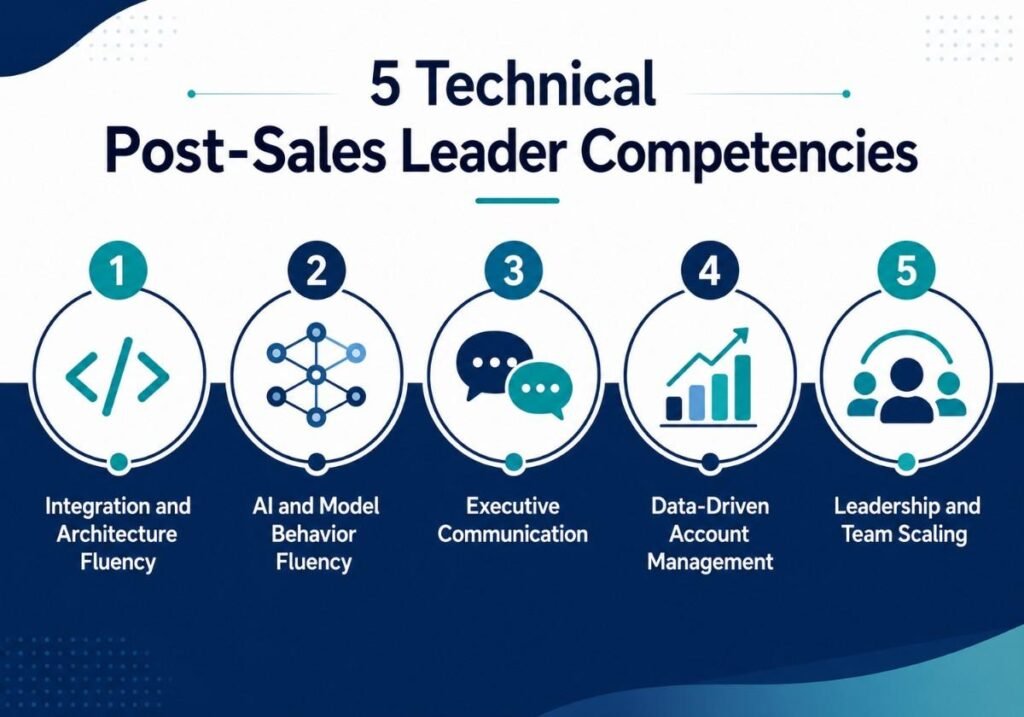
The Five Core Technical Post-Sales Leader Competencies
Below are the five competencies that consistently separate high-performing leaders in developer tooling AI from those who struggle. Treat this as both a self-assessment tool and a hiring rubric.
1. Integration and Architecture Fluency
This is the ability to understand how a customer’s stack connects to your product APIs, SDKs, authentication, data pipelines, and deployment environments. A leader with real integration architecture fluency can walk into a customer’s platform team meeting and hold their own without an engineer translating for them.
Signals to look for:
- Has shipped or reviewed production code, not just read documentation
- Can explain the difference between a synchronous API failure and an asynchronous pipeline failure
- Understands authentication, rate limits, and versioning well enough to diagnose issues without escalating immediately
2. AI and Model Behavior Fluency
This is the newest and fastest-growing competency. Developer tooling AI products depend on model behavior that is probabilistic, not deterministic, which means “it worked yesterday” is not a diagnosis. Leaders need working knowledge of prompt design, tool-use loops, and retrieval quality.
Expert note: Understanding how an AI agent selects and calls tools, sometimes documented through frameworks like the Model Context Protocol, helps a post-sales leader tell the difference between a model limitation and a genuine integration bug. That distinction changes whether the fix belongs to the customer, your engineering team, or nobody.
Signals to look for:
- Can explain, in plain language, why a retrieval-augmented system might hallucinate on a specific customer’s data
- Has hands-on experience evaluating model outputs against a rubric, not just anecdotal impressions
- Understands the cost and latency tradeoffs of different model or context-window choices
3. Executive and Cross-Functional Communication
Technical post-sales leaders translate between three audiences constantly: the customer’s engineers, the customer’s executives, and their own internal product and engineering teams. Each audience needs a different level of detail, and the best leaders can shift between them without losing accuracy.
- With engineers: precise, code-level, and evidence-based
- With executives: outcome-focused, tied to cost, risk, or revenue
- With internal product teams: structured feedback that is prioritizable, not just a complaint
A leader who over-simplifies for engineers loses credibility instantly. One who over-explains to a CFO wastes the meeting.
4. Data-Driven Account and Risk Management
Strong leaders do not rely on gut feel to know which accounts are at risk. They define baseline metrics before rollout, things like onboarding time, ticket deflection rate, or accuracy thresholds, and track actual usage against them.
| Metric | What It Signals | Who Should Own It |
|---|---|---|
| Time-to-first-value | Whether onboarding is too slow or too complex | Post-sales technical leader |
| Ticket deflection rate | Whether documentation and self-serve tools are working | Post-sales + support |
| Model accuracy / output quality trend | Whether the product is degrading or improving in production | Post-sales + product |
| Expansion pipeline from existing accounts | Whether technical trust is translating into revenue | Post-sales + sales leadership |
| Escalation-to-resolution time | Whether the technical team can actually fix what breaks | Post-sales + engineering |
Statistic: Organizations that formalize customer success metrics before rollout consistently report faster identification of at-risk accounts than those that rely on anecdotal check-ins, according to widely cited research on customer success practices in enterprise software.
5. Leadership, Hiring, and Team Scaling
The final competency is often overlooked: the ability to build a team of technical, customer-facing people who don’t burn out. Individual contributors can survive on technical skill alone. Leaders have to hire for it, coach it, and scale it as the customer base grows.
Bullet checklist for this competency:
- Can write an interview loop that actually tests integration debugging, not just communication skills
- Builds documentation and playbooks so knowledge doesn’t live only in senior people’s heads
- Knows when to hire a specialist (a dedicated AI evaluation engineer, for example) versus stretching a generalist too thin
- Protects the team from becoming a dumping ground for unsolved product bugs
How AI Is Reshaping the Post-Sales Technical Role
AI has moved directly into the developer toolchain, IDEs, CI pipelines, support workflows, and onboarding paths, which changes what “technical” means for this job. It is no longer enough to understand APIs and databases. Leaders also need a working mental model of how tools like AI coding assistants generate suggestions and where human review still has to catch mistakes.
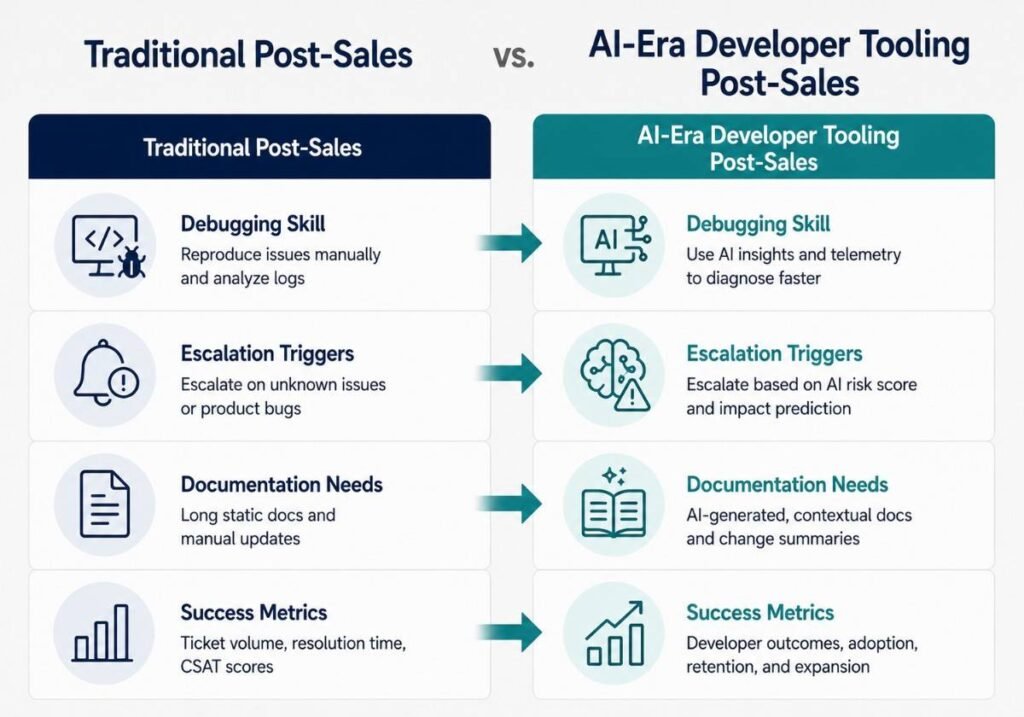
Comparison table: traditional vs. AI-era technical post-sales leadership
| Dimension | Traditional Technical Post-Sales | AI-Era Developer Tooling Post-Sales |
|---|---|---|
| Core debugging skill | Reading logs, API responses | Reading logs, API responses, plus model/agent output evaluation |
| Escalation trigger | Deterministic bug (same input, same failure) | Often non-deterministic; requires reproduction across multiple runs |
| Documentation needs | Static setup guides | Setup guides plus evaluation criteria and prompt/tool-use examples |
| Success metric focus | Adoption and usage volume | Adoption, usage volume, and output quality/accuracy trend |
| Team hiring bar | Strong generalist engineer | Engineer with AI/ML literacy or a dedicated AI evaluation specialist |
Developer productivity itself is being redefined. It is no longer measured only by lines of code shipped; it increasingly includes how much time an AI assistant saves a developer and how much of that output survives human review. Technical post-sales leaders who understand this shift can speak credibly to both a VP of Engineering worried about code quality and a CFO worried about license cost per seat.
A Maturity Rubric for Self-Assessment or Hiring
Use this rubric to place a leader or yourself into one of three stages across each competency.
- Foundational: understands concepts, has not applied them under real customer pressure
- Practicing: has resolved real customer escalations independently, still needs support on complex or novel cases
- Leading: trains others, sets the playbook, and is trusted with the highest-risk accounts without oversight
A leader who scores “Leading” in communication but “Foundational” in AI and model behavior fluency is a common and risky profile in 2026, polished but unable to diagnose the failures that actually threaten renewal.
Building a Hiring Framework for This Role
Founders and CROs hiring for this position often make the mistake of testing for communication skills and assuming technical depth will follow. A better approach tests both directly.
Interview structure that works well:
- A live or take-home technical exercise: debug a failed integration or evaluate a flawed AI output and explain the root cause
- A stakeholder-communication exercise: explain the same technical issue to a simulated engineer and a simulated executive
- A team-scaling case study: how would they structure a team of five to support 50 technical accounts
Did you know? Teams that build structured evaluation criteria for candidates in technical customer-facing roles report materially fewer early departures than teams that rely on unstructured interviews, a pattern consistent with broader research on structured hiring published by outlets like Harvard Business Review.
Common Mistakes That Undermine the Role
- Hiring for personality over technical depth. A likeable leader who cannot debug an integration will lose credibility with engineering-heavy customers quickly.
- Skipping baseline metrics. Without a defined time-to-value or accuracy threshold, “at risk” becomes a guess instead of a signal.
- Treating AI fluency as optional. Leaders who avoid understanding model behavior end up escalating issues engineering could have triaged in minutes.
- Under-investing in documentation. Tribal knowledge that lives only in one senior leader’s head does not scale past a handful of accounts.
- Ignoring team burnout. Technical, customer-facing work is demanding; leaders who don’t build playbooks and protect their team’s time lose their best people first.
Conclusion
Technical post-sales leader competencies in developer tooling AI now span far more than relationship management. The strongest leaders combine integration architecture fluency, AI and model behavior literacy, cross-functional communication, data-driven account management, and team-scaling leadership into one role.
Three takeaways to act on:
- Assess or hire against all five competencies, not just communication skills.
- Define baseline metrics like time-to-value and accuracy thresholds before rollout, not after churn risk appears.
- Treat AI and model behavior fluency as a core requirement, not a nice-to-have, for anyone leading post-sales technical teams in 2026.
If you’re building or scaling this function, start by mapping your current leader or your top hiring candidate against the rubric above. The gaps you find will tell you exactly where to invest next.
Frequently Asked Questions
What does a technical post-sales leader actually do?
A technical post-sales leader owns everything that happens with customers after a deal closes: onboarding, integration support, incident response, and renewal risk. In developer tooling AI, this includes diagnosing whether failures come from the API, the model, or the customer’s own workflow.
What is the difference between a technical account manager and a solutions engineer?
A technical account manager typically owns the ongoing relationship and technical health of specific accounts long-term. A solutions engineer is more often focused on pre- and early post-sale implementation. A technical post-sales leader frequently manages both functions under one team.
What skills do post-sales leaders need for AI products specifically?
Beyond integration and API knowledge, they need to understand model behavior, retrieval quality, and tool-use loops well enough to tell whether a failure is a genuine bug or an inherent AI limitation and to communicate that distinction clearly to both engineers and executives.
How do you measure success in technical post-sales roles?
Effective teams define baseline metrics before rollout, such as time-to-first-value, ticket deflection rate, and accuracy thresholds, then track real usage data against those baselines to catch risk early rather than reactively.
How is AI changing customer success and post-sales engineering?
AI has moved into the toolchain itself, from IDEs to CI pipelines to support workflows, which means post-sales leaders now need working knowledge of AI coding assistants and model evaluation, not just traditional software support skills.
What should founders look for when hiring a technical post-sales leader?
Look for demonstrated integration debugging skills, working knowledge of AI and model behavior, the ability to communicate at multiple altitudes, and evidence they can hire and scale a team rather than only perform the work themselves.
Is this role the same as customer success management?
No. Customer success management is broader and often less technical. A technical post-sales leader in developer tooling AI requires hands-on technical depth that a generalist customer success role typically does not.
Can one person hold this role at a small company?
Yes, especially early on. Many startups start with one technical post-sales leader who personally handles integration support before hiring specialists in AI evaluation or account management as the customer base grows.