
How Do You Program AI? The Real Beginner Guide
Roughly 80 percent of US companies now run some flavor of artificial intelligence in their day-to-day work. And yet most people staring at a blinking cursor still have no clue how to program AI in practice. Sound familiar? You open a tutorial, get five minutes in, and suddenly it’s all tensors and gradients, and you’re lost. That happens to almost everyone. The good news? The actual path is way more learnable than the jargon makes it look.
In this guide you’ll learn how to program AI starting from an empty text editor all the way through the tools working developers actually reach for. We’ll cover how to write AI software that doesn’t fall apart under real use and how to build AI software that scales past your laptop, and yes, we’ll poke at the wild edges of artificial general intelligence too. No fluff. Just the map.
What Programming AI Really Means
Here’s the thing nobody tells you upfront. Programming AI isn’t like writing a to-do list app. Traditional code follows rigid instructions you typed yourself. AI code learns its own rules from piles of examples. Weird, right?
Rule-Based Logic vs Letting the Machine Learn
Old-school AI meant coding every single decision by hand. Endless if-then-that chains. Exhausting. Modern AI mostly skips that grind entirely. You feed it data, it adjusts its own internal dials, and it slowly gets better on its own. On top of that, it keeps improving the more examples it sees.
Why Beginners Trip Up Here
If you’re asking how you program AI, get this distinction locked in early. It’ll save you months of confused Googling. You’re not stacking logic gates for eternity. You’re building a system that writes its own playbook based on the data you hand it.
Skills and Tools You Need First
Skip this part and you’ll quit within two weeks. Seriously.
The Languages That Actually Matter
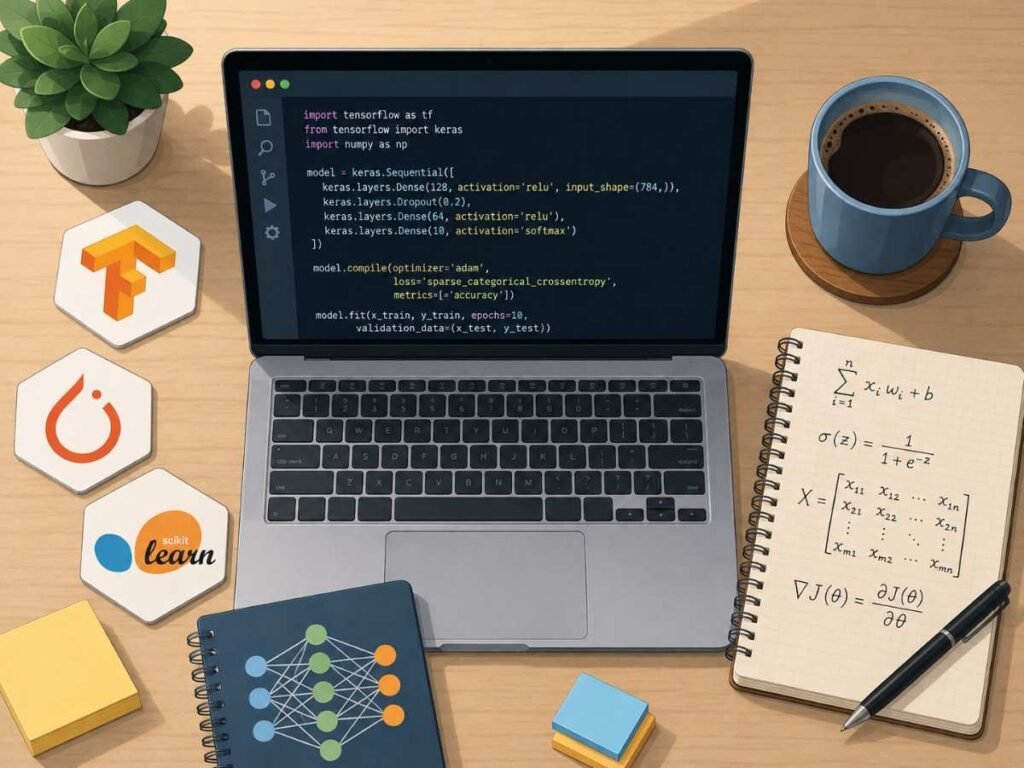
Python. That’s the short answer. Its clean syntax and massive library ecosystem made it the default. The 2024 Stack Overflow Developer Survey found roughly 57 percent of machine learning folks list it as their main tool. Not a close race.
Still, R shows up for stats-heavy work, Java pops up in giant enterprise systems, and C++ handles the speed-critical stuff like robotics or real-time processing on a factory floor.
Math You Can’t Dodge
You don’t need a chalkboard covered in Greek symbols. But linear algebra, probability, basic statistics, and a sliver of calculus? Non-negotiable. These explain why your model spits out weird predictions at 2am and how to fix it.
Frameworks and Libraries Worth Learning
Nobody builds from raw scratch anymore. Established frameworks handle the grunt work.
| Framework | Best For | Difficulty |
| TensorFlow | Big production systems | Intermediate to Advanced |
| PyTorch | Research, fast prototypes | Intermediate |
| Scikit-learn | Classic ML tasks | Beginner-Friendly |
| Keras | Quick neural nets | Beginner-Friendly |
| Hugging Face Transformers | Language tasks | Intermediate |
What About Hardware?
Small models train fine on a beat-up laptop in your kitchen. Bigger neural networks need a proper GPU or a cloud account with AWS, Google Cloud, or Azure. Your fan will thank you either way.
The Actual Process, Step by Step
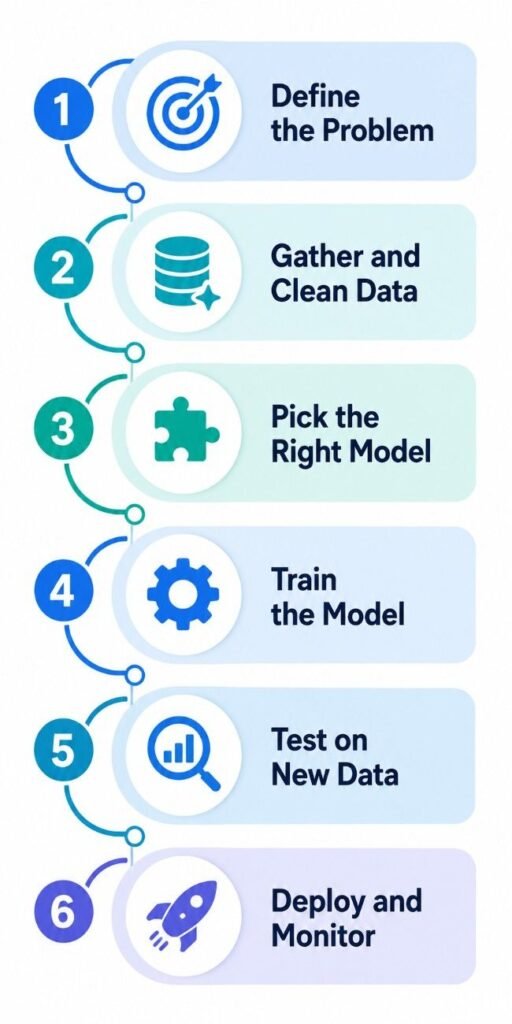
This is the meat of how you program AI. A loop the whole industry basically follows.
Nail Down the Problem First
Don’t say “smart chatbot.” Say what it does, who uses it, and how you’ll know it worked. Vague goals kill projects before they even start.
Wrangle Your Data
AI is only as sharp as what it learns from. Garbage in, garbage out, always. This stage eats up 60 to 80 percent of your total time. Collecting, cleaning, fixing missing values, and formatting things so they actually match up. Tedious. Necessary.
Pick the Right Model Shape
Image tasks usually lean on convolutional neural networks. Text tasks lean transformer-heavy these days. Simple predictions? Sometimes basic regression does the whole job, no fancy architecture required.
Train It
Feed your cleaned data in and let the model tweak its internal weights over and over. Minutes for a tiny model. Weeks for a monster one running on a server farm somewhere.
Test It on Stuff It’s Never Seen
This part matters more than people admit. If it only performs well on training data, it might’ve just memorized answers instead of actually learning. That’s called overfitting, and it’s a trap.
Ship It, Then Watch It Like a Hawk
Deployment isn’t the finish line. Real users bring weird inputs you never planned for. Keep monitoring. Retrain when performance dips. It will dip eventually.
How to Write AI Software That Doesn’t Break
Knowing how to write AI software means more than copying a tutorial line by line—it’s about understanding the true AI purpose behind what you’re building. It means thinking about what might break before it actually breaks.
Keep the Code Clean
AI codebases balloon fast. Name your variables like a human wrote them. Break things into modular chunks. Document as you go, not six months later when you’ve forgotten everything.
Version Control Isn’t Optional
Git and GitHub aren’t extra credit here. AI work means constant experimenting, tweaking one parameter and rerunning everything. Without version tracking, you’ll lose track of what actually helped versus what quietly wrecked your accuracy.
Test Beyond “Does It Crash”
Regular software testing checks if code runs. AI testing goes further. Does the output stay accurate? Fair? Consistent when you feed it slightly different inputs? A model can run perfectly and still be dead wrong.
How to Build AI Software That Scale
Knowing how to build AI software on your own machine is one thing. Handling a hundred thousand users hammering it at once is a whole different beast.
Plan the Architecture Early
Separate your data processing, your model inference, and your user-facing layer. Keep them apart. That way you can upgrade one piece without torching the other two.

Where to Deploy
| Platform | Strength | Typical Use |
| AWS SageMaker | Full ML workflow | Enterprise-scale AI |
| Google Vertex AI | Ties into Google’s data tools | Data-heavy apps |
| Microsoft Azure ML | Security, compliance | Corporate settings |
Watch the cloud bill.
Training costs balloon fast if you’re not careful. Use spot instances for jobs that aren’t urgent. Check your usage dashboard weekly, not monthly. Shut idle resources down the second an experiment wraps up. Your CFO will notice either way.
How to Create Artificial General Intelligence Program Step by Step
A lot of people search for a show to create an artificial general intelligence program step-by-step, expecting some five-step tutorial. Reality check. AGI means a system that can do literally any intellectual task a human can. Nothing like that exists yet. No lab, anywhere, has shipped one, not as of 2026.
What Researchers Are Actually Doing
Instead of chasing full AGI, most labs focus on narrow but increasingly flexible systems. Large language models, multimodal setups juggling text and images and audio together, and reinforcement learning agents. These are the closest things we’ve got right now, and they’re still a far cry from a true artificial general intelligence program.
Realistic Building Blocks
Want to explore this frontier without wasting years? Learn reinforcement learning properly. Study how transformer models generalize across wildly different tasks. Mess around with multi-agent systems where several AI models work on a problem together. That’s the real groundwork behind any serious artificial general intelligence effort.
Patience. Seriously.
Researchers at places like DeepMind and OpenAI have said publicly that AGI timelines are genuinely uncertain. Could be years. Could be decades. Anyone promising a fast track AGI build in a weekend course? Be skeptical. Very skeptical.
Mistakes Beginners Keep Making
Rushing Past Data Cleaning
Jump straight to model building without cleaning your data, and you’ll get unreliable junk out. Every time.
Grabbing the Fanciest Model Too Soon
A lot of new folks reach for deep learning when a plain old simple model would’ve solved it faster, cheaper, and with fewer headches.
Forgetting About Bias
Train on biased data, get biased results. Check your data sources for fairness problems before training starts, not after your system’s already live and causing trouble.
Conclusion
So, how do you program AI, boiled down? Three things stick. Build your fundamentals first, Python, math, and clean data habits, before touching complicated models. Follow the real process: define the problem, gather data, pick a model, train it, test it, ship it, and watch it. And stay realistic about AGI. It’s a research frontier, not a weekend side project.
Whether you’re chasing how to write AI software for some scrappy personal tool or figuring out how to build AI software that handles real traffic, it all starts the same way. Pick one small idea. Open your editor. Write the first line. That’s it. That’s the whole secret.
FAQ Section
Is Python required to program AI?
Not legally required, but practically yes. Its simple syntax and huge library support make it the fastest route from an idea to something actually running. Most professionals default to it without a second thought.
How long does it take to learn AI programming?
Most people hit basic competence in three to six months of steady practice. Getting to production-ready skill usually takes one to two years of real hands-on project work, not just tutorials.
Do you need a degree to program AI?
No formal degree required. Plenty of successful AI developers taught themselves through courses and projects. A solid math background still helps a ton, degree or not.
What’s the difference between AI and machine learning?
AI is the big umbrella term for machines doing smart tasks. Machine learning sits underneath it, a specific method where systems learn patterns from data instead of following fixed rules someone typed out.
Can I build AI software without coding?
Some no-code platforms handle simple tasks fine. But real custom AI software, the kind with actual flexibility, still needs programming knowledge somewhere in the pipeline.
What’s a good first AI project?
An image classifier or a basic text sentiment tool. Both use well-documented datasets and beginner-friendly frameworks, so you won’t drown before you even finish.
Is artificial general intelligence dangerous?
Current narrow AI carries manageable risks when tested properly. True AGI doesn’t exist yet, so most danger talk right now stays theoretical, mostly debated among researchers.
How much does training an AI model cost?
Small personal projects can run free on cloud trial tiers. Big commercial models? Anywhere from thousands to millions of dollars, depending on scale and complexity.