
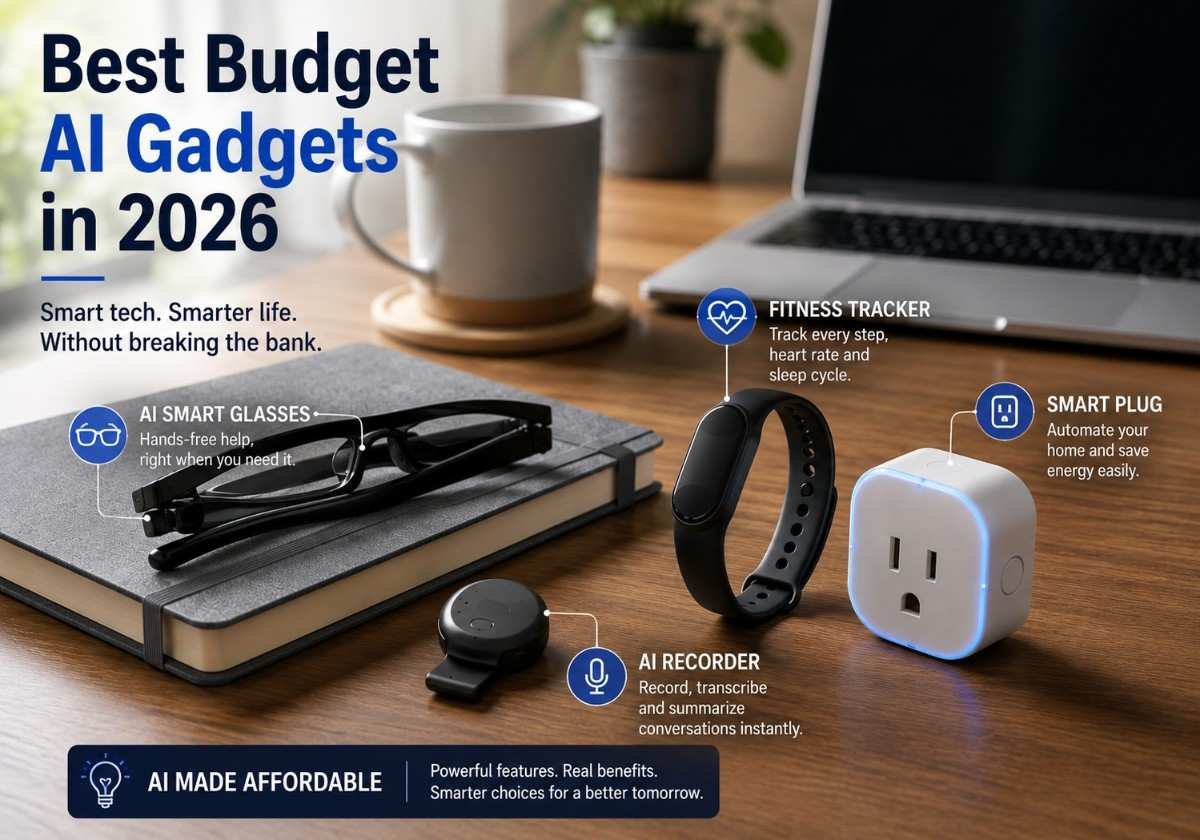
Best Budget AI Gadgets 2026 Under $100: Top Picks
Okay, be honest, when you hear “AI gadget under $100,” does part of you assume it’s just a regular gadget with a sticker slapped on for marketing? I used to think the same thing. A couple of years back that skepticism was fair; most “smart” devices in that price range were smart in name only. But something actually shifted. The best budget AI gadgets of 2026 under $100 now cover voice recorders that turn a full meeting into a clean transcript, wearables that watch your sleep and heart rate without charging you monthly, and glasses that translate a conversation while you’re still mid-sentence.
Why does this matter now and not before? Because AI hardware used to start at $250 or $300, no exceptions. These days a small handful of affordable AI gadgets in 2026 can chip away at real problems: notes you never organize, a home that has to be adjusted by hand, and a task you keep forgetting, all for roughly what you’d spend on dinner out. Here’s what you’ll get from this guide: which categories of cheap smart gadgets with AI are actually worth the money, where the subscription traps hide behind a low price tag, and how to pick the one device that fits the one problem you’re trying to solve.
Why Budget AI Gadgets Make Sense in 2026
The Shift From Flagship to Stack
Fewer people are chasing one do-it-all flagship gadget these days. Instead, they’re piecing together a small stack of low-price AI devices for 2026, one for meetings, one for sleep, and one for the lamp that never gets turned off. A recorder handles the notes, a tracker handles the sleep data, and a plug handles the living room. This “one gadget, one job” habit just seems to hold up better over time than betting everything on a single all-in-one device.
What Actually Counts as an AI Gadget
So what actually makes something an “AI gadget” instead of just another Bluetooth accessory? It comes down to whether the device is running machine learning, either on the hardware itself or through a connected cloud model, to do something a regular gadget simply can’t: turn speech into text, spot patterns in how you sleep, or translate a sentence as someone’s saying it. The general definition of artificial intelligence on Wikipedia frames this as systems built to handle tasks we’d normally associate with human reasoning or perception. That’s really the dividing line: an AI gadget does something with what it hears or senses, while a plain smart device just connects and waits for a command.
Pro Tip
Before you check out, look for whether the processing happens locally or gets sent off to the cloud. On-device usually wins on privacy and works without Wi-Fi, but cloud processing tends to unlock the fancier features, often at the cost of a subscription.
Best AI Voice Recorders and Note Takers Under $100
Why This Category Leads the List
If you want one entry-level AI gadget for beginners that proves its worth almost instantly, start here. You talk, it records, and it hands you back organized notes. No learning curve, no guesswork, and the payoff shows up the very first time you use it.
Top Picks
The Omi pendant runs around $89 and bundles on-device transcription with a decent chunk of free cloud minutes each month, which puts it near the top of the best AI gadgets in the $50 to $100 bracket for anyone recording meetings or quick voice memos. There are also clip-style recorders from a few audio brands doing something similar in an even tinier shell, some barely bigger than a coin, built to catch a conversation and hand you searchable notes without ever pulling your phone out.
Watch the Subscription Fine Print
Here’s the catch a lot of buyers miss: a cheap recorder up front can still cost you plenty over a year if full transcription sits behind a paywall. Do the math on twelve months of use, not just the price on the box, before you assume one device is actually the better deal.
Expert Note
If a device has more than one microphone for noise separation, it usually holds up better in a noisy room than something running a single mic. Worth a quick check on the spec sheet, even at this price point.
Best AI Wearables and Health Trackers Under $100
Screenless Trackers Are Having a Moment
Take the Google Fitbit Air, roughly $99, which tracks heart rate, sleep, and blood oxygen and doesn’t ask for a monthly fee to unlock any of its features. That alone makes it one of the stronger budget-friendly AI tech products on shelves right now, and it works through a companion app on either Android or iPhone.
Smart Rings as an Alternative
Smart rings still tend to creep just past the $100 line, though the gap is shrinking fast. Even the budget ones now track sleep stages, recovery, and oxygen levels, with batteries that can go a week or more between charges.
Hydration and Focus Gadgets
Not every wearable in this category is about your body. Some, usually under $50, exist purely to interrupt a bad habit, nudging you to drink water or put the phone down, using simple pattern recognition on the device rather than any heavy cloud model.
Statistic
Anecdotally, and this shows up across reviews too, gadgets tied to one recurring habit (hydration or sleep tracking) tend to stay in rotation far longer than novelty purchases, which often get abandoned within a few weeks.
Best AI Smart Home Gadgets Under $50
Smart Plugs Remain the Easiest Entry Point
Smart plugs might be the single easiest way into this whole category of cheap smart gadgets with AI. Plug one into the wall, plug your lamp or fan or coffee maker into it, and you’ve suddenly got voice and app control. Pair it with a modern assistant and it’ll start learning your schedule on its own.
AI Speakers With Built-In Assistants
A lot of budget Bluetooth speakers now come with a full voice assistant baked in, so a single $40 to $60 purchase ends up doubling as both your music player and your smart home hub.
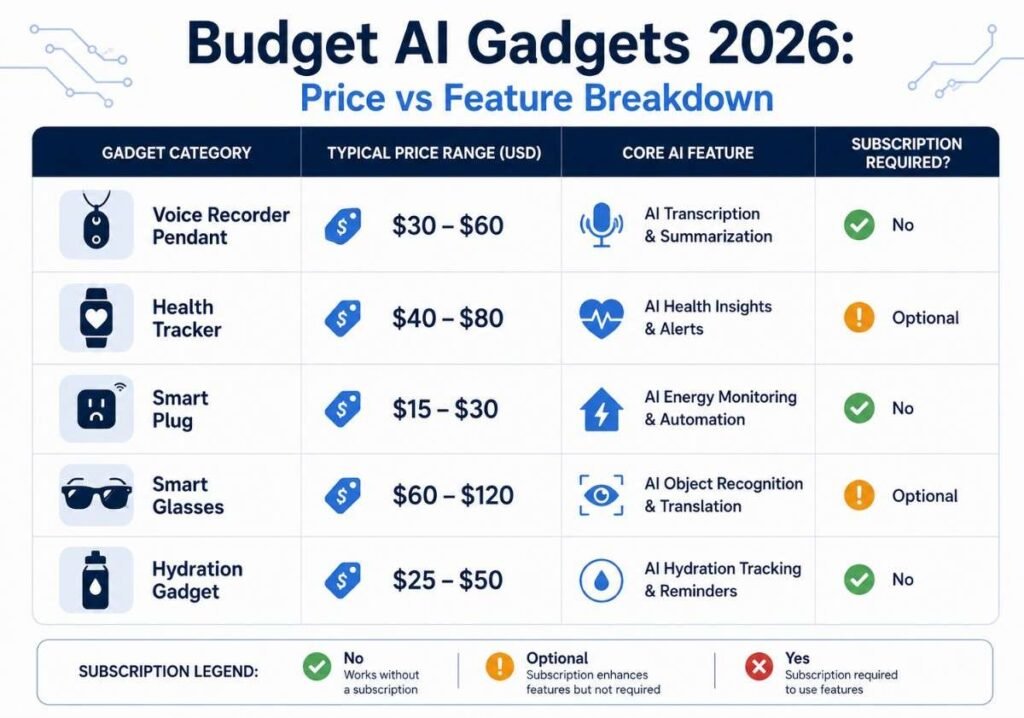
Comparison Table
| Gadget Category | Typical Price | Core AI Feature | Subscription Needed |
|---|---|---|---|
| AI voice recorder pendant | $65 to $95 | On-device transcription and summaries | Sometimes, for full cloud minutes |
| AI health tracker (screenless) | $80 to $99 | Sleep, heart rate, SpO2 analysis | Rarely for core features |
| Smart plug with assistant | $15 to $30 | Scheduling and voice routines | No |
| Budget AI smart glasses | $65 to $100 | Real-time translation, voice AI | Sometimes, for translation limits |
| Hydration or focus gadget | $30 to $50 | Habit nudges via pattern recognition | No |
Pro Tip
Already own a smart speaker? Stick with plugs and sensors from that same brand ecosystem first. Mixing and matching usually just means juggling three different apps instead of running everything from one.
Best AI Smart Glasses Under $100
A Genuinely New Budget Category
Google’s next AI glasses are expected to push the category upmarket later this year, but right now, several models between $65 and $100 already handle real-time translation, voice AI, and basic camera capture. That’s a genuinely solid showing for low-price AI devices in 2026, especially considering where this category was a year ago.
What You Give Up at This Price
Step up to a $300 pair and you’re paying for a verified camera sensor and a deeper, brand-backed AI pipeline. Budget glasses skip some of that, but they still handle bidirectional translation and open-ear audio well enough for everyday use, particularly for travelers and remote workers watching their spending.
Best For
This category works best for travelers who want hands-free translation without committing to a flagship price and for anyone testing whether smart glasses even fit their daily life before they spend real money finding out.
Curious what else is launching this year? Our Droven IO new gadgets 2026 roundup keeps tabs on new releases as they show up, and it’s a decent companion piece if you want to weigh these budget picks against what’s coming down the pipeline.
How to Choose the Right Budget AI Gadget
Start With the Problem, Not the Device
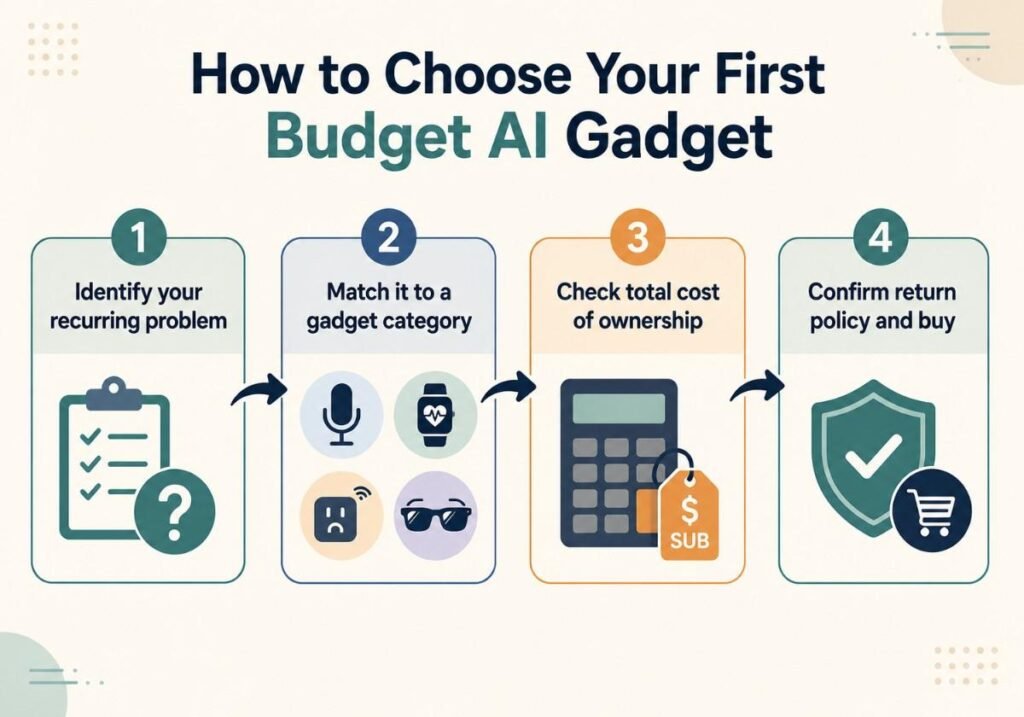
Skip the specs for a second and ask yourself what’s actually bothering you: forgotten notes, restless sleep, or evenings that vanish into your phone. Whatever that answer is, buy the one gadget that solves it. Nothing more.
Check Total Cost of Ownership
Do the math before you commit: a $50 device with a $15 monthly fee runs you $230 in the first year alone. Compare that twelve-month total, not the number on the price tag, especially anywhere you see “best AI gadgets under $50” claims that conveniently leave the app store fee out of the headline.
Confirm Data Handling Before You Buy
A lot of these devices are recording your voice, your health stats, or your location, so it’s worth a few minutes checking how the company actually handles that data. The Federal Trade Commission’s guidance on smart devices is a reasonable place to start if you want to know your rights before connecting anything new to your home network.
Comparison Note
Skimming a hands-on video review, plenty exist on YouTube covering budget AI recorders, which tend to expose battery life and transcription accuracy issues that a spec sheet conveniently glosses over. Our internal Droven IO new gadgets 2026 guide also pulls in user feedback across categories if you want a second opinion before you check out.
Common Mistakes to Avoid When Buying Cheap AI Devices
Buying for Novelty Instead of Routine
If a gadget doesn’t slot into something you already do daily, odds are it ends up in a drawer within a month, no matter how good the AI features looked on the product page.
Ignoring Battery and Charging Habits
An awkward charging case or a battery that dies too fast is a quiet death sentence for any gadget. Look for something that fits a routine you’ll actually keep, like a dock sitting right next to where your phone already charges overnight.
Skipping the Return Window
Build quality on budget AI hardware still varies a lot between newer brands, more than you’d see with established electronics. Check the return policy before that window closes, especially with entry-level AI gadgets for beginners bought through third-party marketplace sellers instead of a known retailer.
Assuming More Features Means More Value
A gadget trying to transcribe, track your health, and run your smart home all at once rarely does any single one of those things as well as a $50 device built for just that job. For a first purchase, go narrow, not broad
Conclusion
What this all really comes down to is that the best budget AI gadgets of 2026 under $100 don’t need a flagship price to actually be useful anymore. Three things worth remembering: tie any purchase to a problem you already have instead of buying for the novelty; work out the twelve-month total cost before you decide something’s actually cheap; and pick one focused category first, a recorder, tracker, or plug, before you start building out a whole stack.
Ready to put together your own setup? Grab one affordable AI gadget that solves whatever’s bugging you most right now, then build from there. Do it right and the thing won’t just sit in a drawer; it’ll quietly turn into part of how you get through the day.
Frequently Asked Questions
What is the cheapest AI gadget you can buy in 2026?
Smart plugs with a built-in voice assistant, usually $15 to $25. They lean on pattern recognition to learn your routines and automate lamps, fans, or small appliances, and they’re probably the easiest, cheapest way into home AI without signing up for anything monthly.
Are budget AI gadgets actually worth it?
Depends on whether it’s solving something real. Tie it to a problem you already have, messy notes, or inconsistent sleep, and it earns its keep. Buy it on impulse for the novelty, and it’ll likely end up forgotten in a drawer within a month.
Do AI gadgets under $100 need a subscription?
Sometimes. Voice recorders and translation glasses leaning on cloud processing often do advanced stuff. Health trackers and smart plugs usually don’t for the basics. Read the fine print; either way, a cheap gadget can still carry a recurring fee.
What is the best AI gadget for beginners?
A screenless health tracker or a simple AI recorder pendant is usually the easiest starting point. Both show a clear benefit within a day of use, and neither buries you in setup steps or a confusing companion app.
Can budget AI wearables replace a smartwatch?
Not really, no. Most budget wearables focus on one job, sleep, hydration, or focus, rather than trying to be a full smartwatch. Think of them as a lighter, cheaper companion device rather than a straight swap.
Are cheap AI smart glasses safe to use?
For the most part, yes, though budget models haven’t gone through the same independent camera and privacy testing that bigger brands have. It’s worth a quick look at the manufacturer’s data policy before your first use, particularly around the camera and translation features.
Do I need Wi-Fi for these gadgets to use AI features?
For the cloud-based stuff, transcription, and translation, yes, you’ll need a connection. Anything running on-device, like basic health tracking or hydration nudges, will work fine offline and just sync up whenever you reconnect.
How long do budget AI gadgets typically last?
It varies by brand, but most well-reviewed budget picks hold up for one to two years of regular use before the battery starts noticeably fading. Sticking with sellers that have a visible, honest return policy tends to lower your odds of an early dud.