
What Is an AI Marketing Agency? Costs and How to Start One
Here’s a number that might surprise you. Fewer than a third of agencies say they’ve fully worked AI into their daily process, yet almost every client walking through the door now expects it. So what is an AI marketing agency, really? Strip away the buzzwords and it’s a marketing company that leans on machine learning, automation, and generative tools to plan, write, target, and report faster than a team working by hand ever could. Some agencies just use AI features tucked inside platforms they already run. Others have built software that handles entire workflows without much human input at all. Both get called the same thing, which is honestly a big part of why the term confuses so many business owners in the first place.
In this guide you’ll learn what an AI marketing agency does in practice, how it stacks up against a traditional agency, which AI marketing tools actually show up in the workflow, what it costs, how to start an AI agency if you’re the one building it, and what questions to ask before you hand anyone your budget. Whether you’re a small business weighing AI agency for small business options or a marketer sketching out your own AI agency business model, you’ll find the whole picture here.
What Is an AI Marketing Agency and How Does It Work
An AI marketing agency is a company that applies artificial intelligence, think machine learning, language generation, and predictive analytics, to the everyday work of marketing: research, content, ad buying, personalization, and reporting. It’s less a single definition and more a spectrum.
On one end you’ve got agencies that just flip on AI features already sitting inside Google’s Performance Max or Meta’s Advantage Plus. On the other end are agencies running their own AI agents, systems that can pull data across a dozen ad accounts, notice a budget pacing problem at two in the morning, and shift spend without anyone touching a keyboard.
The Core Idea Behind What Is an AI Agency and How Does It Work
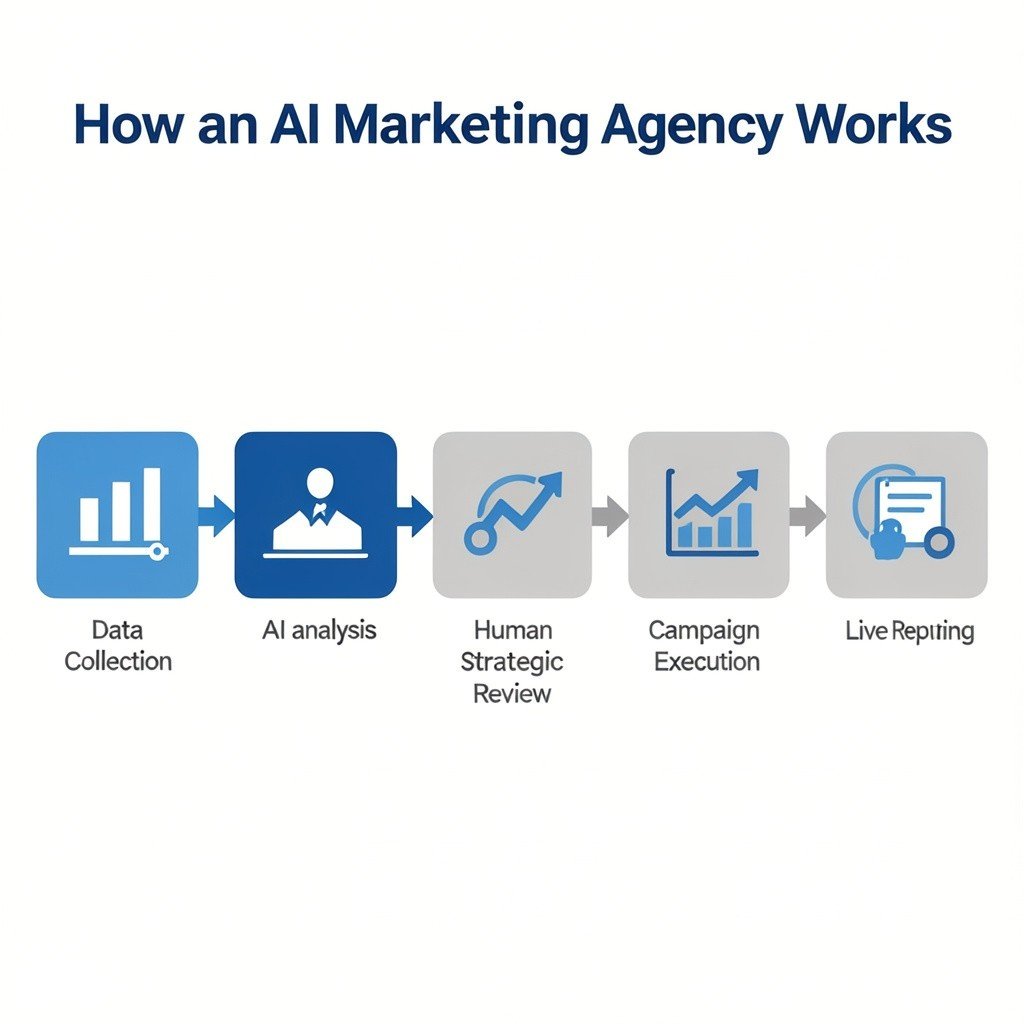
Boiled down, what is an AI agency and how does it work comes down to three steps that repeat over and over. First, the agency feeds its tools data, past campaigns, customer behavior, competitor moves, search trends. Second, the software chews through that data far quicker than a person could, catching patterns in what content converts or which audience is actually worth the spend. Third, and this part gets skipped in a lot of marketing pitches, a real strategist checks the output, adjusts it for tone and context, and only then pushes it live.
That last step is the whole ballgame. No agency worth hiring lets software publish blind. The best teams pair machine speed with human judgment, because AI still trips over tone, cultural nuance, and context in ways a person catches instantly.
AI Agent Versus AI Tool: The Difference That Actually Matters
Every agency calls itself AI driven these days, but there’s a real technical gap worth understanding before you sign anything.
A tool assists. It might suggest an ad headline, but a person still decides whether to use it. An agent executes. It watches a live campaign, notices cost per lead just spiked, figures out why, and reallocates budget across platforms on its own, then tells you what it did afterward. Agencies leaning only on AI tools are basically doing the same work agencies have always done, just with a faster typewriter. Agencies running actual AI agents are automating decisions, not just tasks, and that’s a meaningfully different thing to pay for.
How an AI Marketing Agency Differs From a Traditional Agency
The gap isn’t only about software. It changes the pace of the work, how you get billed, and even how many people you end up talking to.
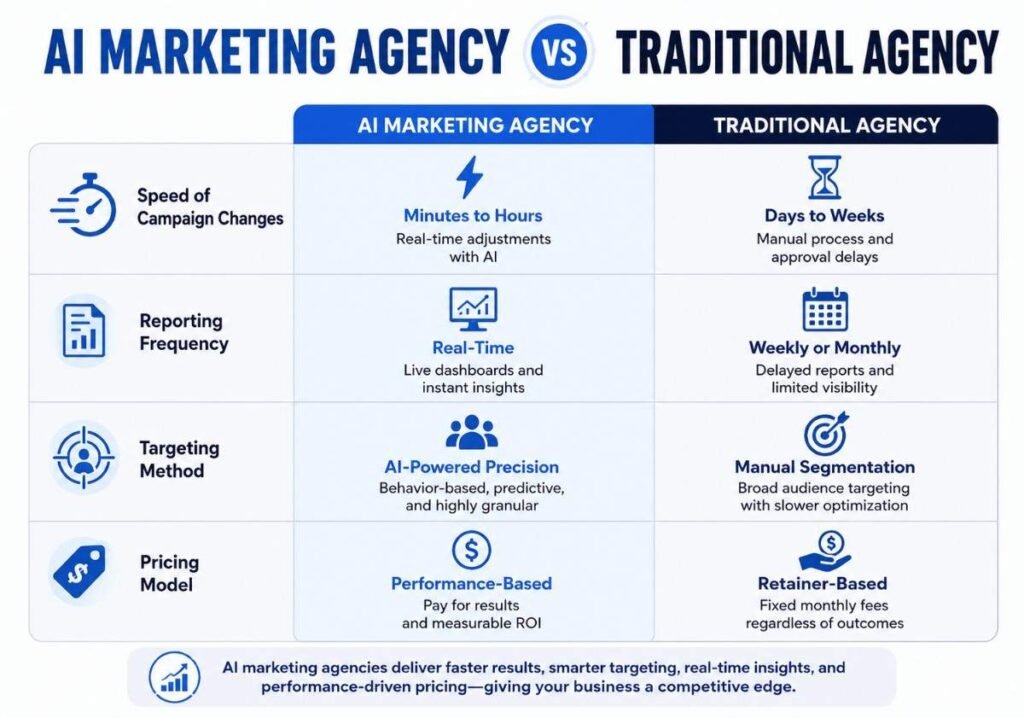
A traditional agency tends to move in weekly or monthly cycles. A strategist writes a plan, a designer builds assets, a media buyer sets up campaigns, and results get reported once the period closes. Want a change? That usually routes through two or three people first, so it can take days.
An AI powered agency squeezes that cycle down. Data refreshes live. A weak performing ad gets flagged and swapped within hours, not weeks. Targeting adjusts off real signals instead of demographic buckets somebody built six months ago and never revisited.
Traditional Agency vs AI Marketing Agency
| Factor | Traditional Marketing Agency | AI Marketing Agency |
|---|---|---|
| Speed of campaign changes | Days to weeks | Hours, sometimes minutes |
| Reporting frequency | Weekly or monthly | Live dashboards, updated continuously |
| Content production | Manual writing and design | AI assisted drafts with human editing |
| Targeting method | Broad demographic groups | Behavioral and predictive segmentation |
| Team size per client | Larger account teams | Smaller teams supported by software |
| Typical pricing model | Flat retainer | Retainer plus performance based fees |
| Best fit for | Brand heavy, high touch campaigns | Performance marketing, fast iteration |
Neither one wins outright. A brand launching a big, highly custom creative campaign might still lean toward traditional agency thinking. A business chasing lead volume on a tighter budget usually gets more out of an AI powered team’s speed.
The AI Marketing Tools Behind the Work
Calling yourself an AI marketing agency means very little without knowing what’s actually running underneath. Here’s what shows up most often.
Content and Copy Generation Tools
These are language model based writing assistants used for blog drafts, ad copy, product descriptions, and email sequences. Agencies rarely ship raw AI output straight to a client. A human editor rewrites for accuracy and voice, and strips out the generic phrasing that makes AI writing sound like AI writing.
Predictive Analytics and Data Platforms
These pull performance numbers from Google Ads, Meta, LinkedIn, and CRMs like Salesforce, then fold them into one dashboard. Predictive models flag a campaign likely to underperform before the budget’s fully spent, which beats the old habit of waiting for a monthly report to notice something went wrong.
Personalization and Recommendation Engines
These adjust what a website shows, what an email offers, or what product gets recommended, based on a visitor’s history, kind of like how a streaming service knows what you’ll probably want to watch next. For ecommerce brands, this alone can meaningfully lift conversion rates, since every visitor is essentially seeing a slightly different store.
Programmatic Advertising and Bid Management
AI systems bid on ad inventory in real time across thousands of placements, shifting spend toward whatever combination of audience, creative, and platform is converting best right now, not last week.
Chatbots and Conversational AI
Customer facing bots handle lead qualification, booking, and basic support, and feed those conversations back into the marketing system so campaigns can be tuned around what customers are actually asking.
AI Agency for Small Business: Is It Worth It
A lot of small business owners assume AI agencies are built for companies with enterprise budgets. That’s not really true anymore. Plenty of providers now package their services specifically as an AI agency for small business offer, often cheaper per month than a full service traditional agency, since software is doing some of the labor a person used to do.
What Small Businesses Typically Get
A small business package usually covers local search, Google Business Profile management, AI assisted ad copy testing, automated email follow ups, and a simplified dashboard. Fewer humans touch the account day to day, which is what keeps the price down, though a strategist typically still checks in weekly.
What to Watch Out For
Not everyone claiming to be AI powered actually has the technology behind it. Some agencies are just typing prompts into ChatGPT by hand and calling it a service. Ask direct questions. Which specific tools do they use? How much is automated versus manual? Can they show you a live dashboard instead of a static PDF from last month? Reporting from the Interactive Advertising Bureau notes that only a minority of agencies, brands, and publishers have fully integrated AI across the whole campaign lifecycle, so a lot of shops are still catching up despite what their homepage says.
AI Agency Business Ideas and How to Start an AI Agency
If you’re on the other side of this, thinking about building rather than hiring, there’s real room here. Below is a practical look at AI agency business ideas and the steps behind how to start an AI agency from scratch.
Choosing a Niche
The agencies growing fastest right now aren’t general practitioners. They pick one lane and go deep on it. A focused AI agency business model might mean lead generation for local service businesses, personalization for ecommerce, AI search visibility for B2B software, or AI assisted content production for publishers. Going narrow makes your systems repeatable and makes your pitch a lot easier to explain in one sentence.
Building Your Tech Stack Before You Sell Anything
Don’t sell what you haven’t tested. Pick two or three tools across content, analytics, and reporting, then run them on a pilot project or your own site first. Clients will eventually ask what makes you different from someone using the same free tools on their own, and the honest answer needs to be your workflow and judgment, not the tools themselves.
Pricing Your Services
Most new agencies start with one of three setups: a flat monthly retainer, a performance based fee tied to leads or sales, or a hybrid of the two. A hybrid model tends to earn trust faster with a first client, since it signals you’re willing to share some of the risk instead of just collecting a check no matter what happens.
Steps to Launch
- Pick one niche and one core service rather than trying to offer everything at once.
- Test your tool stack on a pilot project before you pitch a single client.
- Build one detailed case study, even from your own business, with real numbers attached.
- Price with a hybrid retainer plus performance model to lower the barrier for that first client.
- Systemize your reporting early so growth doesn’t force you into hiring a full team too soon.
Want to see this in motion rather than just read about it? Here’s a walkthrough on YouTube covering how AI marketing agencies actually operate.
Choosing and Working With an AI Marketing Agency
Once you get the model, the harder part is picking the right partner and knowing what to actually expect.
Questions to Ask Before You Sign
Ask what percentage of their work is genuinely automated versus done by hand. For a real dashboard, not a screenshot pulled from a sales deck. Ask how often a human reviews AI generated content before it ever goes live, since unsupervised output is still a real risk to tone and accuracy. Ask what happens to your data and campaign history if you leave, since some agency dashboards aren’t built to travel with you.
Red Flags Worth Noticing
Be wary of agencies that can’t explain their own process in plain terms, that promise guaranteed rankings or guaranteed leads, or that show the same single case study on every call. Agencies genuinely doing this work well are usually happy to get specific about their tools and methods, because that specificity is a lot of what they’re actually selling.
Setting Realistic Expectations
AI speeds up testing and reporting, but it doesn’t replace strategy. A weak offer or fuzzy positioning won’t be rescued by sharper targeting algorithms. Think of an AI marketing agency as a way to run a good strategy faster, not a substitute for having one in the first place.
There’s a useful, more candid thread on Quora covering the major real world use cases for AI in marketing if you want perspectives outside a polished sales pitch.
Where AI Still Falls Short in Marketing
No honest guide skips this part. AI is genuinely good at pattern recognition and speed, and genuinely weaker at judgment and originality. It can tell you which subject line won last month. It can’t reliably invent a new brand idea or read the emotional temperature of a sensitive moment the way a person can. Background research summarized on Wikipedia’s page on artificial intelligence in marketing points to the same conclusion, that most successful implementations still pair automated systems with human oversight rather than cutting people out entirely. Agencies claiming otherwise are usually overselling.
Conclusion
An AI marketing agency blends automation, predictive data, and generative tools with human strategy to run campaigns faster and target more sharply than most traditional shops manage alone. Three things worth carrying away from this. First, there’s a real difference between an agency that just uses AI tools and one running true AI agents capable of acting on their own. Second, whether you’re hiring one or building an AI agency business model yourself, the tools matter less than the workflow and judgment wrapped around them. Third, the best results still come from a hybrid setup, AI handling speed and scale while people handle strategy, tone, and the final call.
If this has you thinking seriously about next steps, start by listing your actual marketing bottlenecks first. Then go looking for a partner or a plan built to solve those specific problems, not one just selling AI as a headline.
Frequently Asked Questions
What is an AI marketing agency and how does it work?
An AI marketing agency uses machine learning, automation, and generative tools to handle research, content, targeting, and reporting. It works by feeding customer and campaign data into AI systems, letting the software spot patterns quickly, then having a strategist review and approve everything before it goes live.
What is an AI agency business model?
Most charge a monthly retainer, a performance based fee tied to results, or some mix of both. It usually depends on the niche. Lead generation agencies tend to lean performance based, while brand and content focused shops often stick with flat retainers.
How do I start an AI agency?
Pick one niche, test a small tool stack on a pilot project, build a solid case study, and price with a hybrid model to land your first client more easily. Growing from there comes down to consistent results and referrals, not the tools alone.
Is an AI marketing agency good for small business?
Yes. Many providers now package AI agency for small business services at lower monthly rates than full service traditional agencies, since automation cuts down on manual hours. Just confirm how much of what they promise is actually automated before you sign.
What tools do AI marketing agencies actually use?
Common categories include content generation tools, predictive analytics dashboards, personalization engines, programmatic ad bidding systems, and conversational chatbots. Most agencies run several of these together rather than betting on one platform.
Does AI replace human marketers at these agencies?
No. Most credible agencies use AI to speed up testing, analysis, and reporting while people still handle brand voice, strategy, and final review. Fully unsupervised AI output is still considered risky for tone and accuracy.
How much does an AI marketing agency cost?
It varies a lot by niche and scope, but small business packages often run cheaper than traditional full-service retainers because software absorbs some of the manual work. A hybrid retainer plus performance fee setup is becoming increasingly common.
What is the difference between an AI tool and an AI agent in marketing?
A tool assists a person who still makes the final call, like suggesting an ad headline. An agent carries out multi step tasks on its own, like spotting a budget pacing issue and reallocating spend without anyone clicking through each step.