
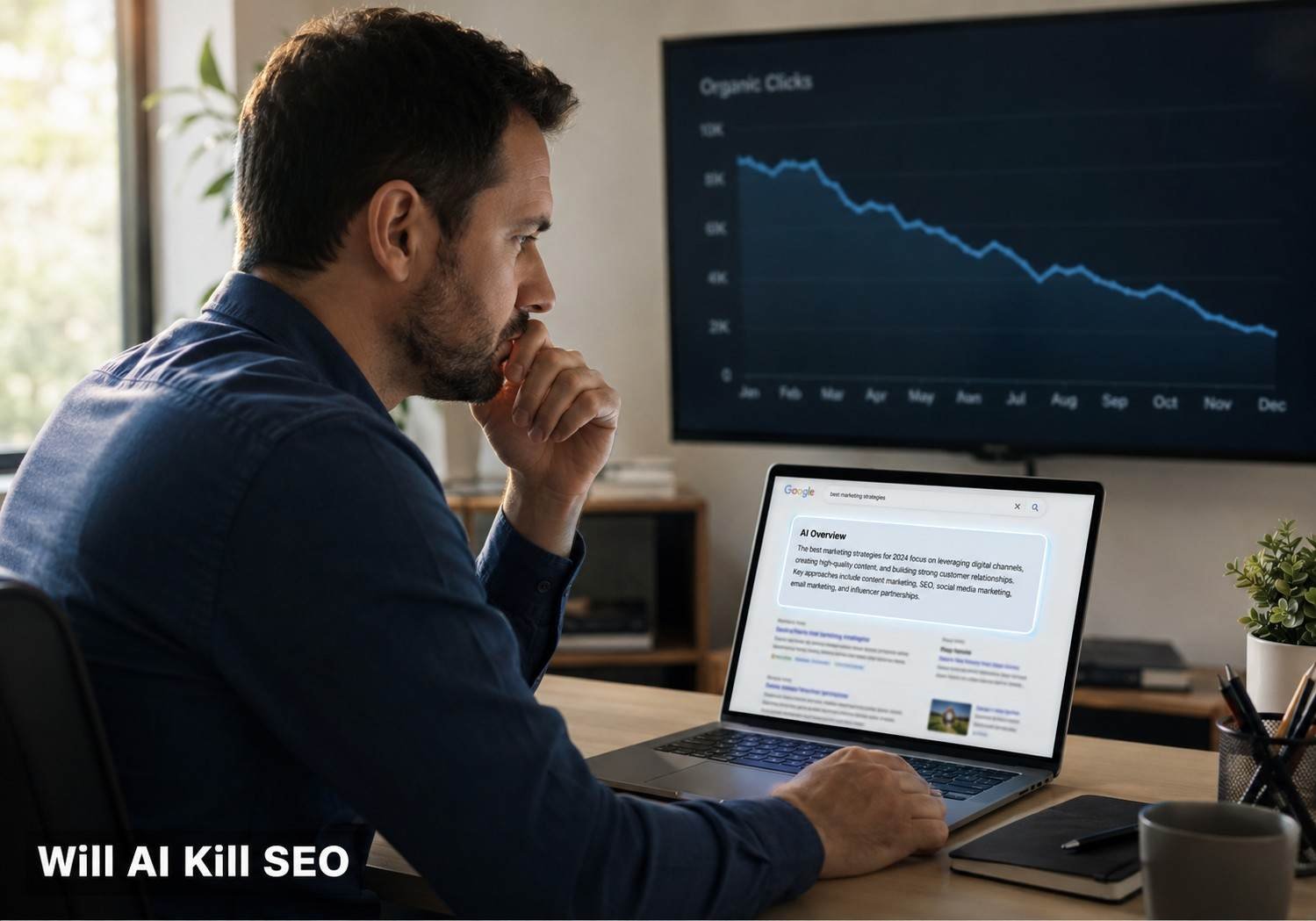
Will AI Kill SEO? What The Data Actually Shows
Here’s a number that should make you sit up: on some searches, organic clicks have dropped by more than half since AI Overviews showed up. So will AI kill SEO, or is this just growing pains for an industry that got a little too comfortable? That’s the real question, and it deserves a real answer instead of another doom post.
Is AI going to kill SEO for good, or is it just clearing out the sites? That we’re coasting on thin content and decent rankings? That’s what we’re going to sort through here. In this guide you’ll learn what’s actually happening to search traffic right now. Whether AI is replacing SEO or just reshaping it, here’s how to use AI tools without producing content that search engines quietly ignore. And how to get your pages pulled into AI overviews, ChatGPT searches, and Perplexity answers instead of buried underneath them.
What’s Actually Happening To Search Traffic
Before you decide whether AI SEO impact is a five-alarm fire. It helps to look at the numbers instead of the headlines.
The Click Data Behind The Panic
A randomized study run in early 2026, registered ahead of time with the AEA RCT registry, pulled AI Overviews for one group of searchers and left them in place for another. The group that saw the AI overview clicked outbound links 38 percent less often. And their zero-click sessions jumped from 54 to 72 percent. Ahrefs found something similar looking at 300,000 keywords: the page ranked in position one lost 58 percent of its expected clicks. Whenever an AI overview sat above it. Pew Research’s panel study backs this up from another angle. Only 8 percent of people click an organic result when an AI overview shows up, compared to 15 percent when it doesn’t.
These studies don’t agree on an exact number, and that’s fine, since they used different samples and time frames. What they agree on is the direction. When the search engine answers the question itself, fewer people scroll past it.
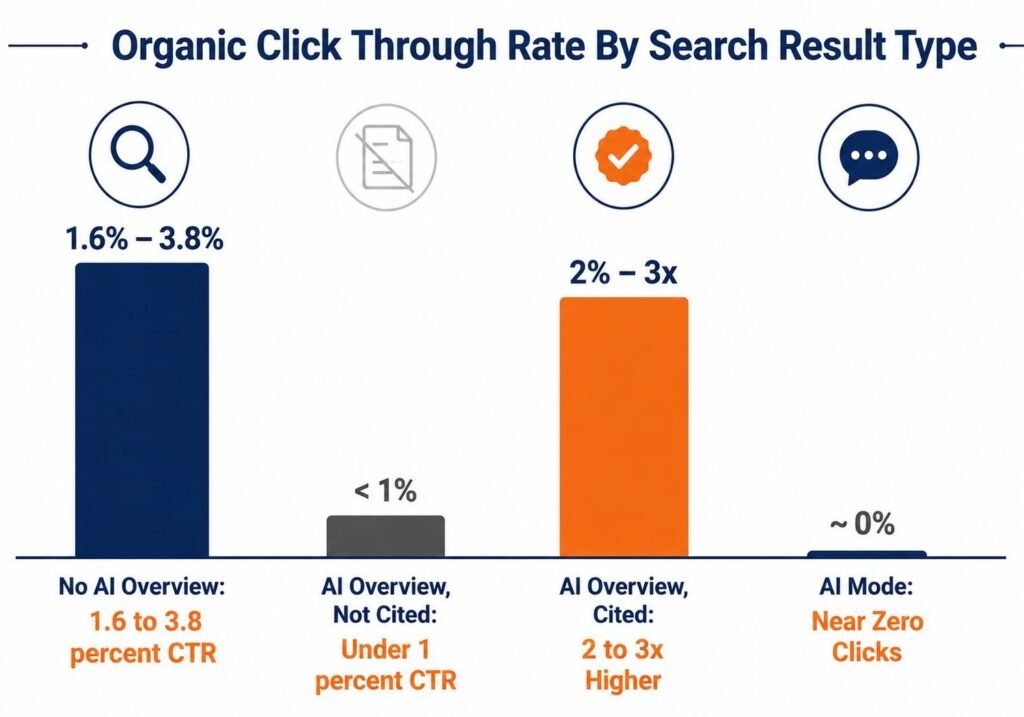
Zero-Click Search Isn’t The Exception Anymore; It’s The Default
Similarweb tracked zero click sessions climbing from 56 to 69 percent in roughly a year, right in step with the AI Overview rollout. Inside Google’s AI Mode specifically, some measurements put zero click rates above 90 percent, since AI Mode often swaps out the traditional results list entirely. For a huge chunk of informational searches, the answer box is now the final stop, not a doorway to your site.
Why It Feels Like SEO Is Dying, Even Though The Full Picture Is More Complicated
Here’s the part most panic pieces leave out. The same research showing falling clicks overall also shows that brands who actually get cited inside an AI overview do noticeably better than brands who rank underneath it and get ignored. One dataset put cited brands at 120 percent more clicks per impression than uncited ones answering the identical question. So the fair read isn’t “AI killed SEO.” It’s closer to “AI killed the middle of the pack,” while quietly rewarding whichever sources it trusts enough to quote.
| Search Result Type | Typical Organic CTR | What It Means For You |
|---|---|---|
| No AI Overview present | 1.6 to 3.8 percent | Traditional ranking still drives visits |
| AI Overview present, not cited | Under 1 percent | Your ranking barely matters anymore |
| AI Overview present, cited | 2 to 3 times higher than uncited | Citation is the new page one |
| Full AI chat answer (AI Mode) | Close to zero clicks | A brand mention replaces the click |
Is AI going to kill SEO or just redefine it?
This is the part worth actually arguing through, so let’s take both sides seriously.
The Case That AI Will Kill SEO
The logic here is simple enough. If Google, ChatGPT, and Perplexity can answer most questions directly, the traffic that used to flow to “how to” and “what is” articles dries up. Healthcare and education content already see AI overviews on more than 80 percent of relevant searches. If that spreads further into commercial searches the way it’s already touched informational ones, plenty of ad-supported and affiliate sites are in real trouble.
The Case Against It
Search engines still need a web full of content to summarize in the first place. Every AI overview, every ChatGPT search answer, and every Perplexity citation pulls from somewhere, and a human still has to write that somewhere. It’s also worth noting that Google has kept AI Overviews largely off transactional and shopping searches, letting them show up on roughly 4 percent of that category, according to BrightEdge’s tracking, because those searches still drive ad revenue Google isn’t willing to give up on. That’s a pretty strong hint that the whole system still depends on people making content, even if fewer readers click through to see it directly.
What Earlier “SEO Is Dead” Moments Actually Taught Us
We’ve heard this warning before. Mobile search was going to kill desktop SEO. Voice search was going to kill keyword targeting. Featured snippets were going to kill click-through entirely. Each shift did force real changes in how content gets built and measured, but SEO as a whole adapted instead of disappearing. The lesson that keeps repeating is this: the tactics keep dying, but being the source people (and now machines) actually trust keeps mattering more, not less.
How AI Is Reshaping Search Beyond Just Google
AI SEO impact isn’t one story happening on one platform. It’s three overlapping shifts happening at once.
Google AI Overviews And AI Mode
AI Overviews now show up on close to half of tracked searches as of early 2026, up sharply from around 8 percent when they first rolled out broadly. AI Mode takes it further, swapping the usual list of results for a full conversation with the searcher.
ChatGPT Search And Perplexity Are Both Growing Fast
ChatGPT crossed roughly 1 billion monthly active users in 2026 and now handles hundreds of millions of search-style queries every week through its search feature. Perplexity is much smaller in raw numbers, sitting around 45 million monthly users, but it’s grown faster percentage-wise than ChatGPT over the same stretch, and its whole product is built around showing sources for every answer. That citation’s first design matters a lot here, because it means a well-sourced page has a real shot at earning a visible mention even inside an AI-generated response.
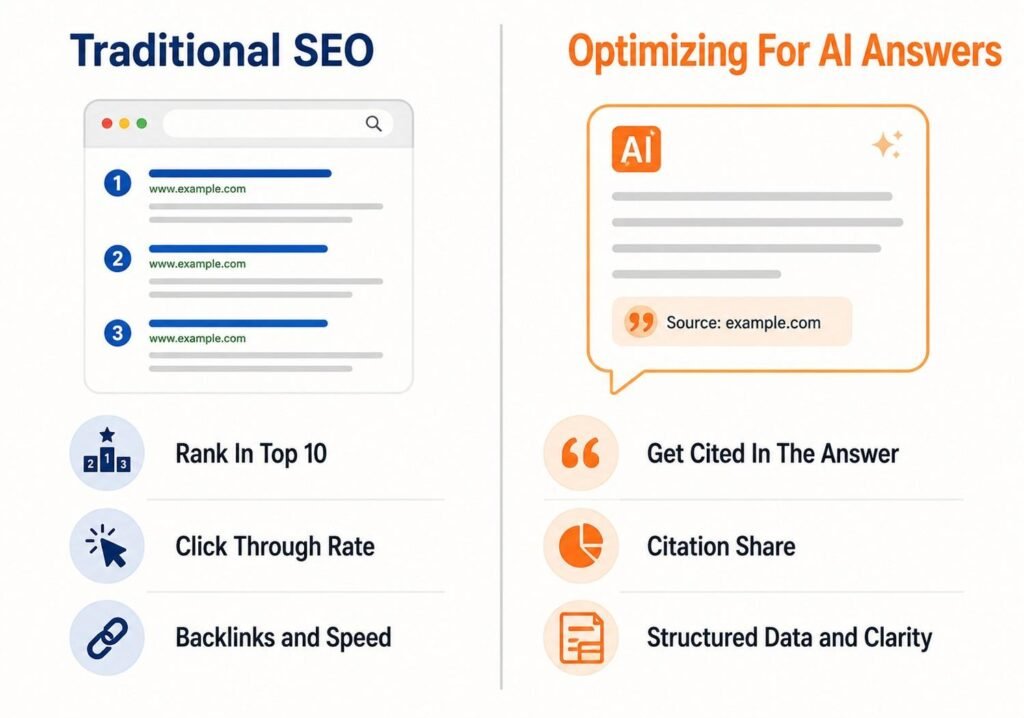
Traditional SEO Versus Optimizing For AI Answers
| Factor | Traditional SEO | SEO For AI Overviews (GEO) |
|---|---|---|
| Main goal | Rank in the top 10 blue links | Get quoted or cited inside the AI answer |
| Success metric | Click-through rate, rankings | Citation share, brand mentions |
| Content format | Long pages targeting one keyword | Clear, quotable answers plus real depth |
| Technical priority | Page speed, backlinks | Structured data, clear entity signals |
| Where it wins | Commercial and transactional searches | Informational and research-heavy searches |
Can I Use AI For SEO Optimization Without Tanking My Rankings
Yes, and most serious SEO teams already do this every day. The real question isn’t whether you can use it; it’s where.
Where AI Actually Speeds Things Up
AI tools are genuinely good at keyword clustering, spotting content gaps, drafting meta descriptions, suggesting internal links, and summarizing technical audit reports that would otherwise eat up your whole afternoon. Used this way, AI works more like a fast research assistant than a replacement writer.
Where AI Quietly Hurts Your Rankings
Search engines have gotten noticeably better at spotting generic, repetitive AI output that adds nothing new and reflects no real experience. Pages built entirely this way tend to sink rather than climb, because they lack the depth that citation systems now look for. This is exactly why AI SEO content optimization has shifted away from “produce more content” and toward “produce a solid structured draft, then have a real person add the parts a model can’t.”
AI For SEO Optimization: Free Options Worth Trying First
You don’t need an expensive toolkit to get started here.
- Google Search Console, free, for click and impression data straight from Google itself
- ChatGPT or Claude’s free tiers, for outlining articles and drafting FAQ sections
- Google’s Keyword Planner, free with an ads account, for search volume estimates
- AnswerThePublic’s free tier, for surfacing the actual phrasing people type into search bars
How To Automate SEO With AI Without Losing Control Of Quality
Automate SEO with AI in layers rather than all at once, so you can catch problems before they cost you rankings.
Automate The Repetitive Research Work First
Rank tracking summaries, competitor gap reports, and weekly traffic alerts are safe to hand almost entirely to AI, since a mistake here just means redoing a report, not publishing something wrong for the world to see.
Automate The Draft, Not The Final Version
Let AI build the first pass, the outline, and the FAQ skeleton, then run every piece through a human editor who adds real examples, checks the facts, and rewrites anything that sounds too generic. This one habit is the real difference between AI-assisted content that ranks and AI-generated content that just sort of sits there.
What You Should Never Fully Hand Off
Final quality review, fact checking on statistics, and anything touching medical, financial, or legal claims should stay with a person. These are exactly the categories where search engines apply their strictest trust checks before ranking or citing anything.
SEO For AI Overviews: How To Actually Earn A Citation
This is the part most guides skip entirely, and it’s arguably the most valuable skill in search right now.
Write So You Can Be Quoted Cleanly
AI systems tend to lift short, self-contained, clearly stated sentences rather than long, winding paragraphs that build up slowly to a point. Put the direct answer to a question in the very first sentence of a section, then explain your reasoning after it.
Use schema markup and structured data.
FAQ schema, HowTo schema and article schema give AI crawlers a clean signal about what your page actually answers, which raises your odds of getting cited even when you’re not sitting in the top ranking spot.
Build Real Topical Authority, Not Just One Good Page
BrightEdge’s tracking found that only 17 percent of AI Overview citations now come from pages that also rank in the traditional top 10, a steep drop from about three quarters of citations back in mid-2024. Ranking well on its own clearly isn’t enough anymore. Sites that consistently cover a topic in depth, across a cluster of connected pages, are increasingly the ones AI systems trust enough to quote, even when any single page from that site isn’t the top traditional result.
AI SEO Tips You Can Put To Use This Week
A handful of habits separate the sites quietly gaining ground from the ones losing it without realizing why.
- Answer the exact question in your first two sentences before adding context, since that’s what tends to get lifted into AI summaries
- Add at least one original data point, screenshot, or first hand example per major page, since generic advice rarely earns a citation anymore
- Check Google Search Console monthly for pages losing clicks despite steady rankings, since that pattern usually means an AI Overview has landed above you
- Keep author bios and credentials visible, since trust signals influence whether AI systems treat a page as citation-worthy.
You can read more on how search ranking evolved over the years on Wikipedia’s search engine optimization page, and Google’s own Search Central YouTube channel breaks down algorithm changes directly from the source.
Conclusion
So, will AI kill SEO? Based on everything above, no, but it is killing off the version of SEO that relied on ranking alone to earn a click. Three things matter most going forward. First, click through rates on AI Overview queries really have dropped, sometimes by more than half, so judging success by rankings alone is already outdated. Second, getting cited inside an AI answer now often matters more than owning the top traditional spot, which means clarity and topical depth carry more weight than keyword density ever did. Third, AI tools can safely handle research, drafting, and reporting, but a human still decides what actually earns trust and gets published.
Start this week by checking your own Search Console data for pages losing clicks despite steady rankings, then rework those pages to answer the core question in the first two sentences. That one change is the fastest way to start showing up inside the answers instead of buried underneath them.
FAQ
Will AI kill SEO completely?
No. AI is changing how people find information, not erasing the need for searching visible content. Click-through rates have dropped sharply on queries with AI overviews, but sites earning citations inside those answers are doing better than sites getting bypassed entirely.
Is AI going to kill SEO jobs specifically?
It’s changing the job more than wiping it out. Repetitive tasks like keyword clustering and reporting are increasingly automated, while strategy, quality control, and earning citations inside AI answers still need human judgment that tools can’t fully replace.
Can I use AI for SEO optimization safely?
Yes, as long as a person reviews and improves whatever AI drafts before it goes live. AI works well for research, outlines, and technical audits, but fully AI-generated pages with no original input tend to underperform in both rankings and AI citations.
What are the best AI for SEO optimization free tools?
Google Search Console and Google Keyword Planner are both free and essential. Free tiers of ChatGPT or Claude help with outlines and FAQ drafts, and AnswerThePublic’s free version surfaces the real questions people are typing in.
How is SEO for AI overviews different from normal SEO?
Normal SEO focuses on ranking in the traditional results list. SEO for AI Overviews focuses on being clear and well structured enough that an AI system chooses to cite your page directly inside its generated answer.
What are some practical AI SEO tips for beginners?
Answer the main question in your first two sentences, add original examples or data instead of generic advice, use FAQ and article schema, and check Search Console monthly for pages losing clicks despite stable rankings.
Can I automate SEO with AI entirely?
Not entirely, and you shouldn’t try to. Automate the repetitive research and first drafts, but keep final review, fact checking, and anything involving expertise claims under human control to protect quality and trust.
Does AI SEO content optimization mean writing less content?
It means writing fewer, deeper pages instead of a lot of thin ones. AI systems increasingly reward topical depth and original insight over sheer volume, so quality per page now matters more than how often you publish.