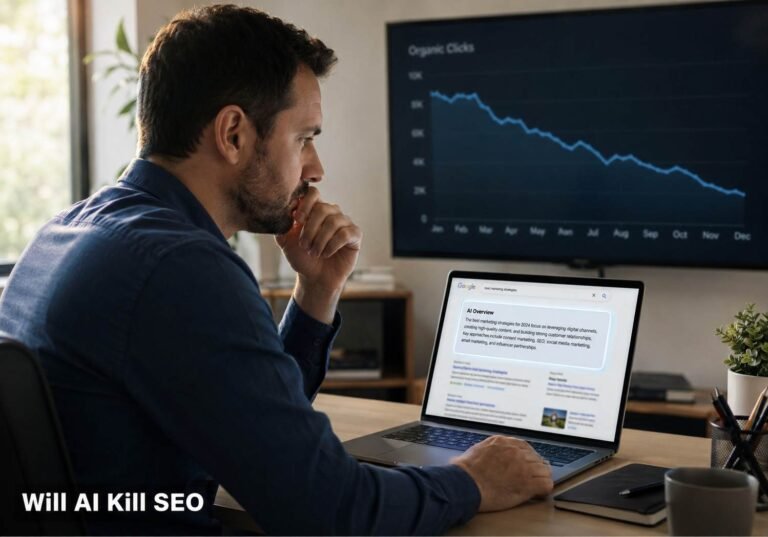

Can AI Replace Digital Marketing? The Truth for 2026
Seventy-six percent of companies now run AI through some part of their marketing. Back in 2021 that number was 29 percent. So yeah, marketers are lying awake wondering whether AI replacing digital marketing is still a theory or something already eating their job description from the inside out.
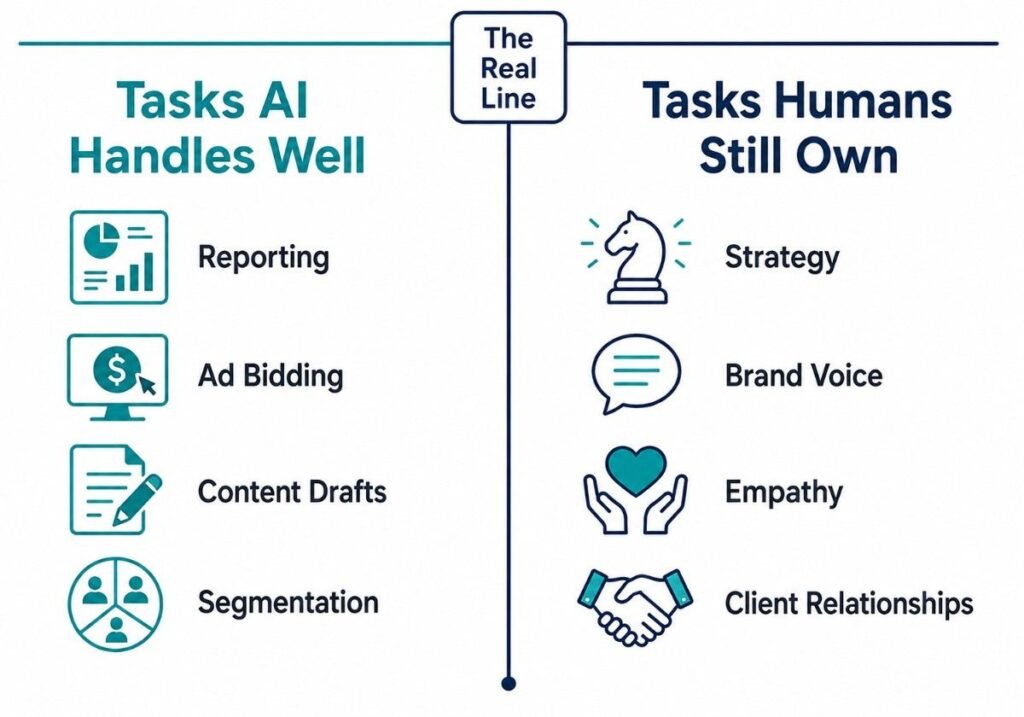
Here’s my actual take, and it won’t fit neatly into a headline. AI already ate the boring stuff. Reporting. Bidding. First drafts nobody loved anyway. What it hasn’t touched, not really, not yet, is the gut call. The weird instinct that tells a strategist a campaign feels wrong three days before launch. That part’s still stubbornly human.
In this guide you’ll learn what AI can and can’t pull off in marketing right now, sharp AI in digital marketing examples, fresh AI in marketing statistics, the blunt pros and cons of AI in marketing, the uncomfortable disadvantages of AI in marketing, and where the future of AI in marketing is dragging your paycheck next.
What People Are Actually Asking When They Ask This
Before tackling whether AI can replace digital marketing head-on, let’s separate two claims that keep getting glued together like they’re the same thing. They’re not.
Claim one. AI replaces tasks. Already happened. Old news.
Claim two. AI replaces marketers; the entire profession, poof, is gone. That one’s shaky at best, propped up mostly by LinkedIn hot takes and investor decks.
Tasks Versus Careers
Marketing isn’t one job, wearing a trench coat. It’s forty small jobs stacked on top of each other. Writing six headline variants. Staring at a spreadsheet of click-through rates until your eyes cross. Deciding, in a genuine crisis, what the brand should even say out loud. AI crushes the narrow stuff with a clean input and a clean output. Ask it to read a room during a PR disaster? Different story entirely.
Simple way to picture it. AI is devouring anything that smells like data entry. It still trips over anything that smells like storytelling.
Why Your Feed Is Suddenly Full Of This Question
Every time a new AI model drops, whether it writes ad copy or spits out a thirty-second video clip, panic spikes right along with it. Search volume for “will AI replace marketing jobs?” jumps like clockwork. Makes sense. Nobody wants to read their own obsolescence in a press release. But the adoption numbers below tell a messier, more interesting story than the panic does.
AI in Marketing Statistics: Where 2026 Actually Sits
Numbers beat vibes. Here’s the real snapshot, not the recycled listicle version.
Adoption Went Vertical
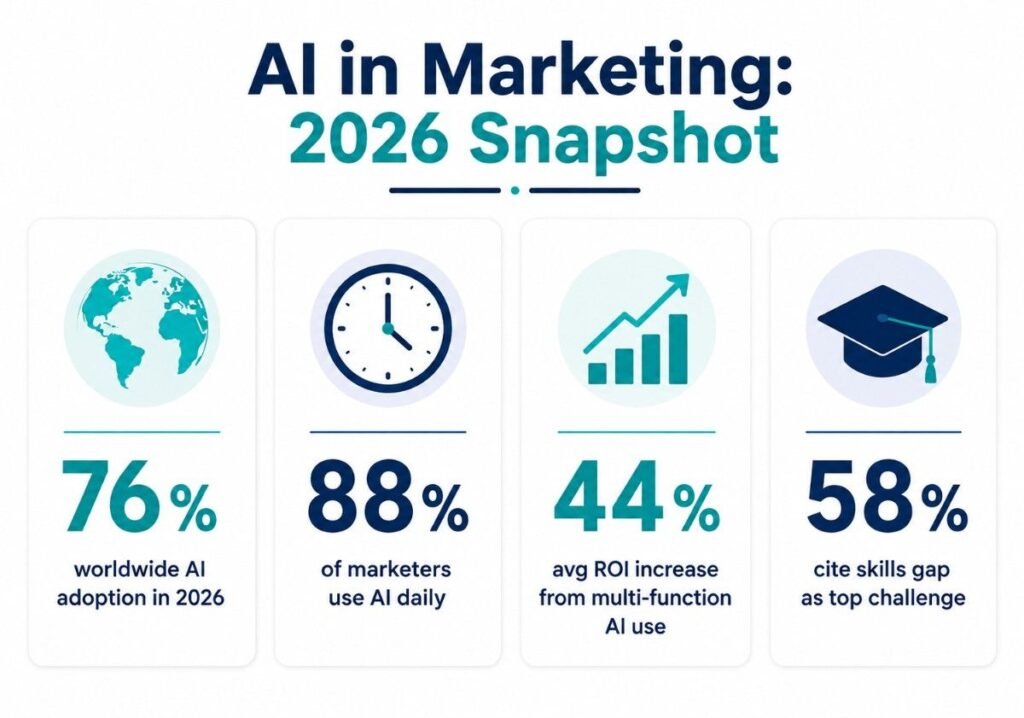
Worldwide, AI in marketing adoption hit 76 percent in 2026. Five years earlier it sat at 29 percent. That’s over a 160 percent climb in half a decade. Ninety one percent of marketing teams say AI helps with their work in some form. Eighty-eight percent use it daily. The question isn’t whether teams use AI anymore. Obviously they do. The real fight is over how deep it goes.
The Skills Gap Is The Actual Villain
Buried stat, rarely quoted, probably should be shouted from rooftops. Fifty-eight percent of marketers say skills gaps, not the software, are their number one AI headache. Only seventeen percent call their training genuinely job-specific. Companies that invest properly in training see 43 percent higher project success rates. Translation. Most “AI failed us” stories are really “we skipped the manual” stories wearing a fancier costume.
A few numbers worth staring at for a second:
- 76 percent worldwide AI marketing adoption in 2026, up from 29 percent in 2021
- 88 percent of marketers open an AI tool every single day
- 58 percent blame skills gaps for their AI struggles; only 17 percent call their training solid
- 59.8 percent now worry AI threatens their role, up from 35.6 percent one year prior
ROI Shows Up, Just Unevenly
Teams running AI across several core functions report a 44 percent average bump in output and return, compared to teams sitting it out. Meanwhile, 45 percent of martech leaders say the AI agents their vendors sold them never delivered what was promised. Both facts, sitting side by side, are both true. AI pays rent when someone actually manages it. It becomes an expensive paperweight when it’s bought as a shortcut and abandoned on day two.
Where That Daily AI Time Actually Goes
Content creation. Reporting and analytics. Creative ideation. Market research. Those top the list of where marketers spend AI hours. Notice what’s missing. Campaign strategy. Brand positioning. Actual client relationships. Those stay locked in human hands, at least for now.
| AI in Marketing Metric | 2021 | 2026 |
|---|---|---|
| Worldwide AI marketing adoption | 29% | 76% |
| Marketers using AI daily | Low single digits | 88% |
| Marketers worried AI threatens their role | 35.6% | 59.8% |
| Marketers reporting solid AI training | Rare | 17% |
| Average output and ROI lift from multifunction AI use | N/A | +44% |
Pros and Cons of AI in Marketing
Anyone serious about AI in marketing needs both columns, not the highlight reel your vendor’s sales deck showed you.
What AI Actually Gets Right
Speed, real speed. AI drafts a dozen ad variations while a human is still opening a blank document. Fifty-five percent of marketers already lean on generative AI for writing tasks because of exactly this.
Sharper aim. Machine learning chews through purchase history and browsing behavior faster than any analyst ever could, catching patterns a tired human brain glosses right over at four in the afternoon.
Personalization that never sleeps. Recommendation engines and chatbots tailor an experience to one lonely shopper scrolling at two in the morning. No overnight shift required.
Cheap on the boring stuff. Bidding, basic reports, A/B test crunching. All faster, all cheaper, once AI takes the wheel. That frees up budget for the parts that actually need a human touch.
Where It Falls Apart, Fast
The disadvantages deserve equal airtime, and honestly, a couple of them are getting worse, not better:
- Sameness. Everywhere. When thousands of brands prompt the same tools the same lazy way, everything starts sounding like the same tired press release.
- Trust is sliding. Comfort with AI-driven brand experiences dropped from 57 percent in 2023 to 46 percent in 2024. That’s not a small dip.
- Privacy landmines. Feeding customer data into third-party AI tools opens real compliance questions nobody wants to answer during an audit.
- The skills gap, again. Thirty-two percent of marketers report zero formal AI training. Zero. That shows up as wasted spend and clumsy execution.
- No feel for the room. AI can’t sense that a tone is wrong during a tragedy, a scandal, or a tense news week. A seasoned strategist catches that instantly. The algorithm doesn’t blink.
AI in Digital Marketing Examples Worth Stealing
Stats are fine. Concrete AI in digital marketing examples hit harder.
Copy That Writes Its Own First Draft
Retail brands let generative AI bang out a rough product description, then a human editor fixes the tone and checks the facts before it ever goes live. First draft time collapses. A person still holds the final say.
Predicting Who’s About To Ghost You
E-commerce teams feed purchase history into models that flag customers likely to churn, then fire off a retention email automatically. The offer itself, the discount, and the tone still come from a human brain. The trigger and the timing don’t.
Ads That Test Themselves While You Sleep
Meta and Google now let advertisers dump in several headlines and images, and the AI quietly tests combinations in real time. What used to take a media buyer three exhausting weeks of manual split testing now runs in the background.
Chatbots That Never Take A Coffee Break
Conversational AI handles first contact customer service now, answering the obvious stuff instantly and routing anything messy to an actual human. Response times shrink. Headcount doesn’t grow.
Search Itself Is Shifting Under Everyone’s Feet
AI Overviews, Perplexity, and ChatGPT Search are all summarizing web content directly now. Marketers are writing for extraction by these systems, not just for a blue link on page one anymore.
Wait, there’s also a whole side conversation happening on video. If you want a feel for how this plays out in real campaigns, this collection of AI in digital marketing explainer videos on YouTube is a reasonable starting point.
Will AI Replace Marketing Jobs? What Reddit And Quora Actually Say
Type “Will AI replace digital marketers?” into Reddit’s search bar or scroll Quora for an hour, and one theme keeps surfacing from people who actually clock into this job every day.
What The Practitioners Keep Repeating
Dozens of Quora threads ask some version of “Will AI replace marketing jobs?” The answer, over and over, from actual working marketers, lands close to identical. AI won’t fully replace digital marketers. It’ll automate the repetitive layer while creativity and human insight stay in the driver’s seat. One well upvoted answer nailed it plainly: <cite index=”19-1″>AI will not fully replace digital marketers but will transform their roles, automating routine tasks like data analysis, ad targeting, and content optimization while creativity, strategy, and human insight remain essential</cite>.
Another recurring comparison calls AI a jetpack, not a replacement. A weird side effect of that framing is how many marketers now describe feeling relieved instead of threatened once they actually start using the tools daily instead of just reading about them.
The Actual Fault Line In This Debate
Nobody serious is arguing “replace or don’t.” The real fight is over speed and scale. Some tech executives predict most agency work gets automated within a few years, full stop. Other well-known figures in SEO have publicly bet real money that less than 5 percent of marketing jobs will vanish in the next five years. The messy middle, backed by the adoption data above, says job descriptions are morphing way faster than headcounts are shrinking.
The Fear Is Real Even Without The Layoffs
Worth saying plainly. The share of marketers worried AI threatens their role nearly doubled in twelve months, jumping from about 36 percent to nearly 60. That fear is reasonable. Change this visible, this fast, tends to rattle people even before any pink slips show up.
The Future Of AI In Marketing: What’s Coming Next
A handful of trends are shaping where AI in marketing heads from here, not where it’s already been.
On top of the usual content churn, industry forecasts suggest roughly two thirds of AI-generated marketing content will soon come from outside dedicated content teams entirely. Sales reps. Product managers. Support staff. Everyone’s suddenly a content creator with a prompt box.
AI agents are also graduating from single tasks to entire workflows. Researching a topic. Drafting it. Scheduling it. Reporting back on how it performed. A human checks in at key moments instead of babysitting every single step.
And here’s the part nobody predicted five years ago. Training and governance are becoming the actual competitive edge. Companies building real training programs and clear usage rules are quietly pulling ahead of competitors who just bought a subscription and crossed their fingers.
Human skills, the ones that resist automation, brand judgment, storytelling, and reading a cultural moment correctly, are getting more valuable, not less. That tracks with everything practitioners are already saying on Reddit and Quora.
How Marketers Actually Stay Ahead Of This Thing
Waiting it out isn’t a strategy. Adapting is.
Get genuinely good at the tools, not casually good. Only seventeen percent of marketers say their AI training was actually solid. Becoming fluent in prompt writing and AI-powered analytics is one of the fastest ways to matter more on any team.
Keep the strategy chair for yourself. Let AI draft, sort, and crunch. Keep the calls about audience, positioning, and tone. That’s the part people still pay real money for.
Check everything before it goes live. AI leans generic by default. Build a review step that catches flat tone and sloppy facts before a client ever sees them.
Say the quiet part out loud to customers. Trust in AI-driven brand experiences keeps sliding. Disclosing where AI touches a customer interaction, especially in service or personalized offers, protects credibility down the road.
For more background on how digital marketing looked before AI barged in, the Wikipedia entry on digital marketing is a solid, boring, reliable reference.
Conclusion
So. Can AI replace digital marketing? Not the way the scariest headlines want you to believe. The 2026 numbers, the real examples, and hundreds of honest opinions scattered across Reddit and Quora all point in one direction. AI swallows the repetitive layer. Strategy, creativity, and trust stay stubbornly, annoyingly human.
Three things to walk away with. Adoption’s basically universal now, but skills gaps decide who actually wins, not the software itself. Trust in AI-driven marketing keeps dropping even as usage keeps climbing, which makes honesty a real edge, not just a nice value statement. And the marketers treating AI like a booster rocket, not a replacement pilot, keep showing up highest in the ROI numbers.
If you’re rebuilding your marketing approach for the rest of 2026, don’t fight AI and don’t hand it the keys either. Work next to it, on purpose, with a clear line drawn between what the machine handles and what only a person should decide. Not a chance that line disappears anytime soon.
Frequently Asked Questions
Can AI replace digital marketing completely?
No. AI automates reporting, ad optimization, and first drafts, but strategy, brand voice, and real customer relationships still need a human behind the wheel. Most 2026 data shows the job shifting, not vanishing.
Will AI replace marketing jobs in the next five years?
Estimates swing wildly, from under 5 percent displaced to far higher predictions from some tech leaders. The safer read says job descriptions shift long before headcounts actually shrink.
What are the biggest disadvantages of AI in marketing?
Generic-sounding content, sliding consumer trust, privacy exposure, and a stubborn skills gap that leaves plenty of AI projects underperforming their promised ROI.
What is a good example of AI in digital marketing today?
Dynamic creative optimization in ad platforms. AI tests multiple headlines and images in real time to find the winner, no human running each test by hand.
Do marketers on Reddit and Quora think AI will replace them?
Mostly, no. The dominant view says AI automates routine tasks like data analysis and ad targeting while creativity and human insight stay essential. Change, not elimination.
Is AI in marketing worth the investment right now?
Teams using AI across multiple functions report a 44 percent average output and ROI increase, but almost half of martech leaders say vendor promises fall flat. Results hinge on training and follow through.
What skills should marketers build to stay relevant as AI grows?
Prompt writing, reading AI-powered analytics, brand strategy, and editing for tone and accuracy. These sit closest to the parts of marketing AI still can’t fake convincingly.
How is AI changing SEO and content marketing specifically?
AI overviews and answer engines like ChatGPT Search and Perplexity now summarize web content directly, so marketers write for extraction by these systems as well as for traditional rankings, reshaping how content gets structured.