
Is AI Marketing Automation Affordable for Small Businesses?
Can a small business actually afford AI marketing automation, or does it just look good on a pricing page and drain the budget by month three? Here’s a number worth sitting with for a second. Businesses that turn on marketing automation often save six to ten hours a week on manual tasks, and well-run email flows have been reported to return as much as thirty-six dollars for every dollar spent. That’s not a line from a sales deck. That’s what happens when repetitive work gets handed off to software instead of eating up someone’s Tuesday afternoon.
Affordability, though, isn’t just about whether a cheap tool exists somewhere. It comes down to whether the full cost, once you count setup, training, and the extra tool you didn’t see coming, actually fits inside a small business budget without wrecking it. In this guide you’ll learn what AI marketing automation cost really looks like in 2026, how pricing shifts by business size, where hidden fees like to hide, how the ROI math works in practice, and how to figure out if now is the right time or if you should wait a little longer. By the end you should have a real answer for your own business, not a generic yes that sounds nice in a headline.
What Is AI Marketing Automation, and Why Small Businesses Keep Asking About It
At its core, AI marketing automation is software that takes over marketing tasks by reading data and making decisions, rather than just following a rigid set of rules someone typed in once. A basic automated system fires off an email the moment someone joins a list. An AI version watches how that person actually behaves, picks the right time to reach them, tweaks the message, and gets a little sharper as more data rolls in.
For an owner already wearing five hats before lunch, that difference matters. Marketing automation for small businesses used to mean scheduling a newsletter and calling it a day. Now it can mean a system that scores leads, personalizes outreach, manages ad spend, and even fields basic customer questions, all without a dedicated marketing hire on payroll.
The Difference Between Basic Automation and AI-Powered Automation
Basic automation runs on a script. If a shopper abandons a cart, send a reminder three hours later, every time, no exceptions. AI automation asks a better question. Does this particular shopper respond better to a discount, a friendly nudge, or a text message, and what hour are they actually likely to open it? That extra layer of judgment needs smarter software, and that’s exactly where the price tag starts to spread out.
Why This Question Is Trending Among US Small Businesses in 2026
Ad costs keep climbing, attention spans keep shrinking, and hiring keeps getting harder, so owners are leaning on tools that do more with fewer hands. Recent industry data suggests roughly two out of every three small and solo firms in the United States now use some form of AI tool in daily operations, which is a sharp jump from just a couple of years back.
Who Actually Needs It (and Who Should Wait)
If you already have a steady trickle of leads or customers, a list sitting unused, or you’re burning hours each week on repetitive tasks like follow-ups or social posts, automation usually pays for itself fast. If you’re under fifty total customers and don’t yet have a repeatable process, the smarter move is building that process by hand first, then automating it once it’s proven to work.
The Real AI Marketing Automation Cost Breakdown for 2026
Here’s where most articles stop at one number and call it a day. A fair answer needs to split AI marketing automation costs into layers, because the sticker price and the real price rarely match.
Software Subscription Costs by Tier
Entry-level tools built around email and light automation usually land somewhere between free and fifty dollars a month for a small list. Mid-tier platforms that bring in customer relationship management, lead scoring, and multichannel campaigns typically fall between one hundred fifty and five hundred dollars a month. Full-stack platforms with predictive analytics and dedicated support can run eight hundred to over two thousand dollars monthly, though honestly that tier is usually built for businesses that have already outgrown the small business label.
Setup, Onboarding, and Data Cleanup
Software is only the part you see on the invoice. Somebody has to build the workflows, clean up a messy contact list, wire up your website and payment tools, and write the first round of email sequences. Businesses that bring in outside help for this should expect somewhere between one thousand and three thousand dollars for setup. Owners willing to roll up their sleeves and do it themselves can push that cost close to zero, at the cost of a few weekends.
Training, Integrations, and the Second Tool Problem
A tool almost never works entirely on its own. It has to talk to your point of sale system, your website forms, and sometimes a separate texting platform. Each connection can carry its own small fee, and plenty of owners end up buying a second tool within six months because the first one didn’t quite cover everything. A few things to plan for before signing anything:
- Add roughly twenty percent on top of the expected software cost as a buffer
- Ask the vendor directly which integrations cost extra
- Confirm whether onboarding support is included or billed separately
- Check if there’s a cap on contacts or emails before the price jumps a tier
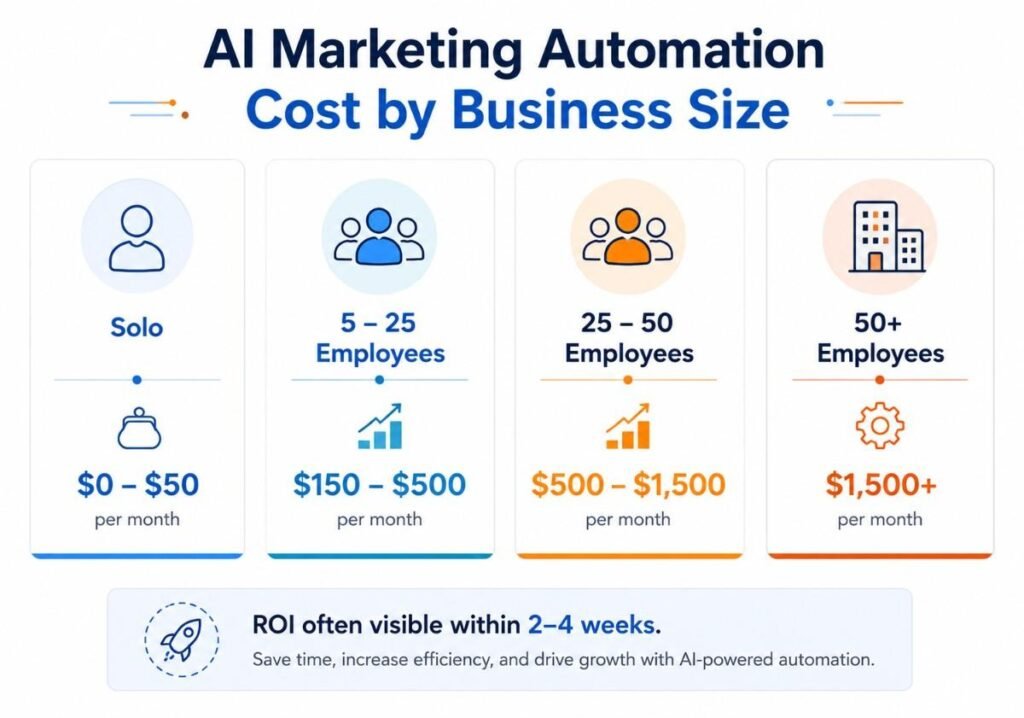
Typical Monthly Cost by Business Size
| Business Size | Typical Monthly Software Cost | Setup Cost (One Time) | Best Fit |
|---|---|---|---|
| Solo or under 5 employees | $0 to $50 | $0 to $300 (DIY) | Basic email automation, simple lead capture |
| 5 to 25 employees | $150 to $500 | $1,000 to $3,000 | Full CRM, multichannel campaigns, AI content tools |
| 25 to 50 employees | $500 to $1,500 | $2,000 to $5,000 | Advanced personalization, predictive analytics |
| 50+ employees | $1,500 and up | $5,000 and up | Enterprise-grade platforms, dedicated support |
Is AI Marketing Automation Affordable for Small Businesses Compared to the Alternatives
The fairest way to judge affordability isn’t in a vacuum. It’s against what you’d pay to get similar results some other way.
AI Automation vs. Hiring a Marketing Employee
A full-time marketing hire in the United States typically runs fifty thousand to seventy thousand dollars a year once salary, benefits, and payroll taxes are all added up. Even a solid mid-tier automation platform, fully loaded with setup and training, rarely crosses ten thousand dollars in year one and drops sharply after that. This doesn’t mean automation replaces a person outright. It usually means one person, supported by automation, can do what used to take two.
AI Automation vs. a Marketing Agency Retainer
A lot of small businesses pay agencies five thousand to fourteen thousand dollars a month for work that a well-set-up AI platform can partly or fully handle, especially campaign management, email nurturing, and reporting. Agencies still earn their keep for brand strategy and creative production, so the smarter setup for many owners is a lean agency relationship paired with in-house automation, rather than picking just one.
Free and Low-Cost Starting Points
Several well-known platforms offer genuinely useful free tiers, including basic customer relationship management and email tracking. Worth squeezing every bit of value out of these before spending a dollar, since they’ll show you exactly which features you actually need before you commit to a paid plan.
How to Calculate Your Own ROI Before You Spend a Dollar
Affordability is relative to what a tool earns back, not just what it costs upfront. Here’s a simple way to check that math yourself, no spreadsheet degree required.
The Napkin Math Formula
Start with the average value of one customer to your business. Multiply that by how many extra customers or repeat purchases you can reasonably expect automation to bring in each month. Subtract your total monthly cost, software, and whatever time it takes to manage it. If that number comes out positive within three to six months, the investment is very likely worth it for your business specifically, no matter what it costs in raw dollars.
Realistic ROI Benchmarks to Expect
Results vary a lot depending on execution, but businesses that fully switch on automated email flows often report strong multiples of their cost back within the first year. Lead follow-up automation tends to pay back the fastest of all, mostly because it recovers sales that were already slipping through the cracks from slow manual response times.
Red Flags That Mean You’re Not Ready Yet
A few signs that automation will probably sit unused rather than earn its keep:
- Fewer than a few hundred contacts on your list
- No consistent product or service offer yet
- A founder who can’t spare even two or three hours to learn the basics
- No clear repeatable process worth automating in the first place
If several of those sound familiar, the honest move is to wait, build your customer base and processes by hand, and come back to automation once there’s a real pattern to plug it into.
How to Choose an Affordable AI Marketing Automation Tool Without Overpaying
Picking the right tool matters just as much as the number on the price tag.
Match the Tool to Your Actual Contact List Size
Pricing on nearly every platform scales with how many contacts or leads you’re storing. Plenty of businesses overpay simply by picking a tier meant for a much bigger list than they currently have. Start smaller than feels comfortable and upgrade only once you actually hit a real limit.
Negotiate Annual Billing Discounts
Most platforms knock off fifteen to twenty percent for paying annually instead of monthly. If a short trial period convinces you a tool is the right fit, that’s an easy way to shave down the effective cost.
Avoid Long Contracts Until You’ve Proven Fit
Some vendors push multi-year deals with steep cancellation fees baked in. For a small business still testing whether automation fits its workflow, a month-to-month plan or a short annual term protects you from getting locked into the wrong tool.
Look for transparent pricing pages.
Platforms that hide pricing behind a “request a demo” button often signal a heavier, less small-business-friendly cost structure underneath. Tools actually built with small businesses in mind tend to just show you the tiers upfront.
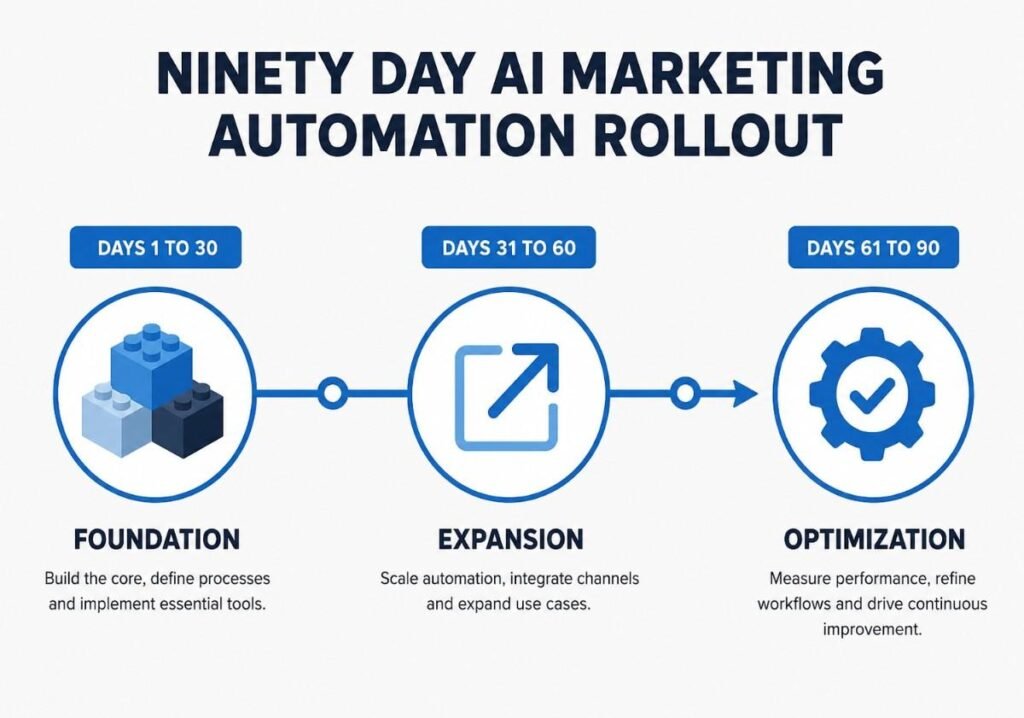
A Ninety-Day Plan for Rolling Out AI Marketing Automation on a Small Budget
Knowing the cost only helps if you also know how to spend it wisely.
Days 1 to 30: Foundation
Clean up your existing contact list, clear out duplicates and dead emails, and get one core automated flow running, usually a welcome sequence or a lead follow-up sequence. Keep the scope narrow on purpose here.
Days 31 to 60: Expansion
Once that first flow is live and you can see open rates and responses, add a second workflow, maybe abandoned cart recovery or a review request sequence. Check results weekly rather than monthly so problems get caught early instead of three months in.
Days 61 to 90: Optimization
Look honestly at what’s working, cut anything with weak engagement, and put that freed up budget back into the flows actually producing results. This is also the natural point to ask whether you’ve outgrown your current plan or platform entirely.
Conclusion
So, is AI marketing automation affordable for small businesses? For most businesses with an existing customer base and a few spare hours a month, the honest answer is yes, especially stacked against the cost of a full-time hire or an agency retainer. The real key to keeping it affordable isn’t the number on the pricing page. It’s matching the tool to your actual size, budgeting honestly for setup and training, and tracking ROI from day one instead of guessing.
Three things worth remembering. First, the true cost includes setup and training, not just the subscription fee. Second, a quick napkin math ROI check tells you more than any vendor’s promise ever will. Third, starting smaller than feels comfortable and upgrading only when needed is the surest way to keep marketing automation for small businesses genuinely affordable over time.
FAQ: People Also Ask
Is AI marketing automation actually affordable for a small business?
Yes, for most small businesses with an existing customer base. Entry-level tools start near free, and mid-tier platforms with real AI features usually run one hundred fifty to five hundred dollars a month, far less than hiring staff or paying an agency retainer for similar results.
What is the average cost of AI marketing automation software?
Costs shift with contact list size and features, generally running from fifty dollars a month for basic tools up to eight hundred dollars or more for advanced platforms. Most small businesses land comfortably in the one hundred fifty to five hundred dollar range.
How long does it take to see ROI from marketing automation?
Email-based flows often show measurable results within two to four weeks. Broader efforts like content or SEO automation usually take three to six months to show up clearly, so patience matters just as much as the tool itself.
Can a very small business with a tiny list use AI marketing automation?
Yes, though the payoff scales with your existing customer base. Businesses with a small but active list often see the strongest relative ROI, since even modest gains show up as a big percentage jump in results.
What hidden costs should I budget for beyond the subscription?
Plan for setup and configuration, contact list cleanup, integration fees with other tools, and the time it takes to learn the platform. A common rule of thumb is adding twenty percent on top of the expected software cost to cover surprises.
Is it cheaper to hire a marketing employee instead of using automation?
Usually not. A full-time marketing hire in the United States often costs fifty thousand dollars or more a year once benefits are included, while a well-chosen automation platform typically costs a small fraction of that in year one.
Do I need technical skills to set up AI marketing automation?
Most modern platforms are built for non-technical users with drag-and-drop workflow builders. A little setup help from a freelancer or the platform’s own support team speeds things along, but it isn’t strictly necessary.
What is the biggest mistake small businesses make with marketing automation budgets?
Picking a pricing tier built for a much larger contact list than they actually have, and signing long contracts before confirming the tool even fits their workflow.






One Comment