AI Search Monitoring Tools: The Essential 2026 Guide
Ask ChatGPT to recommend a product in your category right now. Would your business even come up? For a lot of companies, the honest answer is no, and nobody on the team has noticed yet. That gap is basically the whole reason why use AI search monitoring tools has turned into one of the most common questions marketers and founders are typing into Google this year. People don’t search the way they used to. They ask a question inside ChatGPT, Perplexity, Gemini, or Google AI Overviews and just take the answer they’re given. Rank trackers were built for a different world, one with a page of blue links, and they simply can’t see inside a generated answer.
This guide walks through what AI search monitoring actually does, why it matters more than classic SEO tracking right now, what separates a genuinely useful platform from a flashy dashboard, and how to fold one into a real content or marketing workflow without wasting a budget line on the wrong tool.
What Are AI Search Monitoring Tools
At the simplest level, AI search monitoring tools are platforms that watch how a brand gets mentioned, cited, or described inside answers written by large language models. Instead of checking where a page sits on a results page, they check whether the brand shows up at all inside the sentence an AI assistant actually gives someone.
The mechanics are fairly consistent across platforms, even if the branding differs. A tool fires off a big batch of realistic customer questions at several AI engines on a repeating schedule, then combs through every response looking for brand mentions, competitor mentions, and any source links the AI decided to cite. One way to think about it: this runs something close to a retrieval-augmented generation loop in reverse. Rather than feeding data into a model, it’s querying the model and logging what comes back out.
How AI Search Monitoring Works Behind the Scenes
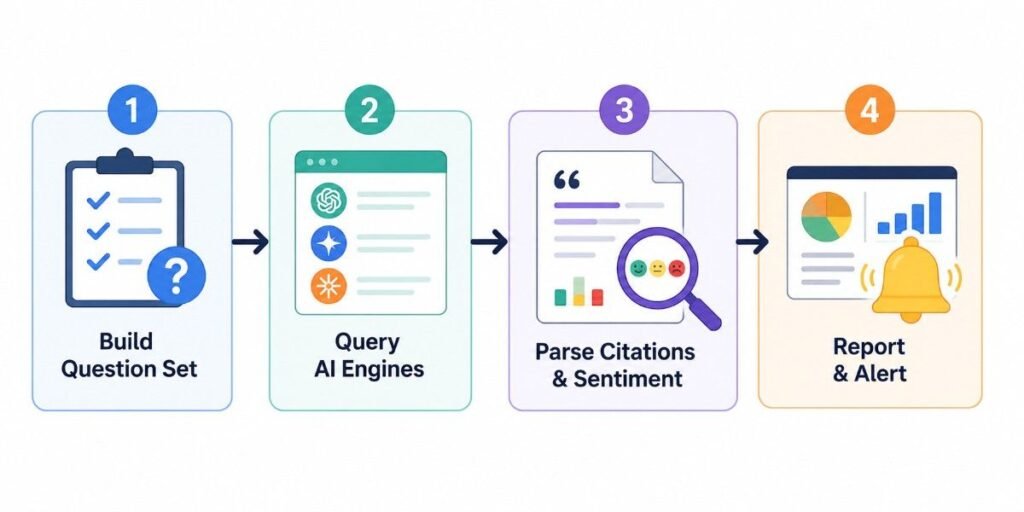
Most tools follow roughly the same four moves.
- They build a question set that mirrors how real buyers actually phrase things in that industry, not just branded search terms
- They send those questions to multiple engines such as ChatGPT, Claude, Gemini, and Perplexity, usually daily or weekly
- They parse every answer for brand mentions, competitor mentions, tone, and cited source domains
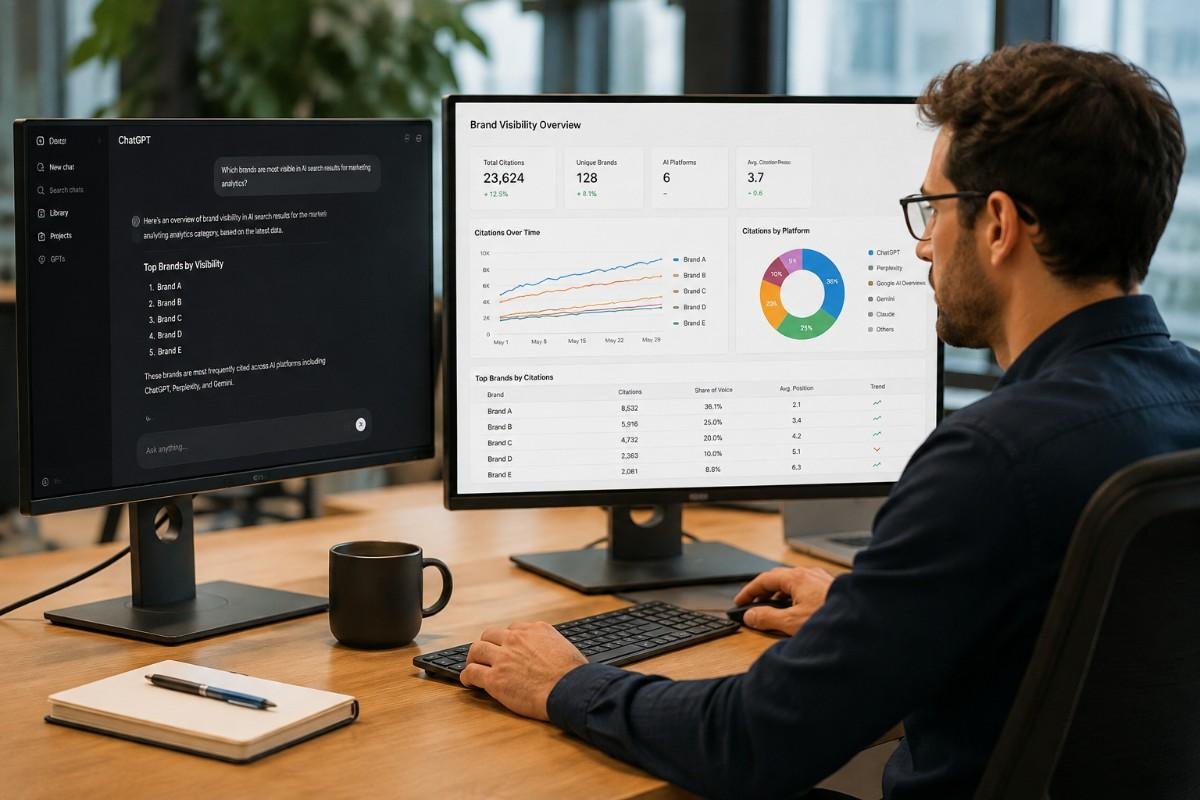
- They score and chart the results over time so a team can tell whether visibility is climbing or quietly slipping
Key Metrics These Tools Track
A decent platform gives you more than a raw mention count. Look for share of voice against named competitors, how often specific domains get cited, the sentiment attached to each mention, and whether the AI actually got its facts right about the brand. A lot of this now falls under the label Generative Engine Optimization, or GEO, which has become shorthand in the industry for shaping content so it gets picked up and cited accurately inside AI answers.
Why Use AI Search Monitoring Tools in 2026
The short version: the place where buyers now form opinions has moved, and most companies’ measurement stack simply didn’t move with it. A handful of forces explain why this is urgent now rather than something to worry about later.
Search volume itself is dropping. Gartner has projected that traditional search query volume could fall by roughly a quarter by 2026 as more people turn to AI assistants for a direct answer instead of a page of links to click through. A team watching only Search Console is blind to the part of the funnel where a growing share of research is actually happening.
Ranking well doesn’t guarantee a citation anymore. Analysts tracking overlap between classic top ten rankings and AI citations have watched that overlap collapse, with some 2026 estimates putting it anywhere from the high teens to the high thirties percent, down from roughly three quarters just a couple of years back. A page can sit at position one on Google and still never appear in the AI answer for that same exact question.
Most brands aren’t even watching this channel yet. Survey data cited across several 2026 industry reports suggests only a small slice of companies, often quoted around sixteen percent, are systematically tracking AI search performance. That’s a real opening for anyone willing to close the gap early.
AI can just get things wrong about a brand, citing old pricing, a discontinued feature, or confusing your company with a similarly named competitor. Monitoring is really the only reliable way to catch that before a prospect does.
Pro tip: treat your first month of monitoring like discovery, not a report card. Most teams are genuinely surprised by which competitor keeps getting recommended in their place, and that discovery alone usually pays for the subscription.
How AI Search Monitoring Differs From Traditional SEO Tracking
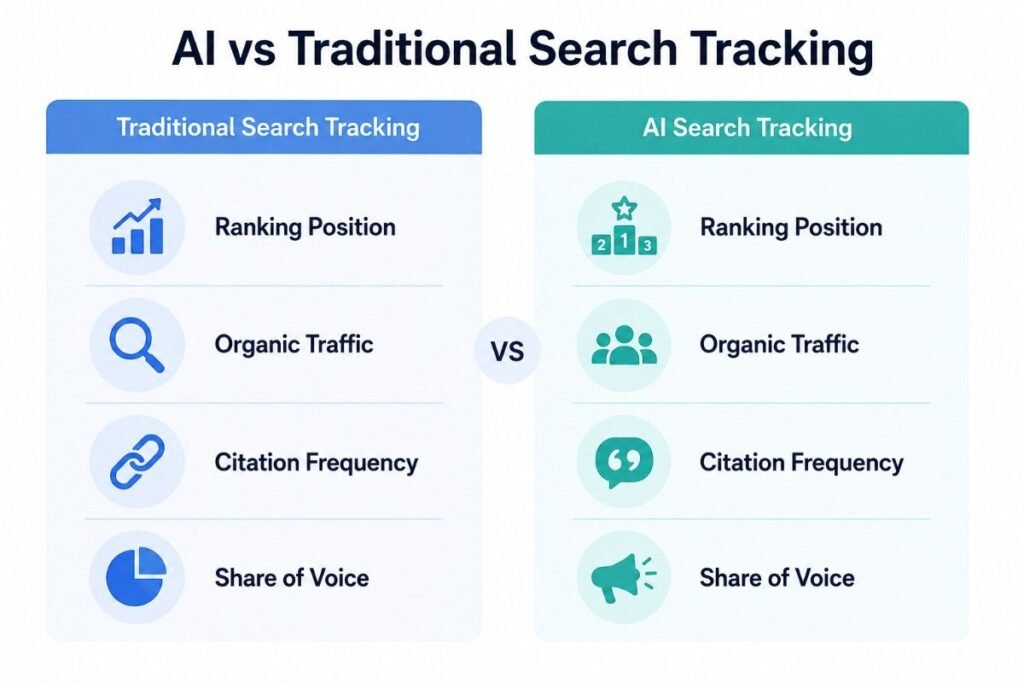
Traditional rank tracking and AI search monitoring are solving related but different problems, and getting clear on that difference matters when you’re building out a measurement stack.
| Factor | Traditional SEO Tracking | AI Search Monitoring |
|---|---|---|
| What it measures | Keyword position on a results page | Brand presence inside a generated answer |
| Primary data source | Google Search Console, rank trackers | ChatGPT, Perplexity, Gemini, Claude, AI Overviews |
| Core metric | Ranking position and organic traffic | Citation frequency and share of voice |
| Update frequency | Daily to weekly crawl cycles | Often daily prompt runs |
| Competitive view | Who ranks above you | Who gets recommended instead of you |
| Content signal | Backlinks and on page keyword usage | Clarity and citability of content for retrieval |
Neither one replaces the other, honestly. A mature marketing team runs both: classic rank tracking to protect organic traffic, and AI search monitoring to protect the newer channel that’s growing faster.
Core Benefits of AI Search Monitoring Tools for Businesses
Protecting Brand Accuracy
When an AI system states the wrong price, mentions a product you discontinued last year, or gets a safety claim wrong, that error can spread across thousands of separate conversations before anyone at the company even notices. Being able to search and analyze themes across recurring AI answers means a team can catch that kind of factual drift early and fix the source content, instead of finding out from an angry customer email.
Measuring Real Share of Voice
Some platforms calculate what percentage of relevant AI answers actually mention a brand compared with its named competitors. That number is basically the AI era version of share of voice in paid media, applied to organic AI presence. And it’s a far more honest read on competitive standing than a handful of top ten rankings ever was.
Informing Content and PR Strategy
Monitoring shows which third party sources an AI engine actually pulls from when it answers a category question. Content and PR teams can use that list to prioritize outreach, guest posts, and structured data updates on the domains the model already trusts, rather than guessing.
Catching Competitive Shifts Early
If a competitor runs a campaign and suddenly starts turning up in AI answers where they never did before, a monitoring dashboard usually flags it within days. That beats waiting on a quarterly brand tracking survey by a wide margin.
Statistic worth noting: research from Seer Interactive found that brands cited inside AI Overviews saw a meaningful lift in organic clicks compared with brands. That weren’t cited at all, which is a good reminder that AI citations aren’t just a vanity number. They actually move traffic.
Key Features to Look for in an AI Search Monitoring Tool
Not every platform on the market covers the same ground, so a short checklist helps narrow things down quickly.
- Coverage of the AI engines your audience actually uses, typically ChatGPT, Gemini, Claude, Perplexity, and Google AI Overviews
- Competitor benchmarking, so you see relative share of voice rather than an isolated mention count sitting on its own
- Citation source tracking that shows exactly which domains the AI is pulling its information from
- Sentiment and accuracy scoring instead of a plain yes or no mention flag
- Alerting so your team learns about a factual error or a sudden competitor gain the same week it happens, not next quarter
- A technical audit layer checking whether AI crawlers can actually access and parse the site to begin with
- Pricing that scales with team size rather than pushing a five person marketing team into a full enterprise contract
Expert Note
Ask any platform you’re evaluating for a short trial covering your own real customer questions before you sign an annual contract. A demo built around generic sample prompts rarely tells you how a tool performs on the specific, niche questions your business actually cares about.
Popular Categories of AI Search Monitoring Platforms in 2026
The market has settled into a few overlapping categories rather than one uniform product type.
Purpose built AI visibility platforms focus entirely on tracking brand mentions and citations across AI engines, often layering in sentiment scoring and a technical audit for AI crawler access. All in one SEO suites have bolted AI visibility features onto existing rank tracking products, which suits teams who’d rather have one dashboard for both channels. High frequency data providers run huge volumes of prompt queries and sell that raw citation data to agencies and larger platforms building their own reporting layer on top.
A market this new is still shaking out. One telling signal came when Profound, a purpose built AI visibility platform, raised a ninety six million dollar funding round at a reported billion dollar valuation in early 2026. Investors clearly expect this category to become permanent marketing infrastructure, not a passing trend.
How to Implement AI Search Monitoring in Your Business
Step 1: Define the Question Set That Actually Matters
Start with the real questions a buyer would ask an AI assistant while researching a purchase, not just a list of branded search terms. A realistic mix of comparison questions, problem based questions, and recommendation requests produces far more useful data than a short list of company name searches ever will.
Step 2: Choose Platforms Based on Where Your Audience Actually Searches
A consumer brand might need heavier coverage of ChatGPT and Gemini, while a technical B2B product could see more influence from Perplexity and developer focused assistants. Match the tool’s coverage to your audience instead of picking whichever platform lists the most engines on its pricing page.
Step 3: Build a Weekly Review Habit
Treat the monitoring dashboard the way your team already treats Google Analytics: a short recurring check, not a one time setup you forget about. A weekly review catches sentiment shifts and competitor gains while they’re still small enough to fix.
Step 4: Feed What You Find Back Into Content
When monitoring shows a competitor getting cited for a topic you should own, that’s a content brief, plain and simple. Update the underlying page, tighten the structured answers, and clarify sourcing so the next crawl has a better shot at surfacing accurate, citable information.
Step 5: Track the Business Outcome, Not Just the Vanity Metric
Citation counts and share of voice are useful, but the real test is whether AI referred traffic actually converts. Tie the monitoring data back to lead source tracking wherever you can, so the whole effort gets justified by revenue rather than mention volume alone.
Common Challenges and Mistakes to Avoid
Treating AI monitoring as a replacement for SEO. Traditional search still drives real traffic for most businesses in 2026, and dropping rank tracking in favor of AI monitoring alone leaves a genuine hole in the funnel.
Trying to chase every AI engine at once. Smaller teams usually get better results going deep on the two or three engines their customers actually use rather than spreading themselves thin across ten platforms.
Ignoring negative or inaccurate mentions. A brand that only skims its mention count without checking sentiment can miss a slow reputational problem building quietly inside AI answers.
Skipping the technical audit. If AI crawlers can’t properly access or parse a website, no amount of great content earns a citation. This is one of the most overlooked reasons brands stay invisible in the first place.
Solution: pair the monitoring software with a quarterly technical crawl check and an actual documented content update cadence, so what you find turns into fixed pages instead of sitting untouched in a dashboard.
Conclusion
AI search monitoring tools exist because how people find answers has genuinely changed, and the old measurement stack just can’t see into that new channel. The reasons to adopt one come down to a few things: protecting brand accuracy inside AI answers, measuring real share of voice against competitors, catching shifts early, and feeding what you learn back into content that actually earns citations instead of losing them. Businesses that start tracking this now, while a lot of competitors still aren’t paying attention, have a real window to build a lasting edge. The next move is simple. Pick two or three AI engines that matter most to your audience, choose a monitoring tool that covers them well, and run your first question set this week.
Frequently Asked Questions
What is an AI search monitoring tool?
It’s a platform that tracks how a brand is mentioned, cited, or described inside answers generated. By AI systems such as ChatGPT, Gemini, Claude, and Perplexity. Reporting on things like citation frequency and sentiment rather than simple rankings.
Why use AI search monitoring tools instead of regular SEO tools?
Regular SEO tools measure where a page ranks on a results page. AI search monitoring tools measure whether a brand actually shows up inside the generated answer, which has become its own, increasingly important visibility channel.
Do small businesses need AI search monitoring?
Small businesses that lean on reputation, local trust, or simply want to be recommended. Over competitors benefit here too, since even a modest citation gain can meaningfully sway a buyer in a niche category.
How often should a brand check AI search monitoring data?
A weekly review is a practical starting point for most teams, with tighter checks during a launch, a PR moment, or a known competitor campaign.
Can AI search monitoring tools fix inaccurate AI answers directly?
No tool can force a model to correct itself instantly, but monitoring surfaces the error fast enough that a team can update the source content and public information the model is likely pulling from.
Which AI platforms should be prioritized for monitoring first?
Most teams start with ChatGPT, Google AI Overviews, and Gemini given their reach, then expand into Perplexity and Claude once a baseline question set and reporting habit are in place.
How much do AI search monitoring tools typically cost?
Pricing varies a lot by scale. Lightweight tools start around usage-based or small monthly plans, while enterprise platforms price by prompt volume, engine coverage, and how many competitors you’re tracking.
Is AI search monitoring only relevant for B2B companies?
Not at all. Consumer brands are affected too, since a growing share of product research. Now happens through conversational AI assistants instead of a traditional results page.