

How to Use AI in Market Research Fast
Here’s a number that surprised me the first time I saw it. Nearly nine out of ten marketing teams already use some form of artificial intelligence somewhere in their research process. And yet most of them are still guessing at the order to do things in. You’ve probably felt this yourself. You open ChatGPT, type in a half-formed question about your industry, and get back something so generic you could have written it yourself. That’s not an AI problem. That’s a sequencing problem.
Learning how to use AI in market research isn’t really about finding the shiniest new tool. It’s about putting the right tool in the right spot at the right stage of a project, from your very first hunch about the market all the way to a finished report someone actually acts on. This guide walks you through the correct sequence for using AI in market analysis; points you toward the best AI tools for market research working well right now in 2026, including several genuinely free AI tools for market research; and hands you real how-to-use-AI-in-market-research examples along with market research AI prompts you can paste straight into a chatbot today.
What Does It Mean to Use AI in Market Research
Before we get into tools, it’s worth pinning down what this actually looks like, because the phrase gets used loosely.
The Traditional Research Process, Briefly
Market research, the traditional kind, starts with a business question, then splits into two paths. Primary research means going out and gathering new data yourself through surveys, interviews, or focus groups. Secondary research means digging through what already exists, competitor filings, public reports, and industry stats. Then comes the part nobody enjoys: sitting down and coding hundreds of responses by hand. That step used to take weeks.
Where AI Actually Fits In
An AI market research tool doesn’t hand you final answers on a plate. What it does is take over the slow, repetitive parts of the job. Reading five hundred survey responses. Scanning thousands of tweets for tone. Summarizing a stack of PDFs nobody wants to read cover to cover. The teams getting real value out of this treat AI like a tireless research assistant, not an oracle. Big difference.
Qualitative vs Quantitative AI Applications
AI for market research really splits into two lanes. One is qualitative, like reading open-ended survey answers or picking up emotional tone in customer complaints. The other is quantitative, forecasting demand or spotting outliers buried in a spreadsheet of numbers. If your research stack only covers one lane, you’re leaving half the picture on the table.
The Correct Sequence for Using AI in Market Analysis
This is the part most guides skip entirely, so let’s actually answer it. What is the correct sequence for using AI in market analysis?
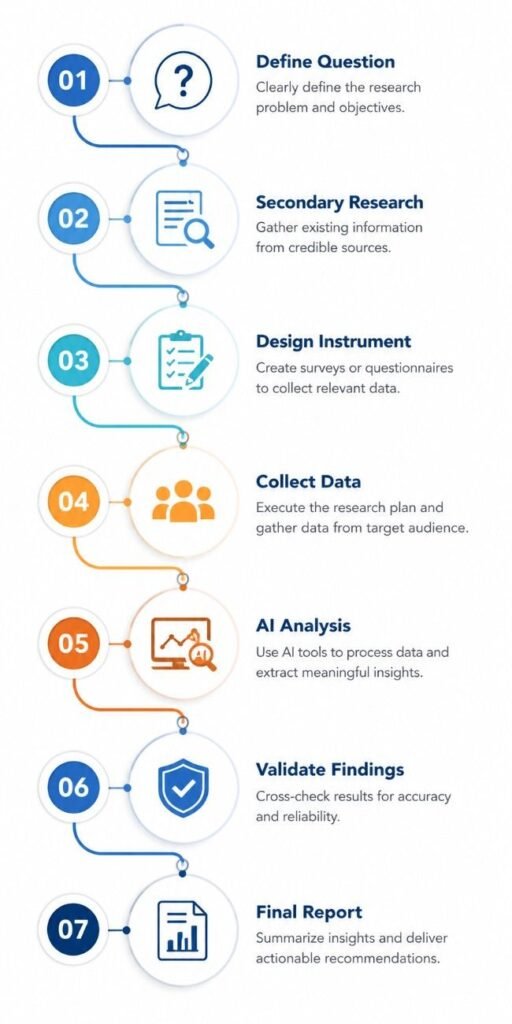
Define the Business Question Before Touching Any Tool
Nearly every wasted research project starts the same way. Someone opens a chatbot before they’ve decided what they actually need to know. Write the question down first, as one sentence. “Should we launch this product in the Midwest?” works. “Tell me about the market” doesn’t.
Use AI for Rapid Secondary Research and Landscape Scanning
Once you know the question, open something built for secondary research. Perplexity AI is a good example here; it pulls current web results with sources attached, which is genuinely useful for mapping competitors and recent industry moves before you spend a dime.
Design Your Primary Research Instrument With AI Assistance
If the question needs fresh data, this is when you bring in a chatbot to draft your survey or interview guide. Let it write the first pass, then edit it yourself. Models tend to sneak in leading language without meaning to, so read every question twice.
Collect the Data Through the Right Channel
AI won’t collect primary data for you. You’ll still need an actual survey platform, a panel provider, or a scheduling tool to reach real people. This is the one place in the sequence where old-fashioned infrastructure still carries most of the weight.
Run AI-Powered Analysis on the Collected Data
Now the specialized tools earn their keep. Something like quantilope for automated statistical modeling, or Claude for chewing through long qualitative transcripts and pulling out the themes that keep showing up.
Validate Findings Against a Second Source
Don’t ship a conclusion off one AI output alone. Check it against a second dataset, a second tool, or a person who actually knows the space. This one habit is the difference between real research and a confident guess.
Synthesize Into a Decision-Ready Report
Last step, and honestly the one AI handles best. Turning pages of notes into an executive summary, a SWOT grid, or a slide outline takes minutes instead of a full afternoon.
Best AI Tools for Market Research in 2026
There’s no single winner here, because these tools solve different problems. Here’s what’s actually doing useful work right now.
Enterprise-Grade Platforms for Structured Research
Qualtrics still covers the broadest ground for large organizations running structured consumer studies, folding survey design, panel access, and AI-powered analysis into one place. Quantilope leans hard into automating quantitative methods like conjoint analysis and MaxDiff, cutting weeks of statistical work down to a few hours.
Competitive and Digital Intelligence Tools
Semrush has become something close to the industry default for SEO-driven competitive intelligence, built around one of the largest keyword and backlink databases out there. That makes it a natural pairing for anyone trying to understand a competitor’s digital footprint alongside its market position. Similarweb fills a similar role, estimating traffic and audience overlap across competitor sites.
Social Listening and Brand Monitoring
Brandwatch is the enterprise standard for social listening at scale, scanning public conversation across social platforms, news outlets, forums, and review sites, then running AI-powered sentiment analysis on top of it. If you need to know what customers are actually saying about a category, not just what competitors claim, this is the kind of tool that fills that gap.
Audience Intelligence Platforms
SparkToro takes a different angle. Instead of telling you what to say, it shows you where your audience already spends time online and who they follow, which turns out to matter a lot when you’re deciding where to run a campaign in the first place.
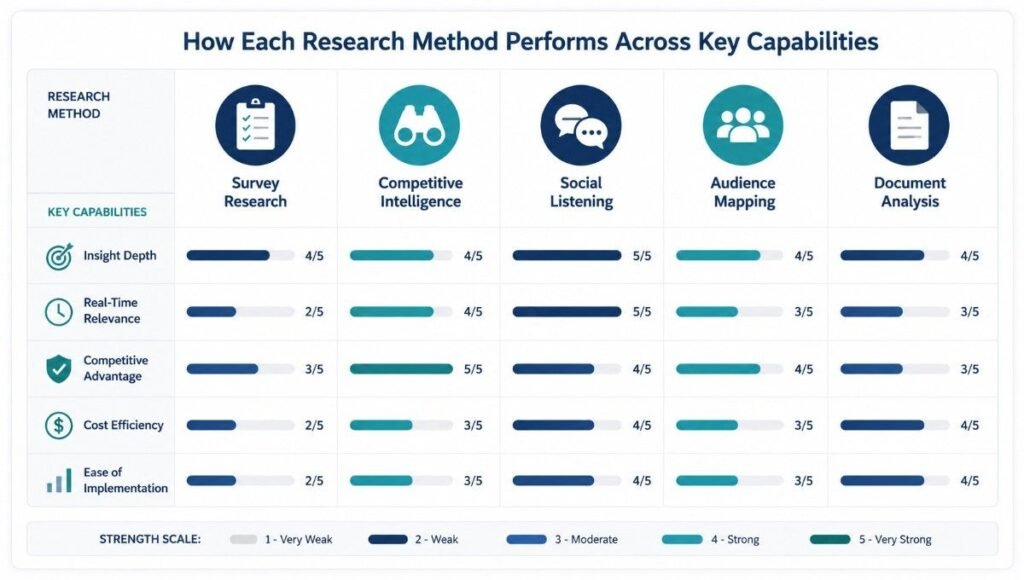
Choosing the Right AI Market Research Tool
| Tool | Best For | Data Type | Starting Cost |
|---|---|---|---|
| Perplexity AI | Fast secondary research with citations | Web, text | Free tier available |
| Qualtrics | Enterprise survey research | Surveys, panels | Custom quote |
| Quantilope | Automated quantitative modeling | Survey, statistical | Custom quote |
| Semrush | Competitive and SEO intelligence | Web, keyword data | Paid, trial available |
| Brandwatch | Social listening at scale | Social, text sentiment | Enterprise pricing |
| SparkToro | Audience and interest mapping | Social, web profiles | Free tier available |
| Claude | Long document and transcript analysis | Text, PDF, qualitative | Free tier available |
Free AI Tools for Market Research You Can Start Using Today
You don’t need an enterprise budget to do real research. Here’s what actually works for the best free AI tools for market research if you’re a solo founder, a freelancer, or a small team stretching every dollar.
General Purpose Chatbots for Synthesis and Drafting
ChatGPT, Claude, and Google Gemini all have free tiers good enough for summarizing reports, brainstorming angles, and drafting a first pass at a survey. Claude in particular is strong with long documents, so if you’ve got a folder full of PDFs or interview transcripts, that’s where I’d start.
Real-Time Research and Fact-Checking
Perplexity’s free tier gives you real-time web search with sources attached right in the answer. That’s a lifesaver when you’re about to drop a statistic into a client deck and want to check if it’s not two years out of date.
Trend Discovery Without a Login
Google Trends costs nothing and shows how interest in a topic, product category, or competitor has moved over time and across regions. It pairs well with whatever qualitative findings you’re already sitting on.
Data to Visualization Without Code
Something like PowerDrill Bloom takes raw spreadsheet exports, survey data, sales numbers, or whatever and turns them into charts and presentation-ready slides without needing a coding background. Handy if your team doesn’t have a dedicated analyst.
Web Scraping Without a Developer
Browse AI lets non-technical users pull structured data off competitor sites, pricing pages, or review pages on a recurring schedule. This used to require a developer and a custom script. Now it’s a few clicks.
How to Use AI in Market Research: Examples From Real Business Scenarios
Theory only gets you so far. Here are real how-to-use-AI-in-market-research examples.
A Local Coffee Shop Deciding Whether to Open a Second Location
An owner used Perplexity to pull demographic and foot traffic estimates for two candidate neighborhoods, then had ChatGPT draft a short survey asking existing regulars where they were commuting from. Secondary data plus one quick primary survey gave a clearer answer than either would have alone.
A SaaS Company Analyzing Churn Feedback
A product team fed several hundred exit survey responses into Claude and asked it to cluster the comments by theme. What looked like scattered, unrelated complaints turned out to circle around a single onboarding problem, something that would have taken a human analyst days to spot by hand.
A Marketing Agency Building a Competitor Snapshot
An agency pulled a competitor’s top-ranking keywords through Semrush, mapped that competitor’s audience through SparkToro, then asked a chatbot to combine both into a one-page brief for a new pitch. What used to take days took an afternoon.
A Consumer Brand Tracking Sentiment After a Product Launch
A brand watched social sentiment through Brandwatch for two weeks after a launch and caught an early complaint pattern about packaging before it spread. They got ahead of it publicly instead of reacting late.
Market Research AI Prompts You Can Copy and Customize
These market research AI prompts work in ChatGPT, Claude, or Gemini. Just swap in your own details.
Prompt for Competitive Landscape Mapping
“Act as a market research analyst. Identify the top five competitors to [your company or product] in the [your industry] space. For each one, summarize their positioning, pricing approach, and one clear weakness based on publicly available information.”
Prompt for Survey Question Drafting
“Write ten survey questions to understand why customers churn from a [type of product] subscription service. Mix multiple choice and open-ended formats, and avoid leading language.
Prompt for Transcript Theme Extraction
“Read the following set of customer interview transcripts and group the recurring themes into no more than five categories. For each category, include two representative quotes and a short summary of the underlying customer need.”
Prompt for SWOT Analysis Generation
“Based on the following notes about [your company], generate a SWOT analysis. Be specific rather than generic, and flag any area where you do not have enough information to make a confident assessment.”
Prompt for Executive Summary Writing
“Summarize the attached research findings into a one-page executive brief for a non-technical stakeholder. Lead with the three most important findings, followed by a clear recommendation.”
Common Mistakes to Avoid When Using AI for Market Research
Treating AI Output as Fact Without Verification
The most common failure, by far, is copying a chatbot’s answer straight into a report without checking it. These models can sound completely confident while being wrong, especially on specific numbers or anything recent.
Skipping the Human Review Step on Sensitive Findings
Anything that’s going to drive real spending deserves a second set of human eyes, especially if the underlying data comes from a small sample or one narrow slice of customers.
Feeding a Tool More Data Than It Can Reasonably Process
Dumping a full year of raw survey data into one chat window usually gets you a shallow summary, not real analysis. Break it into smaller, themed batches and the results get noticeably sharper.
Ignoring Data Privacy When Uploading Customer Information
Check a platform’s data policy before you upload customer transcripts or anything personal. Some free tiers use uploaded content to train future models, which isn’t something you want happening with sensitive customer information.
Conclusion
Doing this well comes down to sequence more than tool choice. Start by nailing down the actual business question. Run secondary research before you go collect anything new. Pick the tool that fits the analysis stage, not just the most talked about one. And always check a big finding against a second source before it reaches someone who’s about to spend money on it. That workflow holds whether you’ve got a full enterprise budget or nothing but free tiers. Pick one small research question this week and run it through the seven steps above, and you’ll already be ahead of most teams doing this right now.
Frequently Asked Questions
What is the best AI tool for market research on a limited budget?
Perplexity AI and Claude both have strong free tiers covering real-time research and document analysis. Pair them with Google Trends, and you’ve got a solid, no-cost stack before you ever pay for anything.
Can AI replace traditional market research entirely?
No. It speeds up analysis and drafting but still depends on real data collection through surveys, interviews, or existing datasets. Think of it as an assistant, not a replacement.
How accurate is AI-generated market research data?
It depends almost entirely on the source data you feed it. Always cross-check an AI summary or forecast against a second source before it drives a real decision.
What is the correct sequence for using AI in market analysis?
Define the business question first, use AI for secondary research, design your primary research instrument with AI help, collect the actual data, run AI-powered analysis, validate against a second source, and then synthesize into a final report.
Is ChatGPT good enough for market research?
It’s solid for drafting survey questions, brainstorming angles, and summarizing findings, but it doesn’t pull real-time citations. Pair it with something like Perplexity for anything that needs current data.
What free AI tools work best for a small business owner starting out?
Google Trends for demand tracking, Perplexity AI for competitor and secondary research, and ChatGPT or Claude for pulling it all together. That combination costs nothing and covers most of what a small team needs.
How do I write good prompts for AI market research?
Be specific about the role you want the model to play, the exact format you need back, and any constraints, like avoiding leading questions or sticking to a word count. Vague prompts get you vague answers every time.
Do I need technical or coding skills to use AI for market research?
Not really. Every tool in this guide, from chatbots to data visualization platforms, is built for a marketer or founder to use directly, no coding required.