
Droven IO AI Automation Tools: Ultimate 2026 Guide
If you’ve typed “Droven.io AI automation tools” into Google recently, you’re probably not looking for a sales pitch. You’re trying to figure out what Droven IO actually offers, whether it’s a real product, and which automation platform is worth your time and budget in 2026. Fair enough. There’s a lot of noise in this space, and most of it comes from vendors describing their own tool as the only one that matters.
This guide skips that. Below you’ll find what Droven IO really is, the categories of AI automation tools it covers, how the major platforms stack up against each other, and a practical way to pick one without wasting a quarter figuring out you chose wrong.
What Is Droven IO?
Here’s the part that surprises a lot of readers. Droven IO isn’t a piece of software. There’s no login screen, no dashboard, no monthly invoice. It’s an editorial site that publishes guides, comparisons, and workflow breakdowns across technology and business topics.
That makes it closer to an independent research desk than a vendor. Its job isn’t to sell you an automation tool; it’s to point you toward the one that actually fits your situation, whether that’s Zapier, Make, n8n, or something else entirely.
This distinction trips people up constantly. A reader searching for Droven IO AI automation tools often assumes Droven IO builds the automations itself, the same way n8n or Zapier does. It doesn’t. And honestly, that’s a good thing, because it means the recommendations aren’t quietly biased toward one product line.
A few reasons this matters when you’re comparing options:
- Vendor blogs almost always favor their own tool, even when a competitor is the better fit
- A neutral starting point saves you from a costly platform switch six months in
- Understanding what a source actually is (editorial vs. product) changes how much weight you give its claims
Quick tip: Before you look at a single platform, write down the three tasks eating the most hours in your week. That short list becomes the filter every tool has to pass.
What “AI Automation” Actually Means
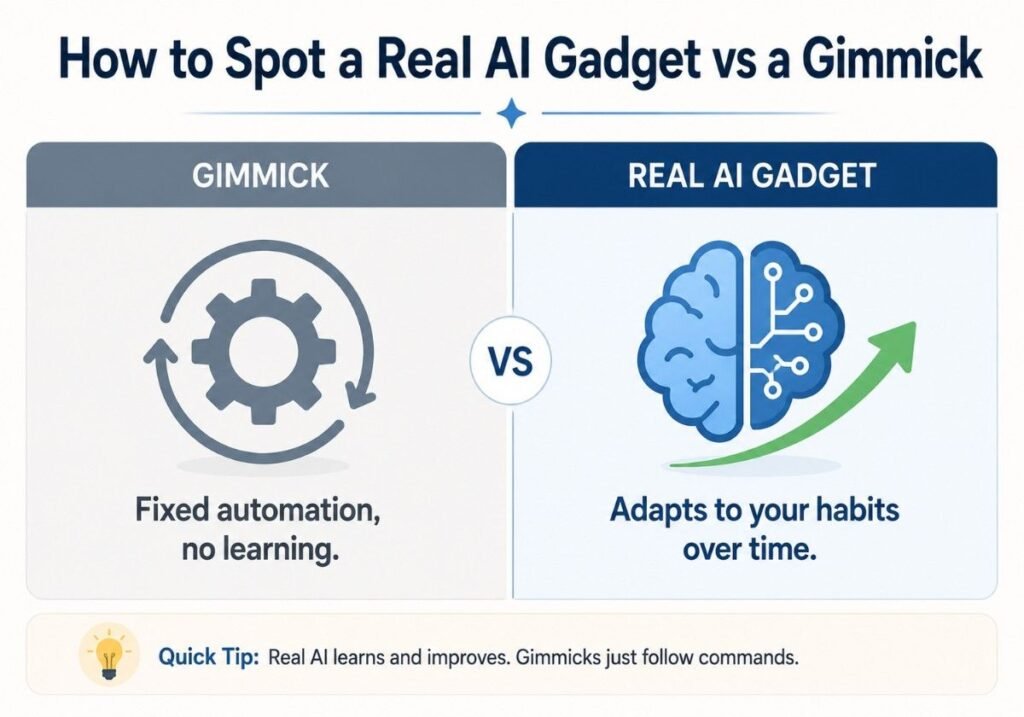
Old-school automation software runs on fixed rules. If X happens, do Y. Nothing smarter than that, and nothing that adapts when the input changes shape.
AI automation tools work differently. They layer machine learning and natural language processing on top of those same trigger and action workflows so the system can read unstructured text, guess at intent, and make a judgment call instead of just following a script. Wikipedia’s entry on robotic process automation traces this shift from rigid rule-based bots toward systems that increasingly lean on machine learning for the judgment-heavy parts of a job. That’s the real line between old automation and what people mean today when they say intelligent workflow automation.
| Aspect | Rule-Based Automation | AI Automation |
|---|---|---|
| Logic | Fixed if this then that rules | Learns patterns from data |
| Flexibility | Breaks when inputs change | Adapts to new formats |
| Best for | Repetitive, structured tasks | Judgment heavy, unstructured tasks |
| Setup effort | Low, but rigid | Higher, but scales better |
| Example | Move an email into a folder | Read the email, summarize it, draft a reply |
A handful of terms come up over and over in this space, and it’s worth knowing them before you start demoing tools: large language models, retrieval-augmented generation, vector databases, and AI agents. The underlying models powering most of this, OpenAI, Anthropic, and Google Gemini, aren’t things these automation platforms built themselves. They’re plugged in.
The Categories Droven IO Style Guides Usually Cover
Not every automation platform is trying to solve the same problem, so lumping them together doesn’t help anyone. Guides in this space tend to split them into a few practical buckets.
No-code workflow builders let non-technical staff connect apps through a visual interface without writing a line of code. Zapier, Make, and n8n dominate here, though each one handles AI a little differently under the hood.
Robotic process automation (RPA) tools like UiPath were built for structured, high-volume tasks across legacy software, often in regulated industries like banking, where someone used to click through the same five screens by hand every single day.
AI agents and copilots are the newer category, and they’re shifting the whole conversation from single-step automations toward systems that plan and execute several steps on their own. GoHighLevel’s AI employee feature and Zapier Agents both live here.
Custom LLM pipelines offer the most control, connecting straight into an API like OpenAI’s or Anthropic’s, but they also demand real development resources to build and keep running.
Most businesses don’t need that last option on day one. Starting with a no-code platform and graduating to custom development once volume actually justifies it tends to be the smarter, cheaper path.
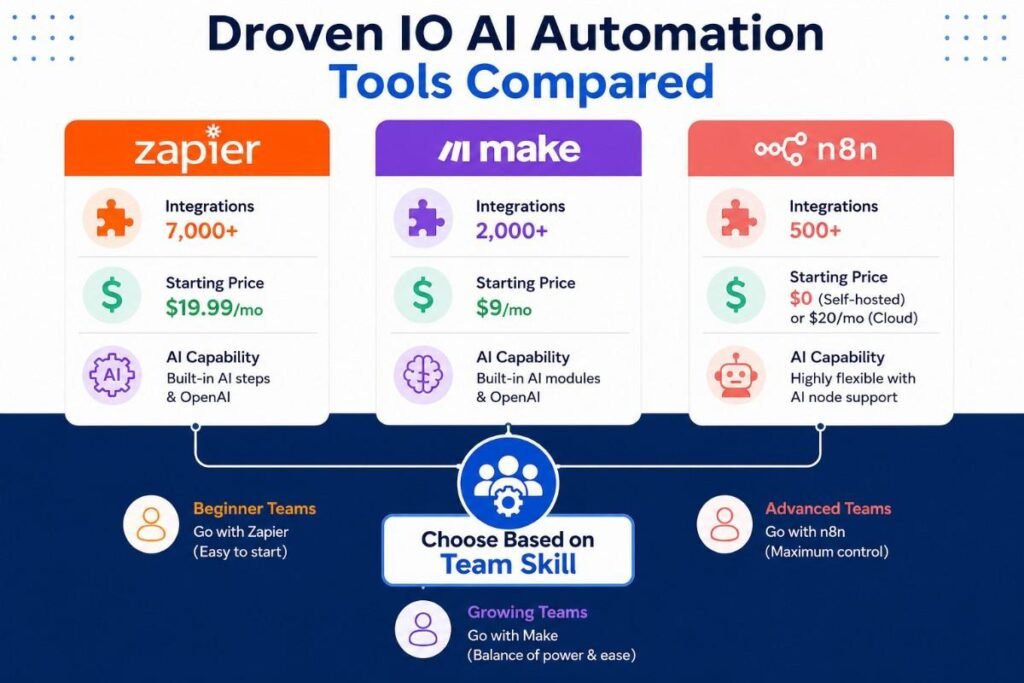
How the Top AI Automation Tools Compare
Since a neutral guide is really about comparing real platforms rather than pushing one, here’s where the leading AI workflow automation tools stand heading into the back half of 2026.
| Feature | Zapier | Make | n8n |
|---|---|---|---|
| App integrations | 7,000+ | 3,000+ | 400+ built in, plus custom code |
| Best for | Non-technical teams | Mid-complexity workflows | Developer teams, regulated industries |
| AI capability | Zapier Agents, AI Copilot | Maia AI builder, agent tools in beta | Native LangChain integration, 70+ AI nodes |
| Self-hosting | No | No | Yes |
| Starting price | Roughly $19.99 to $29.99 a month | Around $9 a month | Free self-hosted, paid cloud tiers |
| Pricing model | Per task | Per operation credit | Per workflow execution |
Here’s a number worth sitting with. For a ten-step workflow running ten thousand times a month, n8n’s per-execution pricing can end up 80 to 90 percent cheaper than Zapier’s, simply because Zapier bills every single action inside a workflow as its own task.
None of these three wins across the board. Zapier is the easiest to pick up and connects to the most apps. It sits in the middle on both price and complexity. n8n has the deepest AI agent architecture, and it’s the only one of the three you can self-host, which matters a lot if you’re in healthcare, finance, or anywhere else with strict data residency rules.
For larger organizations already living inside Microsoft 365 or Google Workspace, Microsoft Copilot or Google Gemini for Workspace often integrate more tightly than a standalone platform ever could. And when a process spans several legacy desktop apps that were never built with an API in mind, UiPath is usually still the go-to.
Where These Tools Actually Get Used
The real payoff from AI automation tools rarely shows up as one big company-wide rollout. It shows up department by department, usually starting small.
Support teams lean on AI to sort incoming tickets, summarize long back-and-forth threads, and draft first response suggestions, which frees agents to focus on the handful of cases that actually need a human. Sales reps use it to knock out meeting summaries, follow-up emails, and lead scoring, work that used to eat an hour after every single call. HR teams apply it to resume screening and candidate matching, shaving real time off the hiring process without adding headcount. Finance departments run it against invoices to catch duplicate payments and flag anomalies a monthly manual review would probably miss. Marketing teams use it to spot which content is actually driving engagement instead of waiting on a report that lands a week too late.
Businesses with a lot of repetitive, rule-based work, think lead routing, invoice processing, and content scheduling, tend to see the fastest and clearest return on investment here.
Picking the Right Tool Without Overthinking It
Start by mapping your single highest-cost manual process. Look for the task that eats the most hours relative to how simple it actually is. Data entry, document review, and email triage are usually the first ones people find.
From there, match the platform’s complexity to your team’s actual skill level. A team without developers should start with Zapier or Make. A team with engineers on staff and real data privacy requirements should take a hard look at n8n’s self-hosted option.
Clean up your data before you automate anything. AI automation is only as good as what you feed it, and scattered or outdated records will produce inconsistent results no matter how good the platform is.
Then pilot before you scale. Run one workflow in one department for thirty to sixty days. Measure hours saved and error rate. Expand only once the numbers actually back it up.
And build in a human checkpoint. Even the most capable AI automation tools should leave room for a person to review edge cases, compliance-sensitive decisions, and anything customer-facing that could do real damage if it goes sideways.
Mistakes That Sink These Projects
The single most common mistake is picking a tool first and working backward to justify it, instead of starting from an actual bottleneck. Close behind that is ignoring total cost at scale. A platform that looks cheap at low volume can get expensive fast once task counts climb, so model pricing against your expected volume six months out, not where you are today.
Skipping employee training kills more rollouts than a bad tool choice ever does. People need to understand not just how to use the new workflow but where its limits sit. And automating a process that was already broken just makes the same mistakes happen faster. Fix the process first. Automate it second.
Where This Is Heading
The whole space is moving from single-step triggers toward autonomous AI agents that plan and run multi-step workflows with minimal hand-holding. n8n’s 2.0 release added persistent agent memory and vector database support for retrieval-augmented generation. Zapier rolled out Zapier Agents for autonomous task execution across thousands of connected apps. “Make,” added Maia, a conversational assistant that builds entire scenarios from plain-language instructions.
The direction is consistent no matter which platform you look at: less manual configuration, more natural language control, and agents coordinating several tools at once instead of running in isolation.
Conclusion
Choosing among Droven.io AI automation tools starts with one correction most people need to make first: Droven IO is a guide, not a product. The real decision is matching a platform, Zapier, Make, n8n, or an enterprise tool like UiPath, to your team’s technical skill, your budget, and whatever manual process is costing you the most time right now. Start with one pilot workflow. Measure it honestly. Scale only what earns it. The businesses pulling ahead in 2026 aren’t the ones using the most AI; they’re the ones using the right AI in the right place, with a person still checking the important calls.
If you’re ready to move past research, list your three most time-consuming weekly tasks and test a single platform against that shortlist before you commit to anything company-wide.
Frequently Asked Questions
What are Droven IO AI automation tools?
“Droven IO AI automation tools” refer to the AI-driven platforms and frameworks that Droven IO covers in its guides, including workflow builders like Zapier, Make, and n8n; RPA software like UiPath; and AI agent tools, rather than a single product Droven IO sells itself.
Is Droven IO a software company?
No. Droven IO functions as an editorial and knowledge platform publishing strategy guides and tool comparisons. It doesn’t offer a subscription-based automation product with its own dashboard.
Which AI automation tool is best for small businesses?
Zapier is generally the easiest starting point for small businesses without technical staff, thanks to its no-code interface and broad app support, while Make offers a similar experience at a lower entry price for slightly more complex workflows.
Is n8n better than Zapier for AI workflows?
For teams that need deep AI agent capability, self-hosting, or strict data privacy, n8n is typically the stronger technical choice. For teams that prioritize speed and simplicity over customization, Zapier remains the easier option.
How much do AI automation tools cost?
Pricing varies widely by platform and usage volume. Entry tiers for tools like Make start around nine dollars a month, while Zapier’s professional tier starts near twenty to thirty dollars a month, and n8n can be self-hosted for free with paid cloud tiers available.
Can AI automation tools replace human employees?
AI automation tools are generally designed to remove repetitive manual work rather than replace judgment-heavy roles entirely. Most implementations work best when AI handles routine tasks and humans review complex or sensitive decisions.
How long does it take to see ROI from AI automation?
Many businesses see measurable return on investment within three to six months of a focused pilot, particularly when automation targets a single high volume, repetitive process rather than an entire department at once.
Do AI automation tools require coding skills?
No code platforms like Zapier and Make require no coding at all. n8n supports both no-code building and custom JavaScript or Python for teams that want deeper control over their workflows.