
Why Is AI So Popular Now? The Real Reasons Explained
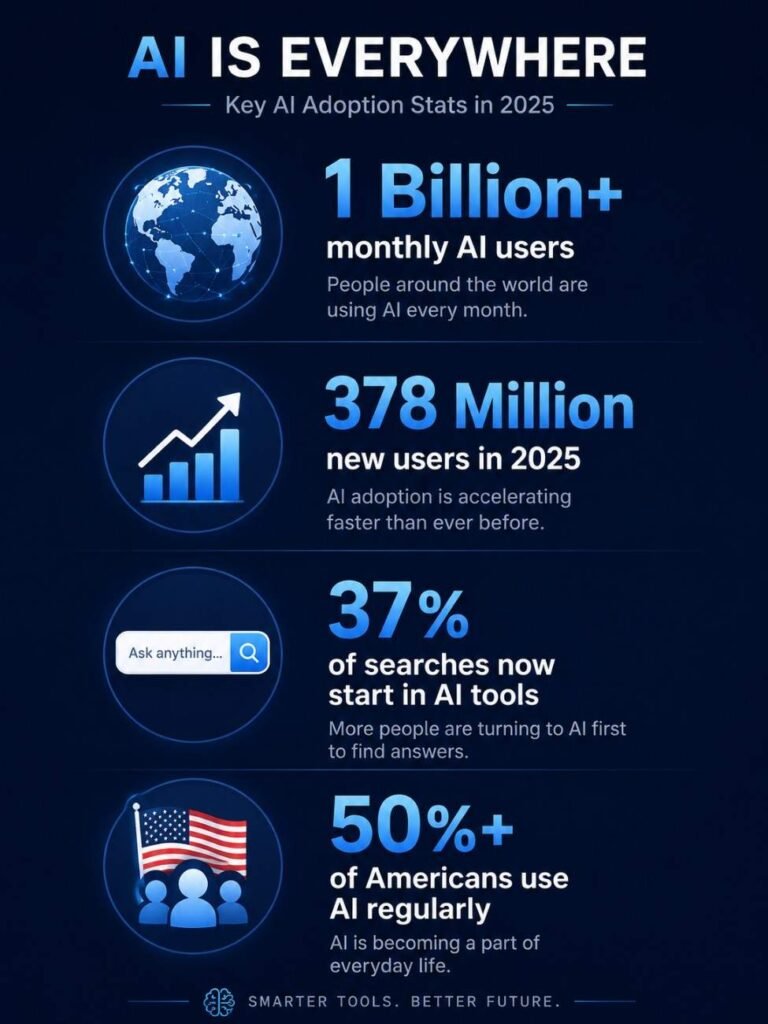
A billion people. Every month. That’s how many humans are now opening some kind of AI tool on a regular basis, and that number is climbing faster than almost anything tech has ever thrown at us. So why is AI so popular now, after sitting in research labs for decades doing basically nothing anyone cared about? Simple. It got easy. It got useful. And it showed up everywhere at once: your phone, your laptop, your car dashboard, and your cousin’s group chat.
This didn’t happen because of one lucky product launch. Better models, cheaper computing, and dead-simple interfaces—all of it landed around the same time. In this guide you’ll get the real triggers behind the boom, who’s actually using this stuff daily, what the U.S. numbers say, and where this is probably headed. Thinking about jumping in yourself? Good. Keep reading.
What Sparked the Sudden Rise of AI
AI’s been around since the 1950s. So why the sudden explosion now, not in 1997, not in 2010? Three things collided.
The ChatGPT Moment
Old AI tools needed a manual. New ones need a sentence. That shift, typing plain English into a box and getting something useful back, is what cracked the whole thing open. No coding. No onboarding call with IT. Just type, get an answer, and move on with your day.
Massive Jumps in Model Quality
Early versions were the intern who means well but keeps getting the math wrong. Painful. Now? They write clean code, hold a thread across a forty-message conversation, read a screenshot, and catch their own mistakes half the time. Reliability breeds trust. Trust breeds a habit. And a habit is what turns a gimmick into infrastructure.
Falling Costs and Wider Access
You used to need a research budget to run anything powerful. Now it’s a phone and a Wi-Fi signal. Free tiers, browser extensions, and AI baked directly into your email and spreadsheets. The last real barrier, cost, basically evaporated.
Why Has AI Become So Popular: The Core Drivers
Forget the technology for a second. Why AI has become so popular really comes down to boring, human stuff: time, money, and convenience.
It saves time on repetitive work.
Nobody’s obsessed with neural networks. People are obsessed with not writing that email themselves. Summaries, drafts, quick answers, and the tasks nobody enjoys—that’s the sweet spot. Workers were quietly using this stuff before their company even had a policy on it. On top of that, once you save two hours once, you don’t go back.
It Works Across Nearly Every Industry
A nurse uses it to summarize charts. A guy running a lawn care business uses it to write flyers. A CS student uses it to debug at 2 a.m. Same tool, wildly different lives. That kind of range is rare, and it’s a huge reason adoption spread sideways instead of staying stuck in one corner of tech.
Competition Between Major Tech Companies
One company shows the world there’s demand, and suddenly every major player is sprinting to ship their own version. Prices drop. Features multiply. Visibility goes everywhere: your keyboard, your search bar, and your notifications. Wait, there’s also the fact that avoiding it now takes actual effort.
Search Behavior Is Changing
Around 37 percent of people now start their searches inside an AI tool instead of a traditional search engine. That’s not a rounding error. That’s a habit migrating in real time.
Who Is Actually Using AI Right Now
The early crowd was engineers and hobbyists poking around out of curiosity. Not anymore.
Everyday American Adults
Roughly one in five American adults now relies on AI daily. That’s not a niche. That’s a pattern, the same kind that showed up when smartphones stopped being a gadget and became a body part.
Younger Generations Lead the Curve
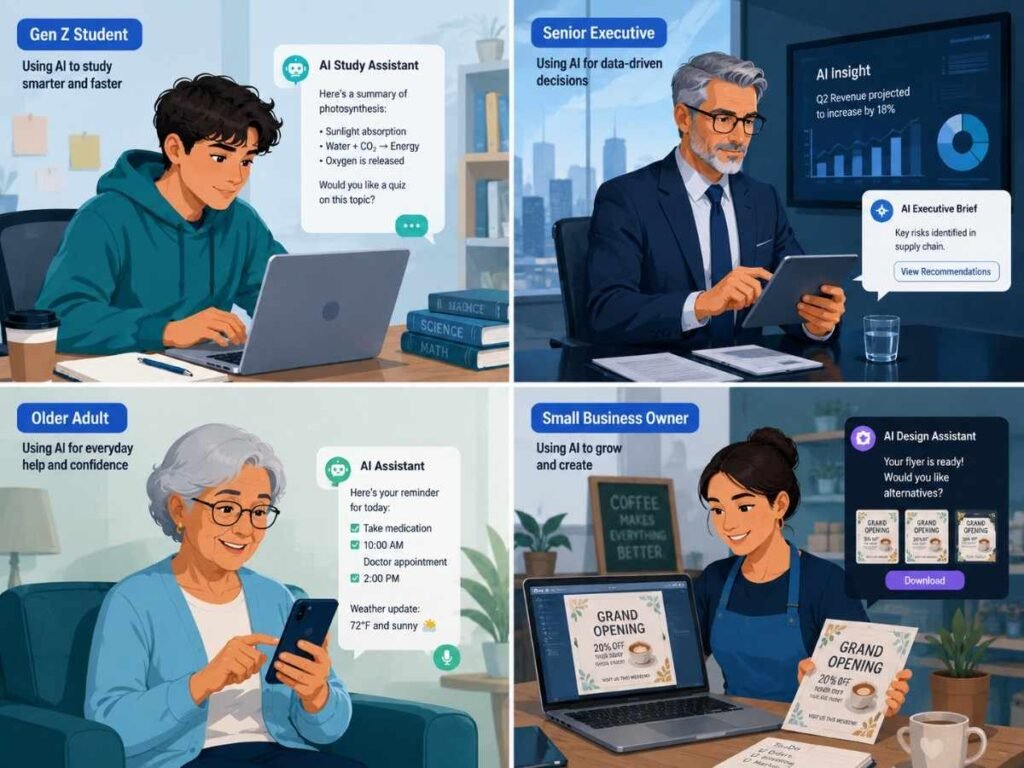
Gen Z and millennials make up the bulk of active users worldwide, and honestly, that tracks. They grew up swiping into new apps without flinching. Older generations are catching up, slower, but steady. The daily habit gap is real, though. It’s not closing overnight.
Professionals Across Every Career Level
Junior employees automating grunt work, sure. But senior leadership, too, is prepping for board meetings, sanity checking numbers, and brainstorming before a big call. What started at the bottom climbed fast.
How Businesses Are Using AI to Gain an Edge
Curiosity got people through the door. Money is what kept the lights on.
Faster Decision Making
Companies now chew through data in minutes that used to take days. In a competitive market, being first to notice a shift can be the whole ballgame.
Lower Operating Costs
Support tickets, data entry, and first-draft copy automate the boring parts and free up humans for the parts that actually need a human. That math is hard to argue with.
Competitive Pressure to Adopt
A large majority of organizations already lean on generative AI in at least one part of the business, clearly reflecting the growing AI purpose in modern operations. This is up noticeably from the year before. Once your competitor speeds up, you speed up—or you fall behind. There’s not much middle ground there. A large majority of organizations already lean on generative AI in at least one part of the business, up noticeably from the year before. Once your competitor speeds up, you speed up. Or you fall behind. Not a lot of middle ground there.
Comparison Table: Consumer AI Use vs Business AI Use
| Factor | Consumer AI Use | Business AI Use |
| Main Goal | Save personal time | Cut costs, boost output |
| Typical Tools | Chatbots, writing helpers | Automation platforms, analytics |
| Adoption Speed | Fast, driven by curiosity | Steadier, driven by ROI |
| Biggest Hangup | “Can I trust this answer?” | “Will this plug into what we already have?” |
| Who’s Using It | Students, freelancers, everyday folks | Whole teams, whole departments |
AI Popularity by the Numbers: A Data Snapshot
Skip the opinions. Here’s the math.
Global User Growth
AI tools reached 378 million people worldwide in 2025, the biggest year-over-year jump ever recorded, with 64 million new users added in just that stretch. That’s more than triple the 116 million users from just five years back. Nothing else in consumer tech grows like that. Nothing.
Monthly and Weekly Active Users
Over a billion people use some AI tool monthly now, roughly one in six working-age humans on the planet. Nearly nine in ten organizations have adopted AI somewhere, though only about a third have actually scaled it. Adoption’s ahead of maturity. Worth remembering.
United States Specific Adoption
More than half of Americans say they use AI regularly. About a quarter interact with it several times a day, and another quarter check in daily or a few times a week. This isn’t a phase anymore.
Concerns Holding Some People Back
Not everyone’s on board. Fair enough.
Accuracy and Trust Issues
AI can sound completely confident while being completely wrong. That combination makes people nervous, rightfully.
Job Security Worries
It depends on who you ask, and honestly, depends what industry you’re in. Some worries are legit. Some are overblown.
Data Privacy Questions
Feed sensitive info into a chatbot, and you’re trusting a company you’ve never met with it. Companies handling client data move carefully here, and they should.
What Comes Next for AI Adoption
The trend line points one direction. Competition keeps pushing quality up and costs down. Younger users keep pulling the average up as they age into bigger roles. Businesses seeing real returns aren’t walking that spending back, not a chance. The next stretch probably looks less like “opening an app” and more like AI just being there, quietly, inside tools you already use, barely visible until you notice it’s doing half your work.
Conclusion
So, why is AI so popular now? Accessibility, real usefulness, and a genuine leap in quality, all landing at once. Three things worth carrying with you: it went mainstream because the technical wall came down, both individuals and companies stuck with it because it saves real time and real money, and none of the growth curves are flattening yet. If you haven’t tried it, there’s no better week than this one to start. Pick one annoying task off your plate. See what happens.
Frequently Asked Questions
Why is AI so popular now compared to a few years ago?
Because it got usable. Chat-style tools killed the learning curve, models stopped embarrassing themselves, and access went nearly free through phones and browsers. Stack those three together and the barriers just, well, disappear.
Why has AI become so popular with businesses specifically?
Cost cuts and speed. Once early adopters proved it paid off, competitors felt the heat and followed. Fast. That’s the whole snowball, right there.
Is AI popularity just a temporary trend?
Doesn’t look like it. Steady year-over-year growth, rising business spend, and improving accuracy—that combination usually signals something sticking around, not fading out.
What age group uses AI the most?
Younger adults, hands down, especially Gen Z and millennials. Older users are catching up but at a noticeably slower clip.
Do most Americans actually use AI regularly?
More than half report regular use, with a solid chunk checking in multiple times daily. Not overstated.
What is the biggest reason people avoid using AI?
Trust, mostly. Accuracy worries, privacy worries, job worries—all three swirl together and make some people hang back even as everyone around them dives in.
Which industries use AI the most today?
Tech, finance, marketing, healthcare. These sectors can actually measure the payoff, which makes the decision to adopt a lot easier to justify.
Will AI replace jobs because of how popular it has become?
More likely job changes than job losses, at least for most roles. AI’s mostly playing the role of an assistant right now, handling the repetitive stuff so people can focus on what actually needs a brain.