Understanding Oil Production Tools and Equipment
Global spending on oilfield equipment now tops 128 billion dollars a year, and none of that money is spent guessing. Every barrel of crude that makes it to a refinery has passed through a long chain of oil production tools built for one purpose: pulling hydrocarbons out of the ground without wasting them, spilling them, or hurting anyone in the process.
This guide walks through what oil production tools actually are, how they differ from drilling equipment, and which machines show up at each stage of the upstream process. You’ll get a full oil production tools list, a look at crude oil production tools, the tools used in oil and gas industry work worldwide, a side by side comparison of land and offshore rig gear, and a rundown of the leading oil drilling equipment companies in 2026.
What Are Oil Production Tools and Why They Matter
Definition and Scope
Oil production tools cover the machinery, hardware, and instrumentation used to bring crude oil out of a reservoir and move it toward a collection point. Wellheads, pumps, separators, valves, and the control systems that keep pressure in check all fall under this umbrella. The term is broader than drilling equipment because it spans the entire working life of a well, not just the hole boring stage.
An oilfield doesn’t work as a pile of standalone machines. It works as a system. A wellhead is useless without a functioning downhole assembly beneath it, and a separator does nothing without pipe feeding it fluid. People in the industry usually split operations into three phases: upstream (exploration and production), midstream (transport and storage), and downstream (refining and distribution). Production tools live almost entirely in the upstream phase, though a handful, storage tanks being the obvious example, bleed into midstream work.
How Oil Production Tools Differ From Drilling Tools
Drilling tools build the wellbore. Production tools keep it flowing once oil has actually been found. A drill bit gets retired the moment a well hits total depth. A sucker rod pump might keep running for a decade after that. Still, the two categories blur together on an active site, since a rig moving from drilling into completion reuses much of the same surface setup, the derrick included.
A simple way to tell them apart:
- Drilling tools cut, circulate, and stabilize the hole (bits, drill collars, mud motors)
- Production tools lift, control, and measure fluid once the well is completed (pumps, chokes, meters)
- Completion tools bridge the two, sealing the well and prepping it for long term flow (packers, tubing, perforating guns)
The Economic Weight of the Oil Equipment Industry
Blackridge Research puts the global oilfield equipment market above 128 billion dollars, with North America holding the largest regional share. That scale is why so many specialized manufacturers exist, everything from giants like Baker Hughes and Schlumberger down to small shops that only make custom valves. A quick look at Wikipedia’s page on oil wells shows just how many distinct parts a single well needs, right down to the casing string and the wellhead valve tree.
The Complete Oil Production Tools List for Every Stage
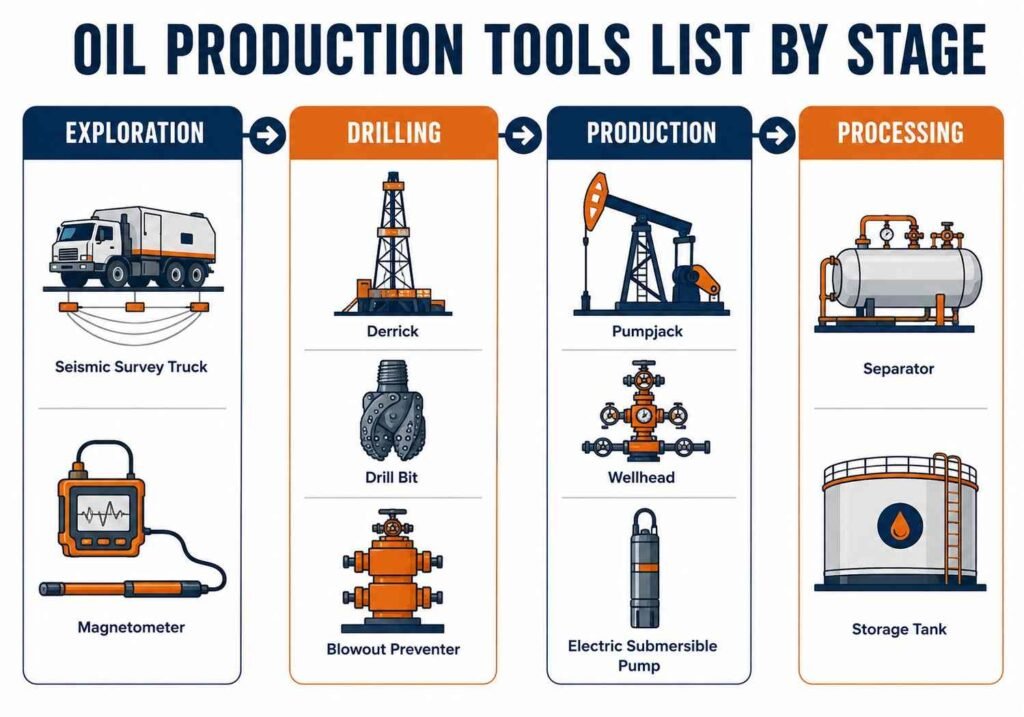
A useful oil production tools list should follow the actual timeline of a well instead of grouping items at random. Here’s a stage by stage version.
Exploration Stage Tools
Before anyone drills a hole, geologists and engineers lean on:
- Seismic survey equipment for mapping subsurface rock
- Gravimeters and magnetometers to spot density anomalies
- Core sample analyzers to check porosity and permeability
- Geosteering software paired with logging while drilling (LWD) sensors
Drilling Stage Tools (Oil Rig Equipment List)
This is the part most people picture when they think about oil work. A standard oil rig equipment list typically includes:
- The derrick, which holds the drill string upright above the wellbore
- Drawworks, the hoisting system that raises and lowers pipe
- The rotary table or top drive, which spins the drill string
- Drill bits, ranging from roller cone to PDC (polycrystalline diamond compact) designs
- Mud pumps, which push drilling fluid down the pipe and back up through the annulus
- Blowout preventers (BOP), the valve stack that seals the well in a crisis
- Shale shakers and mud cleaners, which strip solids out of returning fluid
Production Stage Tools (Crude Oil Production Tools)
Once a well is completed, a different lineup of crude oil production tools takes over:
- Wellhead and Christmas tree assemblies, which manage flow at the surface
- Sucker rod pumps and pumpjacks for artificial lift in lower pressure wells
- Electric submersible pumps (ESPs) when higher volume lift is needed
- Gas lift valves, which inject gas into tubing to reduce fluid density
- Production packers, which isolate zones inside the wellbore
- Flow meters and pressure gauges for ongoing monitoring
Processing and Storage Tools
Crude almost never leaves a field in raw form. Surface facilities rely on:
- Separators that split oil, gas, and water using gravity or centrifugal force
- Heater treaters, which apply heat to break up emulsions
- Storage tanks, usually built to API 650 specifications
- Custody transfer meters, used to measure volume for billing
Tools Used in Oil and Gas Industry Operations: Categories Explained
Sorting the tools used in oil and gas industry work by function, rather than by well stage, makes comparing equipment across operators a lot easier.
Surface Equipment
Surface equipment is everything visible above ground: the derrick, pumpjack, wellhead, tanks, and piping manifolds. This gear takes a beating from weather and needs regular inspection, especially in cold regions where freezing can crack valves.
Downhole Equipment
Downhole tools sit inside the wellbore itself. Casing, tubing, packers, and logging tools all belong here. Because pulling something back out is expensive, downhole equipment is built for long service life and corrosion resistance, often using chrome or duplex steel in high sulfur environments.
Well Control Equipment
Well control is the safety backbone of the whole operation. Blowout preventers, choke manifolds, and kill lines exist for one reason: stopping an uncontrolled release before it happens. In the United States, the Bureau of Safety and Environmental Enforcement requires strict testing schedules for this category.
Monitoring and Automation Tools
Modern fields lean more and more on digital oilfield technology. SCADA systems, remote pressure sensors, and predictive maintenance software now sit right beside the mechanical gear. Fields that adopted automation early have reported real drops in unplanned downtime, based on several industry equipment reports.
Drilling Rig Equipment Breakdown
Rotary Drilling Rig Components
A rotary rig is still the standard setup for most onshore wells. Its core pieces include the mast or derrick, the rotary table, the swivel, and the traveling block. The swivel connects the spinning drill string to the stationary mud hose, letting fluid circulate while the pipe turns freely underneath it.
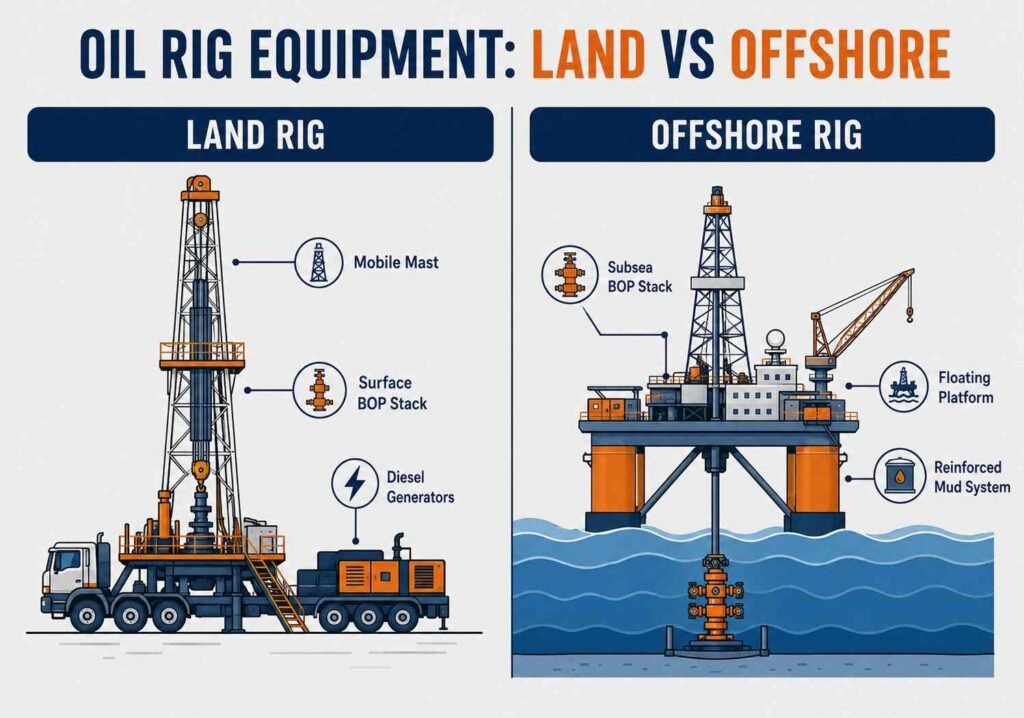
Land Rig vs Offshore Rig Equipment
| Equipment Category | Land Rig | Offshore Rig |
|---|---|---|
| Primary structure | Mobile mast, easy to relocate | Fixed platform or floating drillship |
| Power source | Diesel generators on site | Combined diesel electric or turbine systems |
| Well control | Surface mounted BOP stack | Subsea BOP stack on the seabed |
| Mud handling | Standard shale shakers and pits | Reinforced systems rated for higher pressure |
| Typical depth range | Up to 20,000 feet | Often past 30,000 feet in deepwater |
| Mobility | High, can move in days | Low, platforms are semi permanent |
| Crew size | 15 to 25 workers per shift | 100 or more on a platform |
Offshore rigs need heavier duty versions of almost every tool on a land site, mostly because of pressure, seawater corrosion, and the extra complexity of subsea infrastructure.
Drilling Rig Equipment PDF Resources Worth Checking
A lot of engineering schools and manufacturers publish a drilling rig equipment pdf with component diagrams and specs. If you’re researching a specific rig type, look for documents from API (American Petroleum Institute) or manufacturers like NOV, since those tend to label parts accurately instead of simplifying things for marketing. The Society of Petroleum Engineers also archives technical papers that pair well with a hands on oil and gas plant equipment list PDF for training purposes.
Leading Oil Drilling Equipment Companies in 2026
Major Global Manufacturers
A handful of oil drilling equipment companies dominate global supply chains. Baker Hughes, based in Houston and London, operates in more than 120 countries and supplies both drilling gear and digital oilfield technology. Schlumberger, now going by SLB, is widely seen as the largest oilfield service company by revenue. NOV Inc., formerly National Oilwell Varco, focuses heavily on rig technology and artificial lift systems, and Halliburton rounds things out with a broad lineup covering cementing, stimulation, and completion work. TechnipFMC and Tenaris also supply large volumes of subsea equipment and tubular goods.
Smaller, more specialized manufacturers still matter a great deal here. Firms focused purely on oilfield tools, things like elevators, slips, and stabbing guides, often serve niche markets the bigger companies don’t prioritize. That mix of giants and specialists is part of what keeps the supply chain resilient when one segment hits a shortage.
How to Choose the Right Equipment Supplier
Picking a supplier isn’t just about the lowest price. Buyers should weigh:
- API certification status for the exact product line
- Local service availability and access to spare parts
- Track record on delivery timelines for custom orders
- Warranty terms and post sale technical support
Oil and Gas Plant Equipment List PDF: What a Good One Includes
A solid oil and gas plant equipment list PDF shouldn’t just name components, it should spell out materials, pressure ratings, and maintenance intervals. If a document skips that detail, treat it as background reading rather than a procurement guide. Cross checking any list against a manufacturer’s spec sheet is the safer move before ordering anything.
Maintenance, Safety and Future Trends in Oil and Gas Tools
Preventive Maintenance Practices
Unplanned equipment failure on a rig is costly and dangerous. Preventive maintenance schedules usually cover:
- Daily visual checks of pumps, hoses, and valves
- Scheduled lubrication of moving parts on drawworks and rotary tables
- Periodic pressure testing of blowout preventers
- Vibration analysis on rotating equipment to catch bearing wear early
Safety Standards and Certifications
Operators in the United States generally follow standards from API, OSHA, and, for offshore work, the Bureau of Safety and Environmental Enforcement. Certification isn’t just paperwork, it affects insurance costs and whether a company can even bid on major contracts. Anyone wanting to understand blowout preventer testing in more depth can start with Wikipedia’s overview of blowout preventers before moving into the full API 53 documentation.
Automation, AI and the Future of Oil Rig Equipment
The next decade probably won’t bring brand new tool categories so much as smarter, more remotely monitored versions of what already exists. Predictive analytics now flag pump failures before they happen, and digital twins let engineers test wear patterns without physically pulling equipment out of a well. None of that replaces the hardware covered in this guide, it just helps that hardware last longer and fail less. Readers who want technical standards straight from the source can check the American Petroleum Institute’s equipment standards page for official specifications.
Conclusion
Oil production tools work as a connected system, not a random pile of machinery. From the derrick that raises pipe on day one to the pump that lifts crude years later, every piece earns its place by doing a specific job. Keep three things in mind. Production tools and drilling tools overlap but serve different phases of a well’s life.
A reliable equipment list needs actual specifics, pressure ratings and material grades, not just names. And the companies supplying this gear, from Baker Hughes down to small specialty manufacturers, each play a distinct role in keeping the industry moving. Use this guide as a starting point, and verify specifications directly with manufacturers before making any purchasing decision.
Frequently Asked Questions
What are the most common oil production tools on a working site?
Wellheads, pumpjacks, separators, and flow meters. These control, lift, and measure crude oil once a well is producing, forming the backbone of daily field work.
What’s the difference between production tools and drilling tools?
Drilling tools build the wellbore. Production tools manage flow after completion. A drill bit retires at total depth; a pump can run for years afterward.
What equipment is used for artificial lift?
Sucker rod pumps, electric submersible pumps and gas lift systems. Each accommodates various depths, fluid types, and reservoir pressures.
Which companies make the most oil drilling equipment?
The industry leaders include Baker Hughes, Schlumberger (SLB), NOV Inc., and Halliburton, who operate in the segments of rigs, downhole tools and completion equipment.
What is the use of blowout preventer in production?
It plugs the bore hole when the pressure rises. It sits at the wellhead or seabed and gets pressure tested regularly under API 53 rules.
Where can I find a reliable oil rig equipment list?
Manufacturer spec sheets and API standards are the most trustworthy sources. General articles are fine for orientation, not for procurement.
What tools separate oil, gas, and water at the surface?
Separators do this first, using gravity or centrifugal force. Heater treaters follow, using heat to break up emulsions before storage.
What are the differences between land and sea rigs?
Yes. Offshore rigs are fitted with subsea BOP stacks, reinforced mud systems, and structures with wave and current loading capability. The light weight of the land rigs makes them easy to transport.