How Do Oscillating Tools Work? A Complete Breakdown
So how do oscillating tools work? The secret is a blade that swings back and forth through a tiny arc of just 2.8 to 4 degrees, thousands of times a minute, instead of spinning in a full circle. That small motion is why the oscillating multi-tool cuts, sands, and scrapes safely in spaces where a drill or saw would kick back or grab.
In this guide you will learn how the internal mechanism creates that motion, who invented the oscillating multi-tool, what an oscillating multi-tool is used for, how an oscillating saw for surgery protects patients, and how top brands like Bosch compare when you are shopping for one.
What Is an Oscillating Multi-Tool, and How Does It Actually Work
An oscillating multitool is a handheld power tool that drives an attached blade or pad through a rapid, side-to-side rotational motion rather than a continuous spin. The word “oscillating” simply means moving back and forth in a repeating pattern, and that pattern is the entire secret behind the tool’s versatility.
The Core Mechanism Explained
Inside the tool’s head sits a small motor connected to a gear train that ends in an eccentric drive shaft. An eccentric shaft is off-center rather than perfectly round at its axis, so when the motor spins it in a full circle, the off-center portion pushes a connecting fork left and right instead of round and round. That fork is attached to the tool’s output shaft, where your blade or accessory locks in place.
The result is a blade that swings through a narrow arc, typically between 2.8 and 4 degrees depending on the brand, at speeds ranging from around 8,000 to 20,000 oscillations per minute. Bosch’s popular StarlockPlus tools, for example, run at up to 20,000 oscillations per minute with a 3.0 to 3.4 degree cutting arc, while Fein’s original Multimaster design oscillates between 200 and 350 Hz, which works out to roughly 11,000 to 20,000 oscillations per minute across a 3.2 degree arc.
How Do Oscillating Tools Work Animation Shows the Motion Best
If you have ever searched for “oscillating tools work animation,” it’s because the motion is genuinely hard to picture from a written description alone. Watching a slow-motion clip makes it obvious: the blade tip barely moves more than a few millimeters at its widest point, yet the teeth still bite into material because the frequency is so high. The mechanism rapidly rotates the accessory back and forth, creating friction with sanding attachments and enabling rapid cutting with saw and grinding attachments. Manufacturer demo videos on YouTube clearly show the internal gearing in slow motion.
Why the Narrow Arc Matters
The narrow oscillation angle is not a limitation; it is the entire point. The narrow angle of oscillation allows for precise control over the tool, as it does not kick like a rotating tool can. A drill or angle grinder wants to walk sideways the moment it catches on something because the entire mass of the spinning disc carries momentum in one direction. An oscillating blade changes direction thousands of times per second, quickly correcting any grab and keeping the tool stable, even when you cut one-handed into a corner.
There is also a practical side effect worth knowing about. The angle of oscillation creates increasing friction further from the center of the tool as these areas travel a greater distance, which is why triangular sanding pads work so well in corners and why straight saw blades cut faster near the tip than near the base.
The History of Oscillating Tools: Who Invented the Oscillating Multi-Tool?
Understanding the origin story actually helps explain why the tool is built the way it is today, and it clears up one of the most commonly repeated errors online.
Who Invented the Oscillating Multi-Tool?
Who invented the oscillating multi-tool is a question with a clear, documented answer, even though several low-quality articles online mistakenly credit Andreas Stihl, the chainsaw pioneer, with it. The real answer is Wilhelm Emil Fein and the German company he founded, C. and E. Fein, together with his brother Carl in 1867. Fein became famous for its grinders, electric screwdrivers, and the Fein Multimaster RS, widely considered the original oscillating multitool.
Fein’s engineering legacy goes back further than most people realize. Less than 30 years after founding the company, in 1895, Fein and his employees invented the forerunner of power tools, the first electric hand drill. That drive to combine small electric motors with practical hand tools eventually led to the oscillating concept decades later.
The Surgical Origins: 1967 and the Plaster Cast Saw
Here is the detail almost every competitor skips. The oscillating mechanism was not originally designed for construction at all. It was built for doctors. Exactly 100 years after its founding, in 1967, FEIN introduced a plaster cast saw, a circular saw with an angular oscillating saw blade. The crescent pattern of the oscillating rotation was used to cut through hard plaster casts without damaging the patient’s skin. Fein had actually been making rotating plaster cast saws since 1945, but the 1967 oscillating version was the true breakthrough because it solved the skin injury problem that rotating blades could not.
From Hospitals to Job Sites
The jump from medicine to the trades happened almost two decades later. FEIN worked closely with the automotive industry and eventually adapted the concept for construction and trade applications. In 1985, the company introduced the first oscillating cutting tool, an automotive body saw designed to safely remove windows glued in place with silicone without damaging them.
Fein’s oscillating cutting tool transitioned from automotive applications to the construction and trades market in 2007, with the launch of the FEIN MULTIMASTER, a new generation of oscillating multi-tools featuring the QuickIN tool clamping system, which reduced the time required to change accessories.
The Patent Expiration That Changed the Market
For over two decades, Fein had this entire category to itself. This exclusivity remained the case for decades; the unit was considered the domain of high-end professional consumers until Fein’s patent for the oscillating mechanism expired in 2009. When Fein’s patent expired in October 2008, other tool makers started creating similar products, such as the Dremel Multi-Max, Bosch PS50 Multi-X, Rockwell Sonicraft, and Proxxon Delta Sander. Since then, brands including Milwaukee and Porter-Cable have all released their own versions, and the accessory ecosystem has grown into a genuine industry standard.
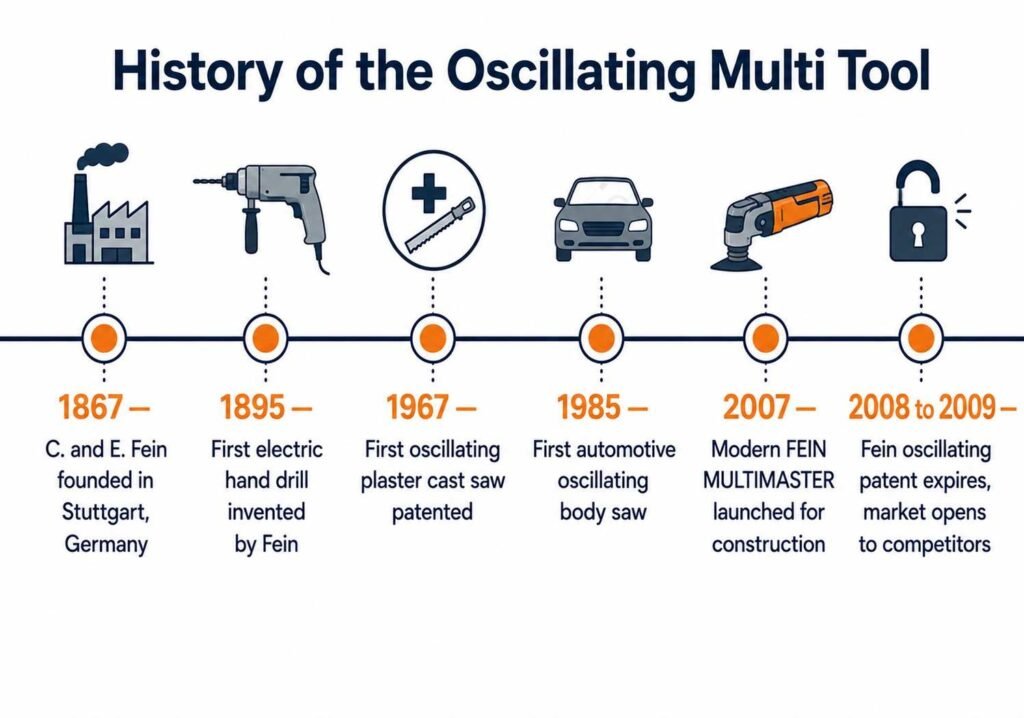
Quick timeline recap:
- 1867: C. and E. Fein founded in Stuttgart, Germany
- 1895: First electric hand drill invented by Fein
- 1945: Fein begins making rotating plaster cast saws
- 1967: First true oscillating tool, the plaster cast saw, patented
- 1985: First automotive oscillating body saw
- 2007: Launch of the modern FEIN MULTIMASTER for construction
- 2008 to 2009: Fein’s oscillating mechanism patent expires, opening the market to competitors
What Is an Oscillating Multi-Tool Used For
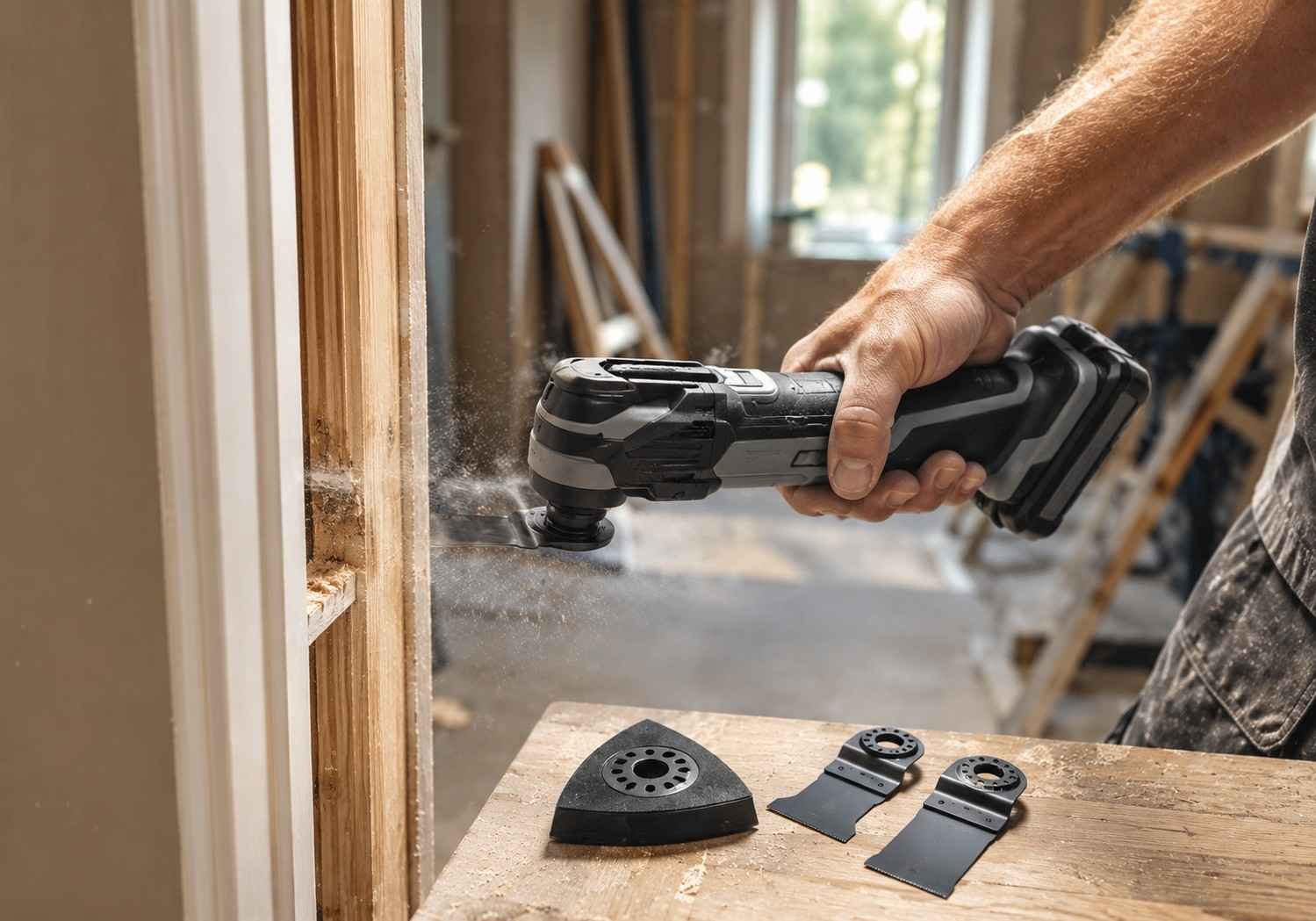
So what is an oscillating multi-tool used for in the real world? The honest answer is almost anything that involves cutting, sanding, scraping, or grinding in a space where a bigger tool would not fit or would not be safe.
Cutting and Flush Trimming
This is the tool’s signature move. Use of an offset in a fitted blade allows the tool to cut flush with a surface, which is particularly useful when fitting flooring along a skirting board, cutting the skirting to allow the board to slide under for a neat finish. It is also the go-to method for undercutting door jambs and casing before installing new flooring, a job that used to require a handsaw and a lot of patience.
Sanding, Scraping, and Grinding in Tight Corners
The small form of these tools and the ability to mount the blade or accessory in any orientation allow cutting in areas that are otherwise virtually unreachable. Triangular sanding pads reach into corners a random orbital sander cannot touch, and rigid scraper attachments strip old caulk, adhesive, and vinyl flooring without gouging the substrate underneath.
Plunge Cuts and Precision Work
The ability to cut a complex or precise recess without needing to remove the work piece from where it is fixed greatly increases productivity, and small, precise cuts are possible even on end grain. Electricians rely on this for cutting outlet boxes into drywall, plumbers use it to notch studs for pipe runs, and cabinet installers use it for scribing panels to an uneven wall.
Grout, Tile, and Masonry Work
Fitted with a carbide rasp or a diamond segment blade, the same tool that trims a door jamb can also chase out old grout lines between tiles or score a cut line in thin masonry, tasks that once demanded a separate rotary tool.
Common Jobs by Trade
- Flooring installers: undercutting door casings, trimming transition strips, notching subfloor
- Electricians and plumbers: cutting box openings, notching studs and joists
- Remodelers: removing old caulk, grout, and adhesive residue
- Woodworkers: trimming dowels and plugs flush, sanding tight inside corners
- Auto body and glass technicians: cutting out glued-in windshields and trim, a direct descendant of Fein’s original 1985 body saw
Multi-Tool vs Oscillating Tool: Clearing Up the Confusion
The phrase “multi-tool vs. oscillating tool” shows up constantly in searches because the two terms genuinely overlap, and manufacturers have not helped by using inconsistent naming.
They Are Usually the Same Thing
The official name of this power tool is the oscillating multi-tool, and it often goes by “oscillating tool” or just “multi-tool.” Some brands used to have proprietary names for their models, like the Ridgid Job Max and the Festool Vecturo, but most brands have shifted away from that thinking, likely to help avoid confusion. So in the vast majority of cases, when someone asks about a multitool versus an oscillating tool, they are comparing the same device against itself under two different names.
Where the Real Confusion Comes From
The genuine point of comparison people usually mean is an oscillating tool versus a rotary tool or an oscillating tool versus a folding pocket multi-tool like a Leatherman. Here is how those actually differ.
| Feature | Oscillating Multi-Tool | Rotary Tool (like a Dremel) | Folding Pocket Multi Tool |
|---|---|---|---|
| Motion type | Back-and-forth arc, 2.8 to 4 degrees | Continuous full rotation | No motor, manual leverage |
| Typical speed | 8,000 to 20,000 oscillations per minute | 5,000 to 35,000 RPM | Not applicable |
| Best for | Flush cuts, plunge cuts, sanding corners | Engraving, detailed carving, drilling | Everyday carry tasks, quick fixes |
| Kickback risk | Very low due to narrow arc | Moderate, can grab and spin | None |
| Power source | Corded or battery | Corded or battery | Manual only |
| Reach into corners | Excellent | Limited by disc or bit shape | Not applicable |
Oscillating tools are designed for more heavy-duty cutting tasks such as sawing through wood, metal, and plastic, and they can also be used to remove grout from between tiles and cut through old nails or screws, while rotary tools are very useful for a wide range of applications, including woodworking, metalworking, jewelry making, and crafting, and can also sharpen knives and various other cutting blades. If your work leans toward flush cutting and sanding in awkward spots, the oscillating tool wins. If it leans toward fine detail carving and engraving, the rotary tool wins.
Oscillating Tool vs Reciprocating Saw
Another frequent mix-up is between the oscillating multi-tool and a reciprocating saw, sometimes called a Sawzall. Professionals typically use reciprocating saws for demolition because they can quickly and precisely cut through wood, metal, and plastic. A reciprocating saw delivers speed and raw cutting power over longer cuts, while an oscillating tool provides better control and precision in small, awkward areas. Most professionals own both because they can hold an oscillating tool with one hand and use it in corners or flush against surfaces, while a reciprocating saw handles fast, heavy-duty cuts that would take an oscillating tool much longer to complete.
Oscillating Saw for Surgery: The Medical Side of the Technology
It surprises a lot of people to learn that the exact same physics used to trim a doorframe also protects a patient’s skin in a hospital room. An oscillating saw for a surgical setting works on the identical eccentric drive principle described earlier, just tuned for a completely different job.
How an Oscillating Saw Orthopedic Setup Works
In an oscillating saw orthopedic environment, the tool is most commonly used as a cast saw. A cast saw consists of a handheld electric or pneumatic motor that drives a blade with fine teeth that oscillate back and forth at high speed, and this unique motion allows the cast saw to cut through the rigid material without harming the patient’s skin underneath. An oscillating saw operates by rapidly vibrating the saw blade so the teeth of the saw blade cut through material, as opposed to a rotary saw, which operates by rapidly rotating the saw blade.
The safety logic depends on skin mobility. Oscillating saw blades are preferred because the blade oscillates within a range of typically a few millimeters, reducing the risk of cuts to the patient, provided that any skin contacted by the blade is mobile, since if the skin can move with the cast saw blade as it oscillates, the skin is unlikely to be cut. Over a bony area with less mobile skin, the risk rises, which is exactly why safety guards and technique training matter so much in clinical settings.
Real Risks Doctors Still Watch For
This is not a risk-free process, and honest clinical research backs that up. A comparative clinical study found that with conventional cast removal methods, the skin mark or scratch rate was 18 percent, the full-thickness skin laceration rate was 0.9 percent, and the rate of first- or second-degree burns was 2.5 percent. That same study found meaningful improvement with better technique, since eliminating saw blade to skin contact with a tong-like, externally guided flexible steel aid provides a high level of safety and decreases removal time by 5 to 10 minutes depending on cast length.
Separate research on protective barriers reached a similar conclusion. Use of a safety strip reduced the number of simulated skin touches compared with casts removed without the safety strip, and the safety strips also decreased heat transfer, preventing temperatures at the cast skin interface from reaching 50 degrees Celsius. Heat, not just direct contact, turns out to be one of the leading causes of injury, because friction between the oscillating saw blade and the cast material causes the blade and cast material to heat up excessively in proximity to the patient’s skin.
Why This Matters for Everyday Users Too
The lesson translates directly to the workshop. Heat buildup from a dull blade, excessive pressure, or cutting through thick material too quickly is one of the most common causes of premature blade failure and burn marks on wood or plastic, even in a hobbyist’s oscillating tool. Letting the tool do the work at a moderate speed, rather than forcing it, mirrors exactly what surgeons have learned from decades of clinical data.
Oscillating Multi-Tool Bosch and Other Leading Brands Compared
Once you understand the mechanism, the next natural question is which brand and model actually deliver the best version of it. The oscillating multi-tool Bosch lineup is one of the most widely recommended in the United States, but it is not the only serious option.
Bosch StarlockPlus Lineup
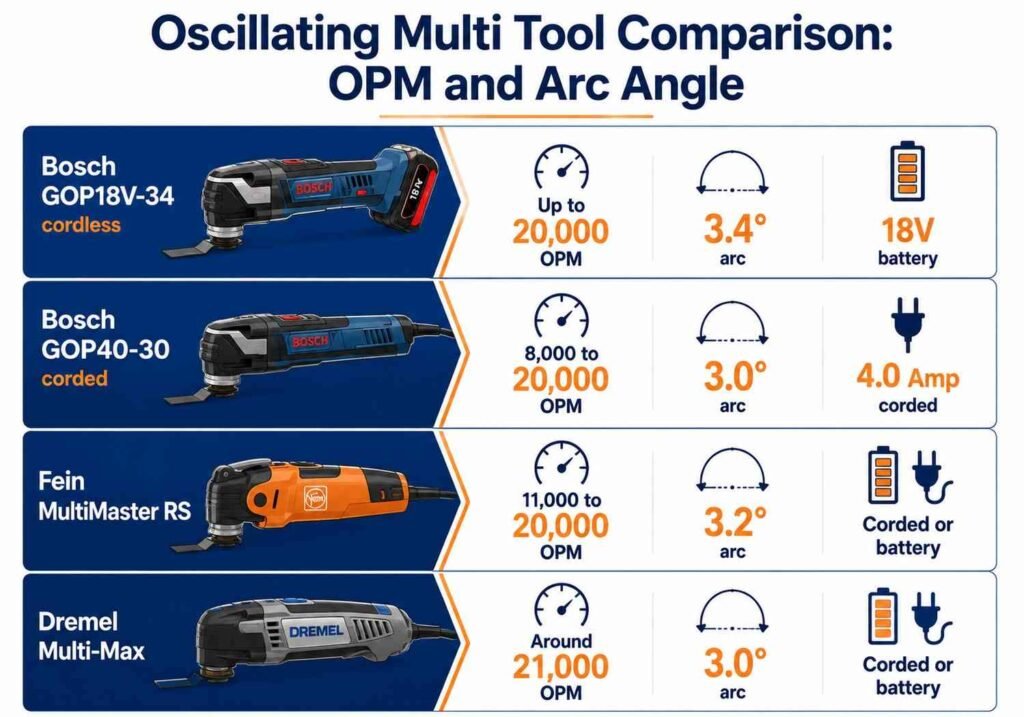
The Bosch GOP18V-34 18V StarlockPlus Oscillating Multi-Tool features a top speed of up to 20,000 oscillations per minute and an improved cutting angle of 3.4 degrees for more efficiency while performing cuts. It uses the Starlock cupped 3-D tool accessory interface with more contact surface area, delivering greater torque transfer, and the Starlock mount offers 8 times faster accessory changes compared to Bosch’s older standard interface.
The corded version is just as capable. The Bosch GOP40-30 runs on a 4.0 amp motor, delivers 8,000 to 20,000 oscillations per minute across a 3.0-degree oscillating arc, and weighs 3.3 pounds. Reviewers note the tool is relatively lightweight at 2.7 pounds for the cordless version and can be held with one or two hands when cutting or sanding.
Fein: The Original Standard
Fein remains the benchmark the entire category is measured against. The Fein MultiMaster RS oscillates at 200 to 350 Hz, which works out to 11,000 to 20,000 oscillations per minute, with the fitted accessory moving along a minimal arc of 3.2 angular degrees. Fein tools tend to command a premium price, largely because of the brand’s original patent history and reputation for gearbox durability.
Head-to-Head Comparison Table
| Model | Oscillations Per Minute | Arc Angle | Power Source | Accessory System | Best For |
|---|---|---|---|---|---|
| Bosch GOP18V-34 (cordless) | Up to 20,000 | 3.4 degrees | 18V battery | StarlockPlus | Jobsite mobility, flush cuts |
| Bosch GOP40-30 (corded) | 8,000 to 20,000 | 3.0 degrees | Corded, 4.0 amp | StarlockPlus | Sustained heavy use |
| Fein MultiMaster RS | 11,000 to 20,000 | 3.2 degrees | Corded or battery | Starlock / QuickIN | Professional daily use |
| Dremel Multi-Max | Around 21,000 | Approximately 3.0 degrees | Corded or battery | Universal / OIS | Light DIY, sanding |
What the Numbers Actually Mean for You
A wider arc angle generally means a slightly faster cut but a bit less control in tight corners, while a narrower arc favors precision over raw speed. Oscillations per minute matter most for material hardness. Softer materials like drywall and plastic cut cleanly at the low end of the range, while dense hardwood, metal, and tile benefit from the higher end, closer to 20,000 oscillations per minute.
Choosing and Maintaining Your Oscillating Tool
A tool this versatile is only as good as the accessory locked into it, so a little bit of buying and maintenance knowledge goes a long way.
Matching the Accessory to the Job
- Bimetal saw blades handle wood with embedded nails or screws
- Carbide grit blades cut fiberglass, cement board, and tile grout
- Triangular sanding pads with hook and loop backing suit fine finishing in corners
- Rigid scraper blades remove caulk, vinyl flooring, and old adhesive without gouging
- Plunge-cut blades are ideal for outlet box cutouts and precise recesses
Cordless or Corded
Cordless tools have closed the performance gap significantly. Bosch’s brushless 18V motor is designed to deliver runtime and performance comparable to corded multi-tools, and vibration control on newer models reduces vibration up to 80 percent compared to the previous generation. That said, corded models still tend to win for all-day professional use where battery swaps interrupt workflow.
Compatibility Across Brands
Because Fein’s patent expired, most accessories today fit multiple brands, but not always perfectly. The term “oscillating” describes the movement of the attachments, and instead of rotating like a drill or reciprocating like a jigsaw, the head moves rapidly back and forth thousands of times per minute, and the Starlock, StarlockPlus, and StarlockMax systems from Fein and Bosch are now considered a de facto industry standard, meaning a Starlock blade will typically fit a Bosch, Fein, or newer Milwaukee tool interchangeably. Older proprietary mounts, however, may need an adapter.
Simple Maintenance Habits That Extend Blade and Motor Life
Following a few consistent habits keeps the tool running well for years.
- Let the blade cool between long cuts to avoid heat warping, especially in plastic or metal
- Clearly build up dust and swarf from the blade regularly, since the oscillating motion does not clear debris the way a rotating blade does
- Store blades flat to prevent the fine teeth from bending
- Check the accessory clamp screw or lever periodically, since a loose mount reduces cutting efficiency and increases vibration
For more community discussion on how these tools stack up against rotary tools, forums like Quora and the Wikipedia page on the oscillating multi-tool offer good additional reading.
Conclusion
How oscillating tools work comes down to one idea: a tiny, rapid arc that trades raw power for control and safety. Born as a 1967 medical device, this same mechanism now drives every modern oscillating multi-tool, from Bosch to Fein. Pick a Starlock-compatible model, match your accessories to the job, and you are set for nearly any tight-space task.
Frequently Asked Questions
How do oscillating tools work in simple terms?
A motor spins an off-center shaft, which turns rotation into a rapid side-to-side blade motion of 2.8 to 4 degrees, thousands of times per minute, allowing precise cuts without kickback.
What is an oscillating multi-tool used for most often?
Flush cutting, plunge cuts, sanding tight corners, and scraping adhesive or grout, especially for undercutting door jambs and cutting drywall outlet boxes.
Who invented the oscillating multi-tool?
Wilhelm Emil Fein of C. and E. Fein invented it, introducing the first oscillating plaster cast saw in 1967 before adapting it for construction use by 1985.
Is an oscillating saw used in surgery?
Yes, it is a standard cast saw tool in orthopedics, cutting rigid cast material while minimizing skin injury risk compared to a rotating blade.
What is the difference between a multitool and an oscillating tool?
They are usually the same product. The real comparison people mean is oscillating tool versus rotary tool, which differ in motion type and best use cases.
How many oscillations per minute does a Bosch multitool run?
Bosch StarlockPlus models run up to 20,000 oscillations per minute, adjustable down to about 8,000 for delicate materials.
Can an oscillating tool replace a reciprocating saw?
Not fully. Oscillating tools excel at precision in tight spaces, while reciprocating saws handle faster, more aggressive demolition cuts.
Are oscillating tool accessories interchangeable between brands?
Many are, thanks to the Starlock and StarlockPlus mounting standard shared by Fein, Bosch, and other major brands, though older mounts may need adapters.