
AI Enterprise Marketing: Strategy, Tools and ROI Guide
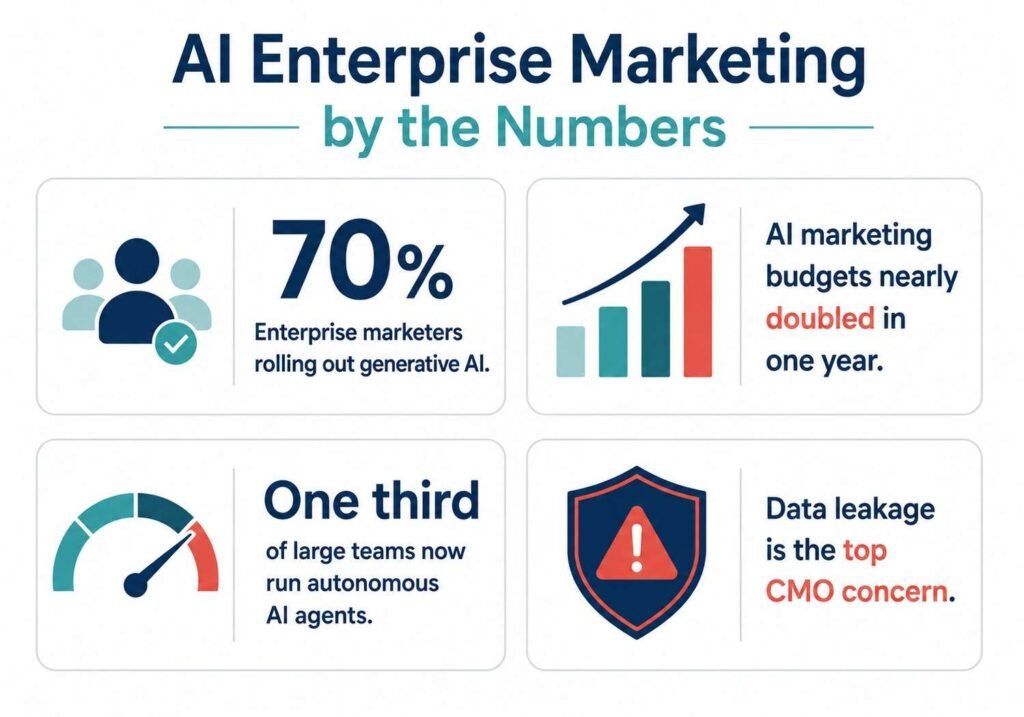
Here’s a number worth sitting with. Almost seventy percent of enterprise marketers are rolling out generative AI tools right now, yet fewer than one in twenty leaders who treat AI as a bolted-on extra actually see a real business gain from it. Something is broken between adoption and results, and that gap is exactly what AI enterprise marketing is supposed to fix.
I wrote this guide the way I wish someone had written one for me a couple of years ago. Not a list of shiny tools, but an actual working model for how a large marketing team should think, plan, and act when AI is part of the toolkit. You’ll get a practical AI enterprise marketing strategy, fifteen real AI in marketing examples pulled from what companies are actually doing today, a solid list of free AI tools for marketing you can use without spending anything, and pointers toward a proper AI marketing automation course if your team needs structured training. There’s also guidance on where to find a useful artificial intelligence in marketing PDF for internal decks. By the time you finish reading, you should have something you can act on this week, not just another bookmark you never open again.
What Is AI Enterprise Marketing, and Why Does It Matter Right Now
AI enterprise marketing is really just the use of machine learning, generative models, and automation across the whole marketing function of a large company. It shows up in small ways, like a chatbot answering a billing question, and in bigger ways, like an algorithm quietly deciding which ad to show which person at which second of the day. What makes it “enterprise” isn’t the technology itself. It’s the scale, the number of teams touching it, and the fact that one mistake can ripple across dozens of markets at once.
How It Actually Differs From Traditional Marketing
Old-school marketing runs on manual lists, scheduled sends, and reports you read after the campaign already ended. Artificial intelligence in digital marketing flips that around in a few clear ways.
- Campaigns adjust themselves in near real time instead of waiting for the next planning meeting
- Personalization happens at the individual level, not just to a segment of a few thousand people who loosely resemble each other
- Reporting starts predicting problems before they hit revenue, instead of just explaining what already went wrong
None of this means strategists become unnecessary. It just moves their time away from repetitive production work and toward the judgment calls machines still can’t make on their own.
The Numbers Behind the Push
Boards care about this because the data backs it up. Enterprise adoption sits in the high eighties percentage range now, a sharp climb from around half just a couple of years back. Budgets dedicated to AI inside marketing departments have roughly doubled in twelve months, and a growing chunk of large companies plan to spend over ten million dollars a year on it going forward.
But the payoff isn’t automatic, and this is the part most articles gloss over. Companies that weave AI into planning, execution, and measurement together report noticeably better results than companies that just plug one tool into an unchanged process. If there’s one lesson buried in nearly every survey published this year, it’s this one: the strategy around the tool matters more than the tool itself.
Building an AI Enterprise Marketing Strategy That Actually Works
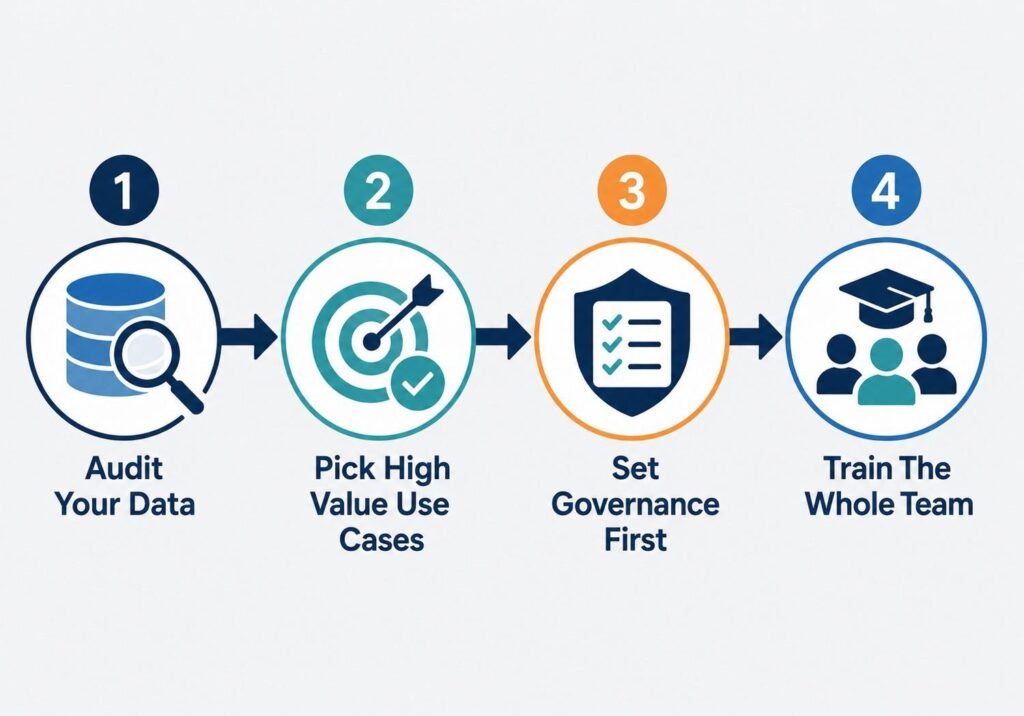
A workable AI enterprise marketing strategy follows a rough order. Skip a step and pilots tend to stall out after a few months, which is more common than most vendors will admit.
Step One: Look Honestly at Your Data
AI is only as useful as what you feed it. Before picking any tool, map out what customer data actually exists, where it sits, and whether it’s clean enough to trust. A lot of enterprises get to this point and realize their customer records are scattered across five systems that don’t talk to each other, which quietly kills any personalization effort before it even starts.
Step Two: Pick a Few High-Value Use Cases
Don’t try to automate everything at once. Choose two or three use cases with clear, measurable outcomes, maybe email subject line testing or ad creative generation, and prove they work before you expand. The enterprises that scale AI well almost always start small and specific rather than broad and open-ended.
Step Three: Set Governance Before You Scale
This step gets skipped constantly, and it’s where enterprise risk actually lives. Data leakage, meaning employees pasting sensitive customer information into public AI tools, is now one of the top worries for chief marketing officers. Brand voice drift, where AI written copy slowly stops sounding like the brand, is right behind it. A short internal policy on what data can go into which tool, plus a human review step before anything publishes, prevents most of the damage before it happens.
Step Four: Train the Whole Team, Not Just One Champion
Every rollout that works has one clear owner, not a committee that meets once a month. Give that person or small team a real budget and make sure the rest of marketing gets actual training, not a single onboarding email nobody reads twice. A structured AI marketing automation course earns its keep here, since it gives everyone the same vocabulary instead of each person figuring things out alone through trial and error.
Fifteen Examples of Artificial Intelligence in Marketing
These are fifteen concrete AI in marketing examples already running inside enterprise teams today, grouped by what they’re used for.
Content and Creative Work
- Drafting first versions of blog posts, product pages, and ad copy
- Generating images and short videos for ads and landing pages
- Cloning voices for localized audio ads across different markets
- Cutting one long video into dozens of short clips automatically
- Checking copy against brand style guides and flagging drift
Customer Experience and Personalization
- Changing website headlines and offers based on how a visitor behaves
- Running chatbots that qualify leads and answer support questions at 2am
- Recommending products based on predicted interest, not just past purchases
- Adjusting pricing on the fly based on demand and stock levels
- Flagging customers likely to churn before they actually cancel
Analytics, Advertising, and Retention
- Shifting ad budget automatically toward whatever is performing best
- Scoring leads so sales knows who to call first
- Reading sentiment across reviews and social posts to catch problems early
- Estimating how much each channel actually contributes to sales
- Running small campaigns start to finish with very little human input, through autonomous agents
That last one, agents running campaigns on their own, is growing faster than anything else on this list. Roughly a third of large marketing teams already run at least one in production, more than double what it was a few months ago.
AI in Marketing and Advertising, Channel by Channel
AI in marketing and advertising looks different depending on where you’re spending money. Here’s how it actually plays out channel by channel.
Paid Ads and Programmatic Buying
Ad platforms now decide bids, targeting, and which creative to rotate in almost entirely on their own. Marketers still set the budget and the goal, but the platform handles the second-by-second tuning that used to eat up a full-time analyst’s week.
Search and AI Overviews
Search itself has changed because AI-generated summaries now show up right inside the results. Content written as a clear, direct answer up front, followed by supporting detail, gets pulled into these AI overviews far more often than content that meanders before getting to the point. That makes answer engine optimization a skill you need alongside traditional SEO, not instead of it.
Social Media and Influencer Work
AI now drafts caption options, suggests when to post, and even flags which influencer partnerships are likely to land based on past engagement. This lets enterprise teams test far more creative variations per campaign than any human team could churn out alone.
Email and Lifecycle Campaigns
Send time optimization, subject line testing, and content blocks that rearrange per recipient are just standard features in enterprise email tools now. The result is fewer generic blasts and more messages that feel personally written, even though a model generated the variation behind the scenes.
| Channel | Main AI Application | Typical Benefit |
|---|---|---|
| Paid Search and Display | Automated bidding and targeting | Lower cost per acquisition |
| Organic Search | Answer-style content structure | Better visibility in AI overviews |
| Social Media | Caption and creative generation | More variants, faster turnaround |
| Send time and content personalization | Higher open and click rates | |
| Customer Service | Conversational chatbots | Faster replies, lower support cost |
Free AI Tools for Marketing Teams on a Real Budget
You don’t need an enterprise budget to start experimenting. Free AI tools for marketing are genuinely useful in 2026, not the watered-down trial versions they used to be.
For Writing and Strategy
General-purpose AI assistants now have free tiers strong enough to draft real copy, outline a whole campaign, or summarize a pile of research. A solo marketer can produce a usable first draft this afternoon without paying a cent.
For Design and Video
Free tier design platforms let small teams build social graphics and short videos without hiring a designer for every single asset. This closes a real gap for teams that had zero creative production capacity before.
For SEO and Analytics
Free search console tools remain, honestly, the single most useful thing any marketer can check daily, since they show exactly which pages and queries drive traffic. Pair that free data with an AI assistant to interpret the patterns, and a small team gets insight that used to require a dedicated analyst.
| Tool Category | Example Free Option | Best For |
|---|---|---|
| Writing and Strategy | General AI chat assistants | Copy drafts, outlines, research summaries |
| Design and Video | Free tier design platforms | Social graphics, short video clips |
| Email Marketing | Free tier email platforms | Newsletters, basic automation |
| SEO and Search Data | Free search console tools | Keyword performance, indexing health |
| CRM | Free tier customer tools | Lead tracking, basic AI email drafting |
Learning AI Marketing Properly
Tools change fast, so ongoing learning matters more than memorizing whatever platform is popular this month.
Finding a Good AI Marketing Automation Course
Look for an AI marketing automation course that teaches strategy and governance, not just which buttons to click in one piece of software. The best programs teach you how to evaluate a use case and manage risk, skills that stay useful long after the specific tools change or get replaced.
Where to Find a Solid PDF Resource
Plenty of industry groups and major platforms publish a free artificial intelligence in marketing PDF report every year, packed with adoption data and case studies. These work well for internal training decks and for checking your own program against the wider industry, and they’re usually far more current than anything you’d find in a textbook.
Mistakes Worth Avoiding
Even well-funded programs fail in fairly predictable ways.
Data Privacy Slip-Ups
Pasting customer data into a public AI tool without checking its data policy is the single most common, and most damaging, mistake enterprises make. Write the policy on what can and can’t go into any AI tool before your first pilot launches, not after something goes wrong.
Generic Content at Scale
AI can churn out a lot of content fast, but volume without a real point of view produces marketing nobody remembers. Teams that get results treat AI output as a first draft, then sharpen it with actual data, a genuine opinion, and the brand’s real voice, rather than publishing it as is.
Chasing the Wrong Metrics
Impressions and content volume are easy to track and easy to be fooled by. Tie every AI project to something finance actually cares about, like cost per acquisition or retention, so the program survives its first budget review.
Conclusion
AI enterprise marketing works best as a full strategy, not a single tool bolted onto old habits. The teams seeing real results follow a rough order: look at the data honestly, pick a small set of use cases, set governance before scaling, and train the whole team instead of one person.
Three things worth remembering:
- The strategy and the governance around AI matter more than which specific tool you choose
- Free AI tools for marketing are genuinely capable in 2026 and worth testing before you commit to anything paid
- Measure against real business numbers, not vanity metrics, if you want the program funded past its first quarter
If you’re just getting started, pick one use case from the fifteen examples above, test it with a free tool for thirty days, and look honestly at the results before you scale it up. That one step will teach your team more than any amount of reading ever will.
FAQ
What is AI enterprise marketing?
It’s the use of machine learning and automation across a large organization’s marketing function, covering content, advertising, customer service, and analytics, rather than one tool used in isolation.
Is this only for big companies?
Not really. The strategy principles apply at any size, and many of the free AI tools for marketing mentioned here give small teams abilities that used to require a whole department.
What are the best free AI tools for marketing beginners?
General AI writing assistants, free tier design platforms, and free search console tools cover most early needs. Add a free email platform once you’re ready to build a list.
How do you actually measure ROI from these tools?
Tie each initiative to something specific, like cost per acquisition or retention, and compare before and after. Don’t lean on activity metrics alone.
Do I need an AI marketing automation course to get started?
It’s not required, but it helps a lot for teams rolling this out across several departments, since it gives everyone shared language and cuts down on expensive trial and error.
What’s the biggest risk in enterprise AI marketing?
Governance failures, especially employees pasting sensitive data into public AI tools without any policy in place, top the list among marketing leaders right now.
Can AI replace human marketers?
Not in any real sense today. AI handles production and optimization well, but strategy and brand judgment still need a human, which is why the strongest teams pair AI drafts with human editing.
Where can I find a good artificial intelligence in marketing PDF report?
Major platforms and industry groups, including Salesforce’s annual research, publish free reports that work well for internal training and benchmarking.