
Will Marketing Be Replaced by AI? The Real 2026 Answer
Nine out of ten marketers are already using AI at work. And yet marketing manager job postings still grew last year. Sit with that for a second, because it doesn’t match the story most headlines are telling. So what’s actually going on? The honest answer to whether marketing will be replaced by AI sits somewhere between the panic and the denial. And where you land on that spectrum depends a lot on what you actually do all day. Someone who spends most of their time pulling reports and formatting spreadsheets is in a very different spot. Than someone who sets strategy or manages a client relationship.
In this guide you’ll learn which marketing tasks AI has already taken over, which ones it still can’t touch, what the data actually says about what jobs will be replaced by AI. Whether digital marketing will continue to grow despite all this change. And which specific skills are worth building right now if you want to stay employed and paid well for the rest of this decade.
Will Marketing Be Replaced by AI? The Short Answer
No. Marketing as a field isn’t disappearing. What’s disappearing is a specific slice of the work, the repetitive part with almost no judgment involved. Marketing manager postings grew roughly 14 percent year over year even while AI adoption hit 91 percent among marketers, which is a strange thing to see happen at the same time if AI were simply eating the profession whole. What seems to be happening instead is more of a sorting process. Report pulling, basic ad variations, campaign tagging, spreadsheet wrangling—all of that is vanishing fast. Setting strategy, managing stakeholders, making a call when there’s no clear playbook, being the person accountable when a campaign flops—none of that is going anywhere. AI has no stake in the outcome and no one to answer to when something fails.
What AI Actually Automates in Marketing Today
Reports, ad copy variations, basic audience segmentation, performance summaries. These are the clear-cut cases. Writing a dozen headline variations for an A/B test used to eat up a copywriter’s whole afternoon. Now it takes a few minutes. Pulling numbers that once needed a dedicated analyst can happen on demand. None of this is even controversial anymore; it’s just how the job works now.
What AI Still Cannot Do
It can’t own the consequences when a campaign underperforms and can’t read the room in a tense client meeting and adjust its tone accordingly. It can’t decide if a brand should walk away from a profitable but reputation-damaging partnership. and can’t build the kind of trust that keeps a client signing new contracts for five straight years. Those aren’t minor gaps. They’re basically the whole center of what senior marketing work actually looks like.
What Is AI in Marketing (and How It Actually Works)
“What is AI in marketing?” sounds like a bigger question than it really is. In plain terms, it means using machine learning, natural language generation, and predictive modeling to handle tasks that used to need a human doing repetitive analytical or creative work. That covers everything from a chatbot answering a customer’s question to an algorithm deciding which ad a particular person sees at a particular moment.
Types of AI Marketing Tools
There are roughly four buckets worth knowing. Content tools that draft blog posts, ad copy, and social captions. Analytics tools that chew through campaign data and surface patterns a human would take days to spot manually. Personalization engines that decide what a website visitor sees based on how they’re behaving. And chat or voice tools that handle customer service and lead qualification around the clock, no lunch breaks required.
How AI in Performance Marketing Is Changing Campaigns
AI in performance marketing is where the shift shows up most clearly, since performance marketing has always been about numbers. Bidding systems now adjust in real time across thousands of auctions every second, something no human team could ever keep up with by hand. Budget splits across channels, creative testing, and audience targeting—all of it is increasingly handled by systems optimizing continuously toward a goal rather than getting reviewed once a week in a meeting. The marketer’s actual job shifts from executing the campaign to setting the goals, the guardrails, and the creative direction the algorithm operates inside of.
The Rise of AI in Marketing: A Timeline
The rise of AI in marketing didn’t happen overnight, even if it feels that way to anyone who only started paying attention in the last couple of years.
From Automation Software to Generative AI
Marketing automation platforms have existed for well over a decade, handling email sequences and basic list segmentation long before anyone was talking about generative AI. What actually changed around 2023 was the arrival of tools that could write, design, and reason rather than just follow rules someone had already programmed in. That’s the real dividing line between old marketing technology and what people mean today when they say AI in marketing.
Where We Stand in 2026
By 2026, AI sits inside the daily routine for most marketers. Roughly two thirds use it regularly, and most say it frees up real time they used to spend on manual tasks. It’s gone from a novelty a handful of early adopters were experimenting with to something closer to basic software literacy, the way spreadsheets or email became table stakes a generation ago.
Will Marketing Be Replaced by AI? Reddit: What Marketers Are Actually Saying
Search Will Marketing Be Replaced by AI on Reddit, and you’ll find a much rawer tone than what shows up in polished blog posts on this same topic.
Common Fears Marketers Share Online
The most common thread is entry-level marketers describing smaller teams, longer hours, and a sense that the career ladder they expected has fewer rungs than it used to. Some describe agencies losing clients who realized they could get comparable results from a chatbot for a fraction of the price. Early career professionals between 22 and 25 have seen an estimated 20 percent net drop in headcount across sales and marketing roles specifically, according to recent labor research, and that figure keeps coming up again and again in these threads.
What Experienced Marketers Say Instead
Right alongside the anxiety, there’s a recurring pushback from more senior marketers. Their argument is that the people struggling most are usually the ones who never built judgment beyond following a checklist. Marketers who can write a sharp creative brief, make sense of ambiguous data, or manage a client relationship describe a completely different experience, doing more with a smaller team and often getting promoted faster because they can supervise AI output at scale rather than compete with it.
How Artificial Intelligence Will Change the Future of Marketing
How artificial intelligence will change the future of marketing really comes down to which parts of the job get amplified and which parts get squeezed out.
Personalization at Scale
Every customer can now see a version of a website, email, or ad shaped around their own behavior, something that used to mean lumping people into a handful of broad buckets. This is already standard in retail and online shopping, which remains the biggest end user category for digital marketing spending.
Predictive Analytics and Customer Journeys
Instead of reacting to what already happened last month, marketing teams increasingly rely on models that predict which customers are about to churn, which leads are worth a sales call, and which creative is likely to flop before it even launches. That shifts marketing from a reporting function into something closer to forecasting.
Content Creation and Generative Engine Optimization
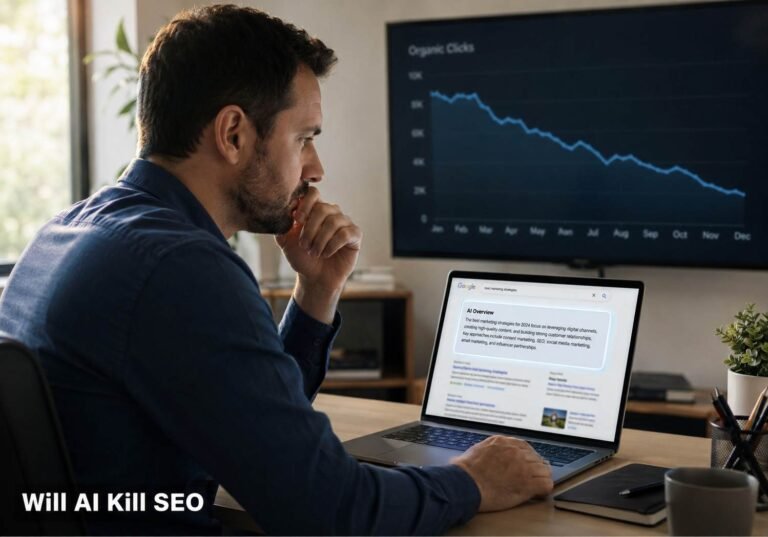
Search itself is changing shape too. Answer engines like Google AI Overviews and other AI-powered search tools now pull information straight into a summary instead of sending someone off to click through ten blue links. That’s created a whole new discipline, sometimes called generative engine optimization, sitting right alongside traditional SEO instead of replacing it.
Will Digital Marketing Continue to Grow Despite AI?
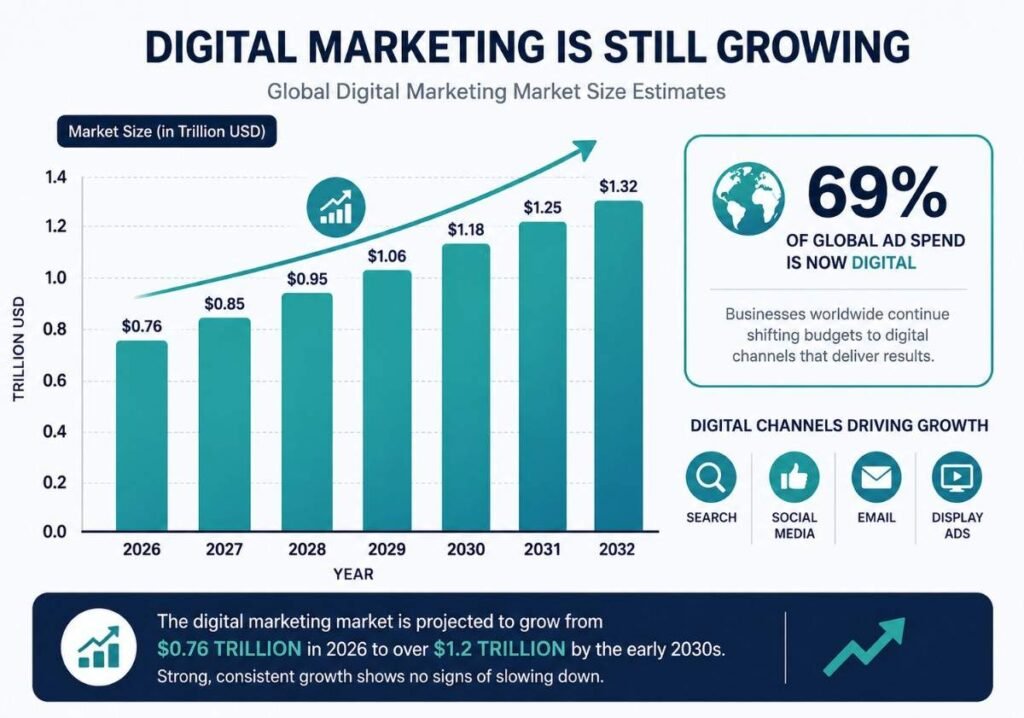
Yes, and honestly the numbers aren’t even close. Will digital marketing continue to grow? This is one of the easier parts of this whole question to answer with hard data instead of opinion, since several independent market research firms keep landing on similar figures.
| Source | 2026 Market Size Estimate | Projected Growth |
|---|---|---|
| Mordor Intelligence | 0.76 trillion dollars | 10.9 percent CAGR through 2031 |
| IMARC Group | 456.7 billion dollars (2025 base) | 11 percent CAGR through 2034 |
| Grand View Research / WordStream | 786.2 billion dollars | 15.4 percent CAGR through 2030 |
| Fungies.io industry analysis | Over 800 billion dollars | Continued double-digit growth through 2030 |
Even accounting for the fact that each firm defines the market slightly differently, every single one of these estimates points the same direction, growth, not contraction. About 69 percent of all global ad spend is now digital, and that share keeps climbing as traditional media keeps shrinking. If AI were actually shrinking the overall marketing industry, these numbers would look nothing like this.
What Jobs Will Be Replaced by AI in Marketing (and Which Are Safe)
What jobs will be replaced by AI is really the question underneath all the anxiety, and it deserves a specific answer instead of a vague reassurance.
Jobs at High Risk
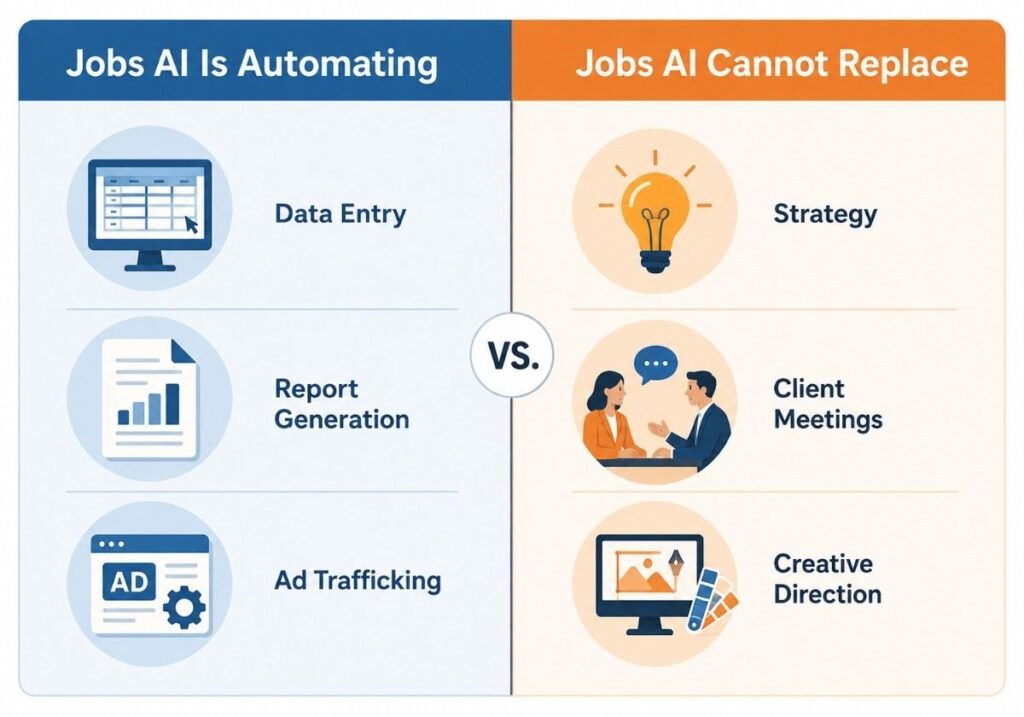
Roles built almost entirely around repetitive execution are the most exposed. Data entry-adjacent marketing work, basic report compilation, simple ad trafficking, junior copywriting limited to formulaic templates, and entry-level social scheduling—all of these are shrinking right now. The Bureau of Labor Statistics has noted that occupations with higher AI exposure are projected to grow more slowly over the coming decade, and marketing sits near the top of that exposure ranking.
Jobs That Remain Resilient
Strategic roles, brand management, client relationships, creative direction, and anything requiring negotiation or judgment when there’s no clear rulebook—all of that remains in demand. Marketing managers who build fluency in directing AI tools, auditing what those tools spit out, and designing sensible governance around how AI actually gets used are described as being in high demand rather than at risk of losing their jobs.
| Role Type | AI Exposure Level | Outlook |
|---|---|---|
| Report generation, ad trafficking | High | Shrinking fast |
| Junior copywriting (templated) | High | Shrinking |
| SEO execution | Medium | Changing shape, not disappearing |
| Brand strategy, creative direction | Low | Growing in value |
| Client and stakeholder management | Low | Growing in value |
| Marketing leadership with AI fluency | Low | Strong demand |
Pros and Cons of AI in Marketing
Any honest conversation about the pros and cons of AI in marketing has to hold both sides at once, instead of quietly picking a side to sell a story.
| Pros | Cons |
|---|---|
| Faster content and campaign production | Risk of generic, forgettable output when overused |
| Lower cost per task for repetitive work | Entry-level roles shrinking, fewer training grounds for new marketers |
| Better personalization at scale | Data privacy and consent complexity |
| Real-time bid and budget optimization | Overreliance can erode brand voice and trust |
| Frees senior staff for strategic work | Requires new governance and quality control processes |
The honest takeaway here is that AI acts as a force multiplier, not a replacement, for teams that already know what good marketing looks like. For teams that don’t, it can multiply mediocre work just as fast as it multiplies the good stuff.
How to Future-Proof Your Marketing Career in the AI Era
Skills to Build
Data literacy matters more than it ever has, specifically the ability to understand attribution models and to sanity check whether an AI-generated insight actually holds up. Strategic prompting, meaning the ability to write a clear brief that produces a genuinely useful output, is quickly becoming its own valuable skill. Governance design, or knowing how to set sensible limits and approval steps around AI use, is increasingly showing up as a job requirement rather than a nice to have extra.
Practical Steps
Start by being honest with yourself about which of your weekly tasks are purely mechanical. Learn one AI tool really well rather than five tools at a shallow level. Volunteer to own the parts of a campaign that need judgment, client contact, or creative direction, since that’s where your value compounds the fastest. According to the American Marketing Association’s most recent career research, adaptability, critical thinking, and quality judgment are the traits AI struggles hardest to copy, yet marketers rated these same skills as less important in 2026 than the year before. That mismatch is worth correcting in your own planning before it costs you something.
If you want a deeper technical breakdown of how digital marketing evolved into what it is today, Wikipedia’s page on digital marketing is a solid place to start, and searching YouTube will turn up plenty of detailed case study walkthroughs from agencies that have already rebuilt their workflows around these tools.
Conclusion
Whether marketing will be replaced by AI comes down to one fairly simple distinction. The mechanical parts of the job are disappearing. The strategic, relationship-driven, judgment-heavy parts are becoming more valuable, not less. Three things worth remembering. First, the overall digital marketing industry keeps growing at double-digit rates even as AI adoption approaches saturation. Second, the marketing jobs actually at risk are the ones built around repetitive execution, not the ones built around strategy.
Third, the marketers thriving right now are treating AI as a tool they direct rather than a threat they’re bracing against. If you’re building a career in this field, start upgrading your judgment, your data literacy, and your client-facing skills today, rather than waiting until the shift forces your hand.
FAQ
Will AI completely replace marketing jobs?
No, AI isn’t eliminating marketing as a field. It’s automating repetitive execution tasks like reporting and basic ad copy while leaving strategy, brand judgment, and client relationships firmly in human hands. Roles built purely around mechanical tasks are shrinking, while strategic and leadership roles keep growing.
What jobs will be replaced by AI in marketing first?
Data entry-style tasks, basic report compilation, ad trafficking, and templated junior copywriting are the most exposed right now. These roles involve almost no judgment and highly repetitive workflows, which makes them the easiest for AI tools to fully take over.
Will digital marketing continue to grow despite AI disruption?
Yes. Multiple independent market research firms project continued double-digit annual growth for digital marketing through 2030 and beyond. AI is changing how the work gets done, but overall spending and demand keep climbing rather than shrinking.
What is AI in marketing exactly?
AI in marketing means using machine learning, natural language generation, and predictive models to handle tasks like content creation, audience segmentation, ad bidding, and customer service that used to require manual human effort.
Is AI in performance marketing actually more effective than human-led campaigns?
AI is excellent at real-time bid adjustments and spotting patterns across huge datasets, something no human could do manually at the same scale. Strategy, creative direction, and interpreting what the data actually means for the brand still need a human in the loop.
What do marketers on Reddit actually say about AI replacing them?
It ranges from real anxiety among early-career marketers facing smaller teams to pushback from senior marketers who argue the people struggling most never developed judgment beyond following a checklist in the first place.
What skills should marketers build to stay relevant?
Data literacy, the ability to write clear briefs that produce genuinely useful AI output, and judgment around ambiguous, high-stakes decisions are the most future-proof skills. Client relationship management and creative direction also remain hard for AI to replicate well.
Are there real downsides to using AI in marketing?
Yes. Leaning on it too heavily can make content feel generic, reduce entry-level training opportunities for new marketers coming into the field, and raise real data privacy questions. Teams that use AI well still apply strong human oversight and quality control on top of it.