
Rank Tracking Tool AI Mode: The Definitive 2026 Guide
Nearly half of all Google searches in the United States now trigger some form of AI-generated answer before a user ever scrolls to a traditional listing. That single shift has quietly broken the way most businesses measure their search performance. A rank tracking tool AI mode feature is no longer a nice extra bolted onto old software. It has become the only way to know whether your brand is actually visible where searchers are looking.
If you have checked your usual keyword report lately and felt confused by numbers that do not match what you see when you search yourself, you are not imagining things. Google is answering many queries directly inside a conversational interface, citing a handful of sources instead of listing ten links. Your ranking might still exist. It just lives somewhere your old tool cannot see.
In this guide you will learn what a rank tracking tool AI mode actually measures, how a modern website ranking checker works behind the scenes, which free and paid tools are worth your time in 2026, how Seobility’s ranking checker fits into a lean SEO stack, and a step-by-step setup process you can finish this afternoon.
What Is a Rank Tracking Tool AI Mode and Why It Matters Now
A rank tracking tool AI mode is software built to answer one specific question. When someone types a question into Google and gets a synthesized, conversational answer instead of a list of links, does your website show up inside that answer, and how prominently?
That question sounds simple. It is genuinely difficult to answer, because AI Mode does not behave like a traditional search results page.
How AI Mode Changed Search Rankings
Google’s AI Mode is a fully conversational search experience, closer in feel to talking with an assistant than scanning a page of links. A user asks a question, gets a synthesized response pulled from multiple sources, then asks a follow-up question in the same thread. The system uses a method often called “query fan-out,” where a single question is silently broken into several related searches behind the scenes so the model can gather enough source material to build a complete answer.
The practical result is that “ranking number one” no longer guarantees visibility. A page can hold the top organic position and still never get cited inside the AI-generated response, while a page ranking eighth or ninth gets quoted directly because its content answers the follow-up question more precisely.
AI Mode vs AI Overviews vs Classic SERPs
These three experiences get lumped together constantly, and the confusion causes real strategy mistakes.
Classic SERPs are the traditional ten blue links, ranked by position, with titles, descriptions, and URLs a user scans top to bottom.
AI Overviews are short summary panels that sit above the traditional results for certain queries. They answer the question quickly and cite a small number of sources, but the standard list of links still appears underneath for anyone who wants to dig further.
AI Mode is different again. It opens a dedicated, chat-style interface where the entire session becomes a back-and-forth conversation. There is no list of ten links sitting below it. The optimization goal shifts from earning a high position to earning a citation across an entire multi-turn conversation, not just a single query.
Why Traditional Rank Trackers Fall Short
Classic rank tracking software was built around a simple loop. Submit a keyword, scrape the resulting search page, record which position your URL occupies, and repeat daily. That loop assumes a stable, list-based results page with a fixed structure.
AI Mode breaks every assumption in that loop. There is no numbered list to scrape. Answers are generated dynamically and can change from one session to the next, even for the exact same query, depending on context and prior conversation turns. Citations rotate frequently too. Independent industry data has found that a large share of cited sources inside AI-generated answers change from one month to the next, meaning a page cited today may drop out within weeks even if nothing on that page changed at all.
This is exactly why a dedicated rank-tracking tool AI mode category exists. It has to simulate real conversations, log which domains get cited and in what order, and track sentiment, not just position.
How a Website Ranking Checker Works Inside AI Mode
Understanding the mechanics helps you evaluate any tool with confidence instead of trusting a sales page.
Query Fan-Out and Multi-Turn Tracking
A modern website ranking checker built for AI Mode does not send one query and record one result. It sends a seed question, then follows the same branching logic Google’s system uses, asking natural follow-up questions the way a real user would. This matters because citations often shift between the first answer and the third or fourth follow-up in the same thread. A tool that only checks the opening response misses most of the picture.
Citation Detection and Share of Voice
Instead of a single rank number, these tools report a citation rate. For example, a brand might be mentioned in sixty-two percent of relevant AI mode responses, cited directly with a link in a smaller share of those, and described with a positive, neutral, or negative tone the rest of the time. Share of voice compares that citation rate against named competitors across the same set of queries, giving you a relative benchmark rather than an isolated number.
Desktop, Mobile and Location-Based Tracking
Location still matters enormously in AI mode, just as it always did for an SEO keywords ranking checker. Responses can differ by country, state, and even city, and device type changes results too. A reliable tool lets you segment reports by city, region, device, and language so a national brand can see exactly where it is winning and where it has gone quiet.
Best Rank Tracking Tool AI Mode Options Compared
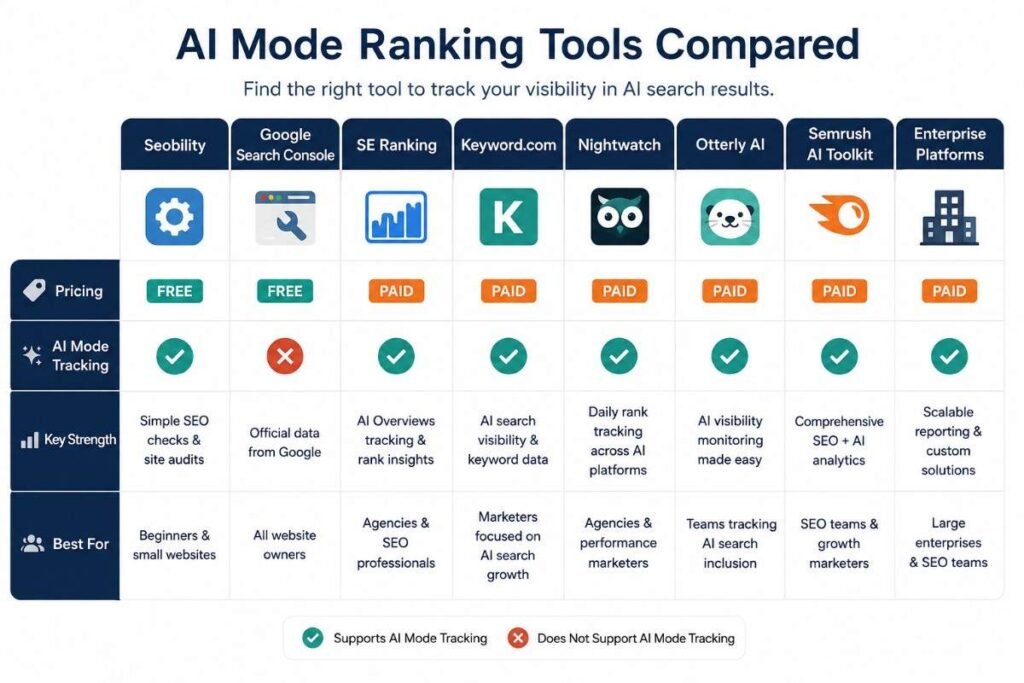
Not every business needs the same tool. A solo blogger monitoring a dozen keywords has completely different requirements than an enterprise brand tracking hundreds of prompts across five countries. The table below separates options by tier so you can match the tool to your actual situation instead of your budget alone.
| Tool | Best For | Free Tier | Tracks AI Mode | Starting Paid Price |
|---|---|---|---|---|
| Seobility | Small sites, beginners | Yes, limited daily checks | Ranking and AI Overview detection | Around $50 per month |
| Google Search Console | Any site with verified ownership | Yes, fully free | Yes, via a generative AI performance report | Free |
| SE Ranking | Agencies and growing teams | Limited trial | Dedicated AI Mode tracker | Mid-range monthly plans |
| Keyword.com | Precise, scheduled tracking | No | Yes | Mid-range monthly plans |
| Nightwatch | Freelancers and small agencies | No | Yes | Entry-level monthly plans |
| Otterly AI | Brands focused purely on AI visibility | Limited trial | Yes, across multiple AI engines | Mid to higher monthly plans |
| Semrush AI Toolkit | Full-stack SEO teams | No | Yes, integrated with existing Semrush data | Higher monthly plans |
| Enterprise platforms such as Profound or Scrunch AI | Large brands with compliance needs | No | Yes, deep multi model coverage | Custom enterprise pricing |
Free Tools for Small Sites
If your site has a manageable list of target terms, a rank tracking tool’s AI mode free option paired with Google Search Console covers most of what you need. Seobility’s free plan lets you run daily ranking checks on a limited number of keywords, view the top one hundred results for a query, and switch between desktop and mobile views. Search Console adds official first-party data straight from Google, including the newer generative AI performance report that separates impressions coming from AI Overviews and AI Mode from your standard organic totals.
Mid-Tier Paid Tools
Once you are tracking dozens of keywords across multiple locations, or once AI visibility becomes a metric leadership actually asks about, tools like SE Ranking, Keyword.com, and Nightwatch earn their monthly cost. They automate the daily grind, store historical trend data so you can spot patterns over months rather than days, and most now include a dedicated module for AI Mode citation tracking rather than treating it as an afterthought.
Enterprise-Grade AI Visibility Platforms
Large brands with compliance requirements, multiple product lines, or a need to prove ROI to a board tend to graduate toward platforms built specifically around AI visibility, such as Profound or Scrunch AI. These track presence across Google AI Mode alongside ChatGPT, Perplexity, and Gemini simultaneously, with role-based access for larger teams and deeper source-level analysis of exactly which pages get cited and why.
Seobility Ranking Checker: A Closer Look at a Free Website Ranking Checker
Because it appears constantly in searches for a website ranking checker free, Seobility deserves a section of its own rather than a single line in a comparison table.
What Seobility Tracks
The Seobility ranking checker lets you enter a domain and a target keyword, then returns your exact position along with the full top one hundred results for that query, complete with titles, descriptions, and URLs. You can filter by city or region, switch between desktop and mobile rankings, and add competitor domains to see how your visibility stacks up against theirs over time. The paid Ranking Monitoring feature automates this into a daily check with saved history and downloadable PDF reports, and it has begun flagging AI Overview appearances alongside standard positions.
Seobility also runs a companion SEO checker that crawls a page and evaluates it against roughly two hundred on-page and technical factors, covering meta information, page structure, internal and external links, and server configuration. That technical foundation matters more than ever, because AI crawlers depend on the same clean, well-structured pages that traditional search bots do when deciding what to cite.
Strengths and Limits of Seobility for AI Models
The strength here is accessibility. You get real ranking data with no signup, no credit card, and a genuinely useful free daily allowance, which makes it one of the better entry points for a keyword rank checker free search. The limitation, and it is a fair one, is depth. Seobility gives you standard positions and basic AI overview flags, but it does not yet run the multi-turn, query fan-out-style testing that dedicated AI mode specialists like Rankscale or Peec AI perform. For a small business checking whether it still shows up in Google’s results, that is rarely a problem. For a brand trying to win a conversational AI mode session across several follow-up questions, it is worth pairing Seobility with a purpose-built AI visibility tool.
Getting Started with Seobility’s Free Plan
Getting a first reading takes about two minutes. Enter your domain and a target keyword into the ranking checker, choose your country and device type, and review your position alongside the full results page. Repeat this for your five or six most important terms; note the date, and you already have a manual baseline you can compare against next month, even before you decide whether a paid plan makes sense.
Keyword Rank Checker: Free vs Paid: Choosing the Right Fit
This decision trips up more small businesses than any other part of the rank tracking process, mostly because the marketing language around every tool makes it sound essential.
When Free Tools Are Enough
If you track fewer than twenty keywords, update your content infrequently, and mainly want a monthly gut check rather than daily automation, a free Google keyword rank checker tool paired with Search Console genuinely covers your needs. There is no reason to pay for daily monitoring you will not have time to act on anyway.
Signs You Need to Upgrade
The signals are fairly consistent across businesses. You are manually checking more than thirty keywords and losing hours to it. Need historical charts going back further than a free tool retains. You manage multiple client sites and need white label reporting. Want automated alerts the moment a competitor overtakes you, rather than discovering it a month later. Any one of these is a reasonable trigger to move to a paid plan.
Cost Comparison
A free stack costs nothing but your time, and that time adds up quickly once you are checking dozens of terms by hand every week. Entry-level paid plans generally start in the thirty to sixty dollar per month range and buy back that time through automation, while dedicated AI mode specialists and enterprise platforms run considerably higher because they are testing far more query variations across multiple AI engines, not just Google. Compare the hourly cost of manual checking against the monthly subscription price before assuming free is always cheaper. Often it is not.
How to Set Up Rank Tracking Tool AI Mode for Your Business
Here is a practical sequence you can complete without any specialized technical background.
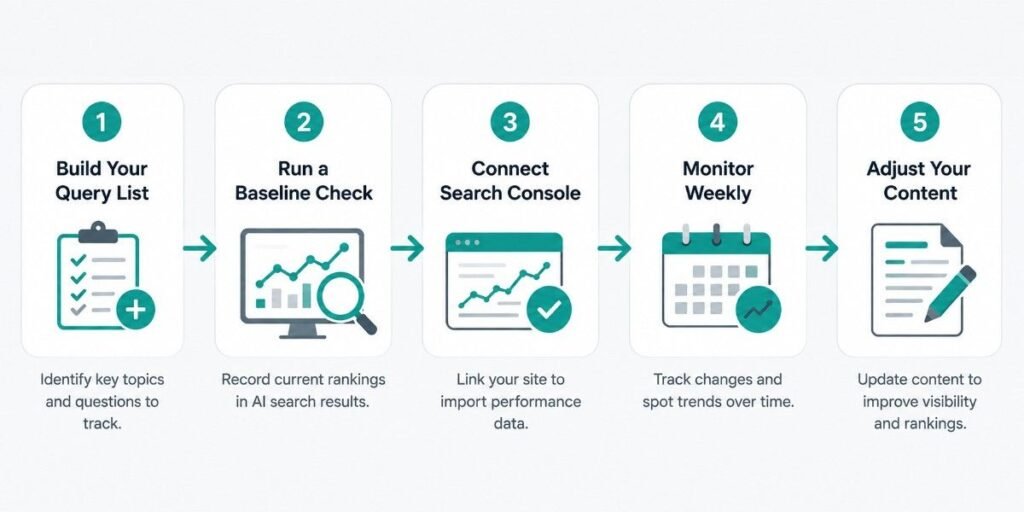
Building Your Query List
Start with three categories rather than one giant, unfocused list. Brand queries cover your company and product names directly. Category queries cover phrases like “best” or “top” plus your product type. Problem queries cover the actual questions your customers ask before they know your brand exists. Industry research suggests tracking at least fifty to one hundred queries across these three buckets gives a meaningful, statistically useful picture of your AI Mode visibility rather than a handful of anecdotes.
Connecting Google Search Console
Verify your property in Search Console if you have not already, then open the newer generative AI performance report. As of its June 2026 rollout, this report isolates impressions coming specifically from AI Overviews, AI Mode, and generative Discover features, broken down by page, country, device, and date. It currently shows impressions only, without click data, but it is still the fastest free way to confirm whether Google is surfacing your pages inside AI-generated answers at all.
Reading Your First Report
Resist the urge to obsess over a single day’s numbers, since citations inside AI Mode rotate constantly. Instead, look for direction over two to four weeks. Is your citation rate trending up or down against the same competitor set? Are certain problem queries consistently pulling in your pages while others never do? Use those patterns to prioritize which pages to update first, rather than trying to fix everything at once.
Common Mistakes and Best Practices
A few habits separate the businesses that actually improve their AI Mode visibility from the ones that just collect confusing data.
Treating AI Mode exactly like traditional SEO is the most common mistake. Position one in classic search results does not guarantee a citation inside a conversational answer, so chasing rank alone without checking citation rate leaves half the picture missing.
Ignoring technical health is another frequent error. AI crawlers still need to reach, render, and understand your pages the same way traditional search bots do, so broken redirects, missing meta information, and weak internal linking hold back AI visibility just as much as classic rankings.
Checking only once and never again defeats the purpose entirely. Because cited sources shift so quickly, a single snapshot tells you almost nothing about your actual trend. Weekly or at minimum monthly checks matter far more here than they ever did with stable, slow-moving traditional rankings.
Finally, watching only your own numbers without competitor context leaves you guessing whether a drop reflects your own content weakening or the entire category simply becoming more competitive. Every serious tool on this list, free or paid, includes some form of competitor benchmarking. Use it.
Conclusion
Search has genuinely split into two tracks. Traditional blue link rankings still matter, but a growing share of queries now get answered inside a conversational AI Mode experience that plays by entirely different rules. Three takeaways from this guide are worth holding onto. First, a real rank tracking tool AI mode setup measures citations and share of voice, not just position, because those are the metrics that actually reflect how AI mode works. Second, free tools like Seobility and Google Search Console cover most small business needs and are a smart place to start before paying for anything. Third, technical SEO fundamentals still decide whether AI crawlers can even find and understand your content in the first place.
Start today with a free ranking check on your five most important keywords, then open your Search Console generative AI report to see whether Google is already citing you. From there, decide whether a paid AI Mode specialist tool earns its place in your stack. Rank tracking tool AI mode visibility is not optional anymore. It is simply the next chapter of the same SEO work you have always done.
FAQ: People Also Ask
What is a rank tracking tool AI mode?
It is software built to measure whether and how often your website gets cited inside Google’s conversational AI Mode responses. Unlike classic rank trackers that record a single position on a results page, it measures citation rate, share of voice, and sentiment across full multi-turn conversations since AI Mode does not use a traditional numbered list format.
Is there a free rank tracking tool AI mode option?
Yes, several exist. Seobility offers a free daily ranking checker plus AI overview flagging, and Google Search Console’s generative AI performance report shows impressions from AI mode and AI overviews at no cost. Together they cover most small business tracking needs without a paid subscription.
How is a website ranking checker different from an AI mode tracker?
A standard website ranking checker records your numbered position on a traditional search results page. An AI mode tracker instead tests conversational queries and follow-up questions, then logs whether your domain gets mentioned or cited inside the generated answer, which is a fundamentally different measurement.
Does Seobility’s ranking checker track AI mode citations?
Seobility tracks standard keyword positions accurately and has added basic AI overview detection to its reporting. It does not yet run the deep, multi-turn query testing that specialized AI mode platforms use, so pairing it with a dedicated AI visibility tool gives a fuller picture for brands that rely heavily on AI search traffic.
What is the best rank tracking tool AI mode for small businesses?
For most small businesses, starting with Seobility’s free ranking checker alongside Google Search Console’s generative AI report is the most cost-effective combination. Once tracking needs grow past roughly twenty to thirty keywords or multiple locations, upgrading to a mid-tier tool like SE Ranking or Nightwatch becomes worthwhile.
How often should I check my AI Mode rankings?
Weekly checks are ideal, since industry data shows a large share of cited sources inside AI-generated answers rotate every month. Monthly checks are the minimum useful frequency. Checking only once provides a snapshot with no way to judge whether your visibility is improving or declining.
Can Google Search Console show AI Mode traffic?
Yes. Since June 2025, AI Mode clicks, impressions, and position data have counted toward Search Console’s performance totals, and a dedicated generative AI performance report launched in June 2026 that isolates AI Overview and AI Mode impressions from standard organic search, though it currently reports impressions rather than clicks.
Is a keyword rank checker free tool accurate enough for AI mode?
Free tools are generally accurate for standard keyword positions and increasingly good at flagging AI overview appearances, but most do not yet run the full conversational, multi-turn testing that true AI mode specialist tools perform. They are a solid starting point, not a complete replacement for a dedicated AI visibility platform once that becomes a priority.