
Top AI Home Gadgets 2026: The Ultimate Smart Living Guide
Be honest for a second. A Wi-Fi bulb you flip on from your phone isn’t intelligence. It’s a remote control that learned to use an app. Something that watches how you actually live and quietly acts on its own — that’s a different animal. Totally different species, really. And in 2026, with the global smart home market blowing past 164 billion dollars, more of these different-animal devices are landing on shelves than ever.
This guide cuts through that noise. We’re going room by room through the top AI home gadgets 2026 actually has on offer—the ones worth your paycheck and the ones that are mostly hype wearing a nicer box.
By the end you’ll know how to spot a genuinely useful gadget versus a gimmick, which AI home devices in 2026 are worth buying, and how to start small instead of dumping cash into devices that refuse to talk to each other.
What Actually Makes a Gadget “AI-Powered”
Here’s the simple version. A regular smart plug turns your lamp on when you tell it to. Every time. No exceptions, no surprises. An AI-powered device notices you flip that same lamp around sunset most nights, and eventually it just… does it first. Before you’ve even reached for your phone.
Small difference on paper. Huge difference in how the house actually feels.
And that gap is exactly why a lot of what gets marketed under best smart home tech 2026 is really just app-controlled hardware with an “AI” sticker slapped on the listing page for good measure.
Real AI devices lean on machine learning to study your habits over weeks — sometimes months — and adjust without being told twice. A programmable thermostat follows a schedule you punched in once and forgot about. An AI thermostat notices when you actually walk through the door; how fast your specific drafty hallway heats up; even what the sky’s doing outside. Then it adjusts. On its own.
Pro tip:
Watch for words like “adaptive,” “predictive,” and “learns your routine.” If a listing just says “AI-enhanced” with zero explanation of what the thing actually learns? Marketing fluff. Not substance.
Why this distinction keeps mattering more. As more brands crowd into this category, the gap between real smart home AI gadgets and dressed-up junk keeps widening. People who learn to spot the difference spend less. And—this is the part that matters—they actually keep using what they bought instead of letting it gather dust in a junk drawer.
The Best AI Kitchen Gadgets for Home
Kitchens might be the single busiest category for AI kitchen gadgets for home right now. Take ovens. Newer AI-powered models use built-in cameras and food recognition to figure out what’s actually inside, then adjust temperature and time without you touching a dial. No more guessing whether that chicken thigh needs five more minutes or is already dry as cardboard.
Fridges have leveled up too. Instead of being a glorified screen you stream playlists from, newer smart refrigerators track expiration dates, suggest recipes off whatever’s actually sitting on the shelf, and nudge you when the milk’s about to run out.
Expert note:
You don’t need to gut your whole kitchen for this to pay off. Not cooking every night? One solid AI-assisted appliance — a smart oven, say — gets you most of the benefit without the price tag of replacing everything at once.
Where the value is real:
- Less food waste, thanks to expiration tracking
- Fewer burnt or undercooked dinners
- Recipe ideas pulled from what’s actually in your pantry
- Hands-free, voice-guided cooking instructions
AI Security and Peace of Mind Devices
Security still eats the biggest chunk of smart home spending. AI is a big reason why. AI-powered cameras now use motion tracking, package detection, and facial recognition to actually tell the difference between your Amazon driver and someone who shouldn’t be standing on your porch. That alone kills a huge chunk of the false alerts older motion-only cameras never managed to filter out.
Smart locks picked up similar tricks. Instead of a plain keypad, a lot of them now recognize patterns — who usually gets home and when — and flag entry attempts that don’t fit.
Statistic:
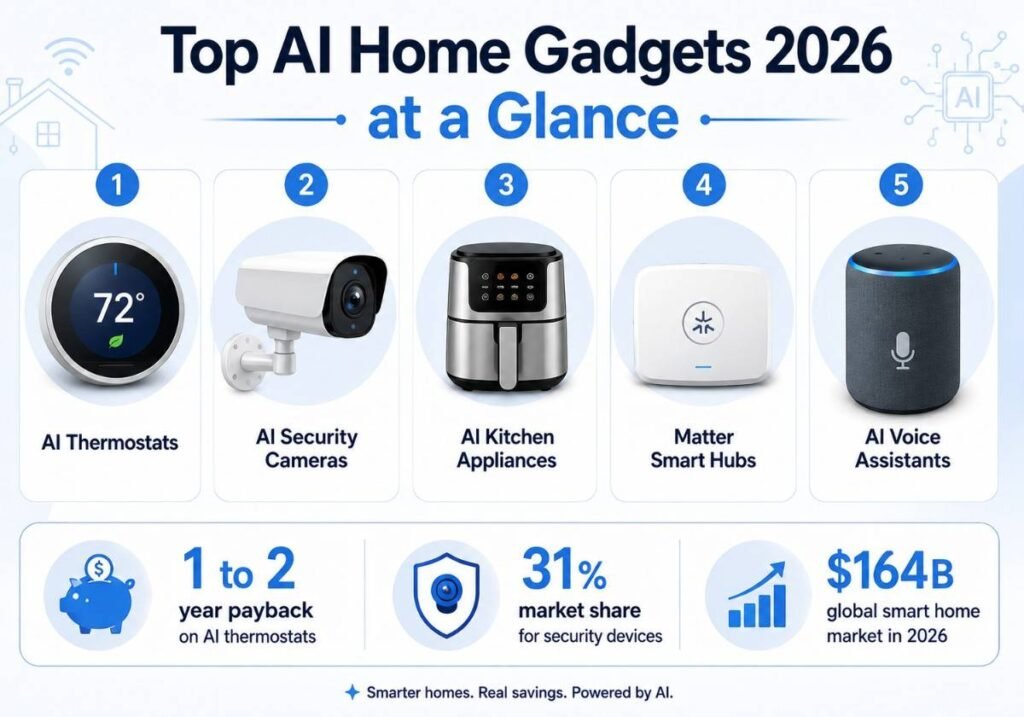
According to Grand View Research, security and access control devices held over 31 percent of the entire smart home product market in 2025. Easily the largest single category.
Comparison note:
An old-school motion-sensor camera alerts you to literally anything that moves — a tree branch, a passing car, somebody’s cat wandering through. AI-powered cameras filter that noise out using object recognition. Honestly? Probably the single biggest quality-of-life upgrade in this entire category.
AI-Powered Home Automation Devices for Energy Savings
Want your smart home to pay for itself? Energy management is where that actually happens. AI-powered home automation devices — especially thermostats that study your schedule and local weather through machine learning — can meaningfully cut heating and cooling costs, according to guidance from ENERGY STAR.
Smart plugs and energy monitors have gotten sharper too. They flag which appliances are hogging power, then suggest running the dryer or dishwasher during off-peak hours instead of prime time.
Data point:
The Department of Energy’s Affordable Home Energy Shot initiative is actively pushing adoption of connected HVAC controllers and adaptive lighting, aiming to cut household energy costs in half by 2030.
Pro tip:
Start with the thermostat. Of everything in this whole guide, it’s usually the fastest to pay for itself—often within a year, maybe two.
Home Assistant AI Devices and Smart Hubs
Fragmentation has always been the smart home’s biggest headache. Five brands, five apps, none of them speaking the same language. Home assistant AI devices and hubs are finally starting to fix that in 2026, largely thanks to the Matter standard—a shared protocol that lets gear from different manufacturers actually cooperate, with no separate app required for each gadget.
Voice assistants remain the main entry point into most smart homes, but they’ve gotten better at parsing how people actually talk. You don’t need exact commands anymore. Say “it’s a bit cold in here,” and the assistant just… turns the heat up. No fuss.
Expert note:
If you’re browsing Droven.io’s new gadgets for 2026, look specifically for listings that confirm Matter compatibility upfront. That one detail is fast becoming the line between a smart home that grows smoothly and one that turns into a junk drawer of orphaned apps.
Comparison Table: Top Categories at a Glance
| Category | Example Use Case | Typical Payback or Value | Best For |
|---|---|---|---|
| AI Thermostats | Learns schedule, adjusts automatically | 1 to 2 years via energy savings | Homeowners wanting fast ROI |
| AI Security Cameras | Filters false alerts, detects packages | Ongoing peace of mind | Renters and homeowners alike |
| AI Kitchen Appliances | Auto-adjusts cooking settings | Convenience, less food waste | Frequent home cooks |
| Smart Hubs (Matter) | Unifies multiple brands | Long-term scalability | Multi-device households |
| AI Voice Assistants | Natural language home control | Immediate daily convenience | First-time smart home buyers |
How to Start Your Smart Home Without Overspending
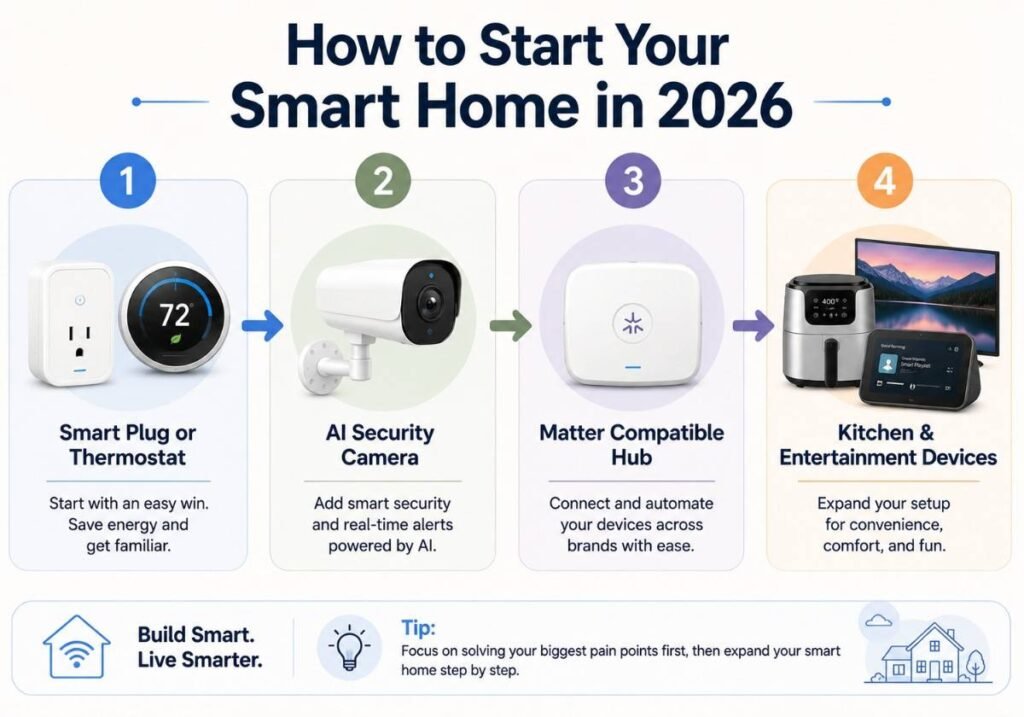
You don’t need to automate the whole house in a weekend. Honestly, trying to is basically how people end up with a drawer full of returns and a guilty conscience. The households that actually stick with this stuff start with one device tied to one real frustration—a painful energy bill, a security worry, or dinner prep that drags on forever.
A rollout that actually works tends to look something like this:
- Start with a smart plug or thermostat. Cheap, easy, and you’ll feel the difference fast.
- Add an AI security camera or video doorbell wherever you actually worry about who’s coming and going.
- Once you’ve got three or more devices running, bring in a Matter-compatible hub so everything lives under one roof, so to speak.
- Save kitchen and entertainment gadgets for last. Nice to have. Not urgent.
Checking out current listings? Sites tracking Droven IO’s new gadgets in 2026 are worth a look before you buy—especially to confirm Matter certification on anything new.
Conclusion
The top AI home gadgets 2026 has to offer aren’t novelties anymore. They cut energy bills, quiet down false security alerts, and take real work off your plate in the kitchen. The people getting the most out of all this? They’re not buying everything at once. They’re picking one frustration—a high energy bill, an unreliable camera, whatever it is—and building outward from there with Matter-compatible gear.
Three things worth remembering. Chase devices that genuinely learn and predict, not ones that just wear the AI label. Start with a thermostat or camera, since those pay off fastest. And confirm Matter compatibility before you add anything new.
Frequently Asked Questions
What makes a smart home gadget “AI-powered” instead of just smart?
An AI-powered gadget uses machine learning to study your behavior and act on its own. A regular smart device only does something when you directly tell it to, or on a fixed schedule. If the label’s accurate, the device predicts and adapts. It doesn’t just connect to an app and call it a day.
Do AI home gadgets actually save money?
Some do — particularly AI thermostats and energy monitors, which tend to pay for themselves within a year or two through lower heating and cooling bills. Others, like most AI kitchen gadgets, lean more toward convenience than savings. Depends entirely on how often you’d actually use one.
What is the Matter standard, and why does it matter for smart homes in 2026?
Matter is a shared connectivity standard that lets smart home devices from different brands actually work together, instead of forcing a separate app for each one. It matters because juggling five incompatible apps just to run one house gets old. Fast.
Are AI security cameras worth the monthly subscription?
For most people, yes — mainly because AI-powered cameras cut down on the false alerts that plague basic motion sensors. Wind, shadows, passing cars, you name it. Whether the subscription itself is worth it comes down to how much you value fewer notifications against an ongoing fee.
What is the Top AI Home Gadgets 2026 for Smart Living
An AI thermostat is usually the smartest first buy. Affordable, simple to install, and it starts saving you money almost immediately. It also gives you a clear, everyday example of what AI automation is actually supposed to feel like.
Are AI home devices safe from a privacy standpoint?
Most well-known AI home devices encrypt your data and let you control what gets stored, though privacy practices vary a lot brand to brand. Check whether a device processes data locally or in the cloud, and stick with manufacturers who publish clear privacy policies.