
Blacksmith Tools: What You Actually Need Before You Start
Here’s a number that surprises most people: nine out of ten new blacksmiths walk away within their first year, and skill almost never has anything to do with it. The real culprit is usually the shopping cart. People buy the wrong gear, spend money they didn’t need to spend, and burn out before they ever get good at the craft. Blacksmithing tools aren’t interchangeable across skill levels or project types, and a shop stuffed with mismatched equipment will empty your wallet faster than any mistake you’ll ever make at the anvil.
Maybe you landed here looking for a blacksmith tools list, maybe you’re trying to put names to old blacksmith tools’ names you found in a barn, or maybe you just want honest blacksmith tools price numbers before you commit a dollar. Either way, you’re in the right spot.
Below you’ll find what a working smith genuinely needs, what each tool does, what it costs in the USA as of 2026, and how older generations handled the same jobs with different equipment. There’s also a full blacksmith tools names with pictures reference section so you can point at something in a shop or a flea market listing and know exactly what you’re looking at.
The Real Blacksmith Tools List: What Beginners Need
Before you spend anything, get familiar with the five categories every forge depends on. Skip one of these and you’ll hit a wall in your first month, guaranteed.
The Anvil
The anvil is your fixed, hardened work surface, and honestly, it’s the piece of equipment most people picture when they think “blacksmith.” A solid anvil has a flat working face, a horn for curving your stock, a hardy hole for seating tool shanks, and a pritchel hole for punching through material. Hobbyist anvils built new usually land somewhere between 55 and 100 pounds. Shops running production work often reach for something 150 pounds or heavier.
The Forge
Strip it down to basics, and a forge is just controlled fire, hot enough to soften steel so you can shape it. New smiths generally pick between a propane forge, which fires up instantly and holds a steady temperature with little fuss, or a coal or coke forge, cheaper to run over time but slower to master. If you want the deeper history of how forge temperature control moved from open hearths to modern gas burners, Wikipedia’s overview of the trade is worth your time: https://en.wikipedia.org/wiki/Blacksmith
Hammers
Your hammer is what moves force from your arm into the metal. Most beginners reach for a cross-peen hammer first, since one face flattens the stock while the other draws it out lengthwise. At this stage, weight matters more than shape, and a 2- to 3-pound hammer is where most people start before adding anything specialized.
Tongs
Tongs keep hot stock away from your skin, plain and simple. Jaw shapes vary for flat bar, round bar, and odd shapes, but wolf jaw or universal tongs tend to be the smartest first buy since they grip a wide range of stock reasonably well.
The Vise
A regular bench vise handles light filing and cold work fine, but a post vise (also called a leg vise) is purpose-built for blacksmithing. Its long legs drive hammer force straight into the floor instead of your workbench, so it can take direct strikes without loosening—something a standard bench vise simply cannot survive.
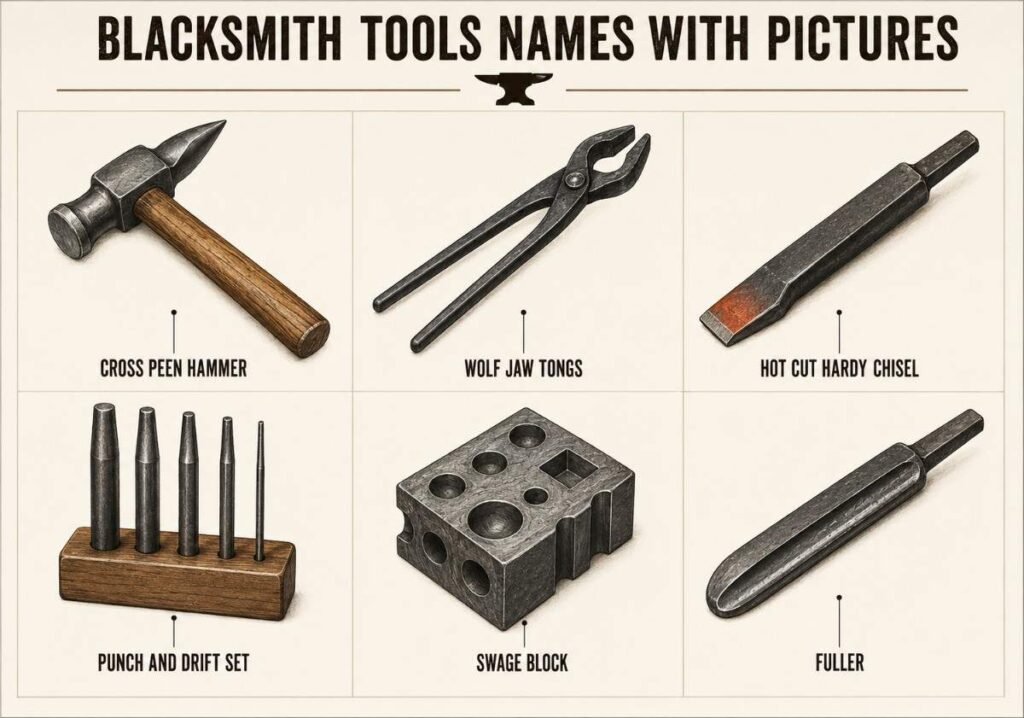
Blacksmith Tools Names With Pictures: A Visual Reference
If you came here searching for blacksmith tool names with pictures, chances are you want to identify gear by sight, whether that’s browsing secondhand listings or flipping through an old catalog. Here’s a category-by-category rundown to match against photos or tools you’ve come across in person.
Striking and shaping tools
Cross-peen hammer: flat face on one side, wedge-shaped peen on the other, used for general shaping and drawing metal lengthwise. Ball-peen hammer: a flat face paired with a rounded ball end, common for riveting and texturing work. Sledgehammer: a large, heavy, two-handed hammer used by a striker working alongside the smith on big stock. Flatter: a hardy tool with a wide flat face, struck with a second hammer to smooth surfaces once rough shaping is done.
Holding and gripping tools
Flat jaw tongs: jaws shaped specifically to grip flat bar stock. Wolf jaw or universal tongs: adaptable jaws that handle round, square, and flat stock. Post vise (leg vise): a floor-mounted vise with a leg that reaches the ground for stability under repeated hammer blows.
Cutting and punching tools
Hot cut hardy: a chisel-shaped tool that sits in the anvil’s hardy hole and cuts hot metal when struck. Cold chisel: used on unheated metal, held by hand and struck with a hammer. Punch: Drives a hole through heated metal, often finished off with a drift to true the shape up. Drift: a tapered tool driven through a punched hole to size and shape it precisely.
Finishing and forming tools
Swage block: a heavy block with grooves and holes of different shapes, used to form curves, rounds, and hexagons. Fuller: a rounded tool used to spread metal or neck it down at a specific point. Mandrel: a tapered steel cone used to shape rings and curved bands to a precise diameter.
Blacksmith Tools and Their Uses: The Complete Breakdown
Understanding blacksmith tools and their uses matters far more than owning a big pile of them. A smith who deeply understands six tools will consistently outwork a shop full of gear nobody actually knows how to run.
Shaping and forming tools
These are the tools touching hot metal directly: hammers, the anvil’s face and horn, swage blocks, and fullers. Their job is moving material, whether that’s drawing a bar out longer, curving it around the horn, or rounding a corner into something smooth.
Measuring and layout tools
A center punch marks exact spots before drilling or punching. Calipers and a steel rule check dimensions once the stock cools. A speed square or combination square keeps bends and angles accurate, which counts most on functional pieces like brackets, hinges, and gate hardware.
Heat and fuel tools
Think of the forge itself; fire tools like a rake and poker for coal forges; and a quench tank filled with water or oil for hardening finished work. Temperature control at this stage is the difference between a blade that holds an edge and a hook that simply bends under load.
Safety gear
Leather aprons, welding-style gloves, safety glasses, and forearm sleeves aren’t optional extras. Sparks travel much further than most beginners expect, and a stray ember landing on bare forearms is one of the most common injuries new smiths report.
Old Blacksmith Tools’ Names: Traditional and Historic Equipment
If you’re digging into old blacksmith tools’ names, you’re probably trying to identify something at an estate sale, in a family barn, or in an old photograph. Older tools often carried completely different names than their modern counterparts, even when the job stayed identical.
Historic hand tools
Bickern: an early horned anvil, generally smaller, used for fine curved work rather than heavy forging. Hardy: the old catch-all term for any tool shank built to sit in the anvil’s square hardy hole. Set hammer: an older name for what most modern smiths call a flatter, used to true up a surface. Butcher: a hot-cut chisel-style tool used historically for rough separation of stock before finer cutting tools existed.
Antique hammer types
Old shops used regional hammer patterns that differed country to country. English pattern, German pattern, and Swedish pattern hammers all shaped the peen and face a little differently, and collectors today still sort antique hammers by these regional names.
Historic anvil styles
The London pattern anvil, known for its single horn and flat step near the face, became the dominant style across the English-speaking world by the 1800s and remains the most common shape sold new today. Farrier anvils split off as their own historic branch, built with extra mass in the horn and heel for shoeing horses rather than general forging. For more on how anvil design evolved, Wikipedia has a solid page: https://en.wikipedia.org/wiki/Anvil
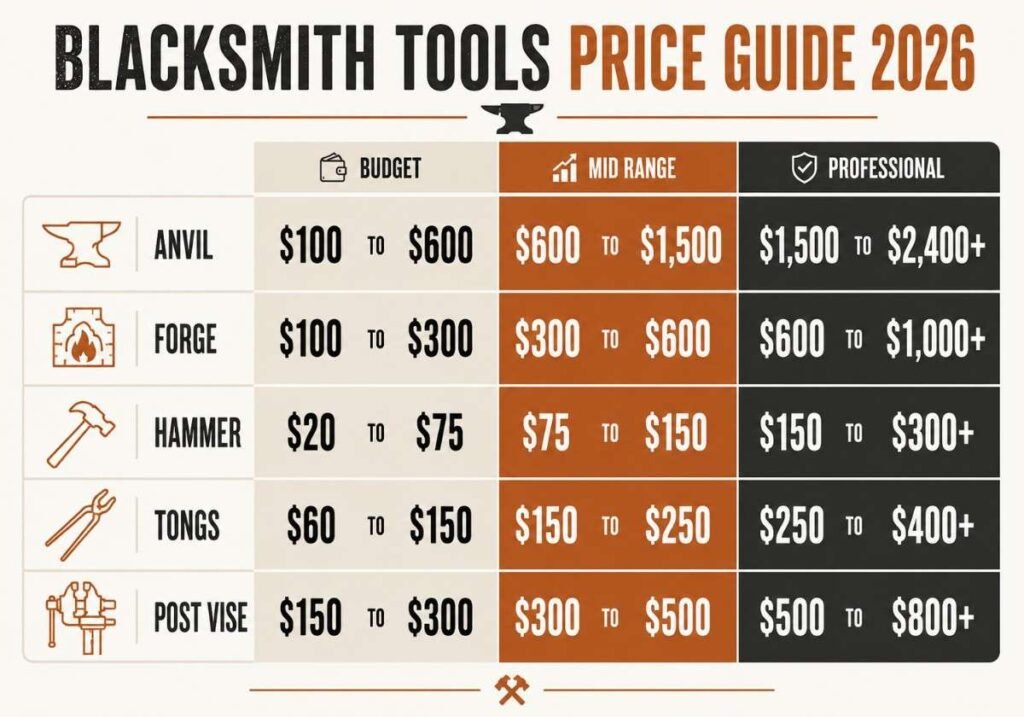
Blacksmith Tools Price Guide (USA, 2026)
Blacksmith tools’ price ranges swing wildly depending on whether you’re buying new, used, or antique. Here’s a realistic comparison across the three most common buying tiers in the United States.
| Tool Category | Budget / Starter | Mid-Range | Professional / Premium |
|---|---|---|---|
| Anvil | $100 to $200 (cast iron, 55 to 99 lb) | $300 to $500 (70 lb cast steel, new) | $800 to $2,400+ (150 to 300 lb cast steel) |
| Forge | $100 to $170 (single- or double-burner propane) | $250 to $450 (multi-burner propane) | $500 to $1,000+ (coal forge with blower setup) |
| Hammer | $20 to $40 (basic cross-peen) | $60 to $120 (name-brand pattern hammer) | $150 to $300+ (hand-forged specialty hammer) |
| Tongs (set) | $60 to $100 (beginner multi-pack) | $120 to $200 (individually forged pairs) | $250 to $400+ (custom-fitted sets) |
| Post vise | $150 to $250 (used, estate sale) | $300 to $450 (reconditioned) | $500 to $800+ (new, name brand) |
Antique tools picked up at estate sales, Facebook Marketplace, or farm auctions are often cheaper than new budget imports, and a well-kept century-old anvil frequently outperforms a brand-new low-cost one.
How to Choose the Right Blacksmith Tools for Your Skill Level
The hobbyist starter kit
A single-burner propane forge, a 55 to 70 pound anvil, one cross-peen hammer, one pair of universal tongs, and full safety gear are needed. This handles basic bar stock projects like hooks, bottle openers, and simple blades.
The serious apprentice kit
Everything above, plus a post vise, a punch and drift set, a swage block, and two or three more tong shapes. At this stage most smiths also pick up a hardy hole tool set that includes a hot cut and a fuller.
The professional workshop
A 150-pound or heavier anvil, a coal or multi-burner propane forge, a full range of specialty hammers, a power hammer or press when budget allows, and a dedicated quench station. Professional shops also tend to keep duplicate tools on hand, since downtime costs real money.
If you’d rather see these tools in action before you buy anything, video demonstrations genuinely help. Search YouTube for current beginner forging tutorials, and community threads on Quora often answer specific buying questions straight from working smiths. (Note: swap these two mentions for the specific videos or threads you want to link to. I couldn’t verify a real URL for either, so I left them as plain references rather than guess one.
Conclusion
You don’t need to build a full shop on day one. Start with an anvil, a forge, one solid hammer, one pair of tongs, and real safety gear, then add to it as your projects demand more. Take the time to actually understand blacksmith tools and their uses before chasing specialty gear, because a tool you can’t use correctly is just money sitting on a shelf. And shop across new, used, and antique markets, because the blacksmith tools price range in the USA is wide enough that patience genuinely pays off. Build your kit gradually, starting with the essentials above, and you’ll sidestep the single biggest reason beginners quit in year one.
FAQ
What are the basic tools used in blacksmithing?
The five basics are an anvil, a forge, a hammer, tongs, and a vise. Together they cover heating, holding, and shaping metal, the three core actions behind every forging project, regardless of skill level or specialty.
What is the most important blacksmith tool?
The anvil, generally speaking. It’s the fixed surface every hammer blow works against, and without a stable, flat, properly hardened face, even a skilled smith can’t shape metal accurately or efficiently.
How much does it cost to start blacksmithing?
A basic starter setup in the USA typically runs $400 to $700, covering a small forge, a lightweight anvil, one hammer, tongs, and safety gear. Costs climb quickly once anvil weight and forge type go up.
What is a blacksmith’s hammer called?
Most beginners start with a cross-peen hammer, though ball-peen and straight-peen versions are also common. Names like “flatters” and “set hammers” actually refer to hardy hole tools, not hand hammers.
What tool holds hot metal in blacksmithing?
Tongs. Different jaw shapes, including flat jaw, round jaw, and wolf jaw or universal tongs, exist to grip different stock shapes without letting the workpiece slip mid-hammer strike.
What is an old-fashioned blacksmith tool called?
Historic names include the bickern, an early horned anvil, and the butcher, an old term for a hot-cutting chisel. Many old blacksmith tool names describe the exact same functions modern tools perform, just under regional or period-specific terminology.
Is blacksmithing expensive to learn?
It can stay moderate if you start small. Plenty of beginners spend under $500 total on a compact forge, a lightweight anvil, and one hammer and tong set, adding tools gradually as specific projects call for them.
Do blacksmiths still use anvils today?
Yes. Even with modern equipment like power hammers and presses in the picture, the anvil stays central to nearly every forge, professional, artisan, or hobbyist, because nothing else offers the same mix of mass, hardness, and shaping features.