Why choose ziptie ai search performance tool
Ranking number one on Google used to mean something simple. People saw you, clicked you, remembered you. That is not quite true anymore. Ask around and you will hear the same complaint from marketers everywhere: rankings look fine, but the phone stopped ringing. Some studies now suggest that holding the top organic spot only earns an AI citation about one out of every four times someone asks an AI engine for a recommendation. That gap is exactly why a tool like ZipTie exists.
If you searched for why ZipTie is a top AI search performance tool, you are probably wondering whether your brand still shows up when someone types a question into ChatGPT, Perplexity, or Google AI Overviews instead of typing it into a normal search box. In this guide you will learn what ZipTie actually does, how the monitoring and optimization process works day to day, who it fits best, what it costs, and how it stacks up against other options. By the end you should know whether it belongs in your AI search tracking tool lineup.
What Is ZipTie and Why Does AI Search Visibility Matter
Search habits have shifted more than most people realize. Fewer people scroll through ten blue links now. Many just ask an AI engine and act on whatever it says back. If your brand is not part of that answer, you basically do not exist to that person, no matter how well you rank in classic search results.
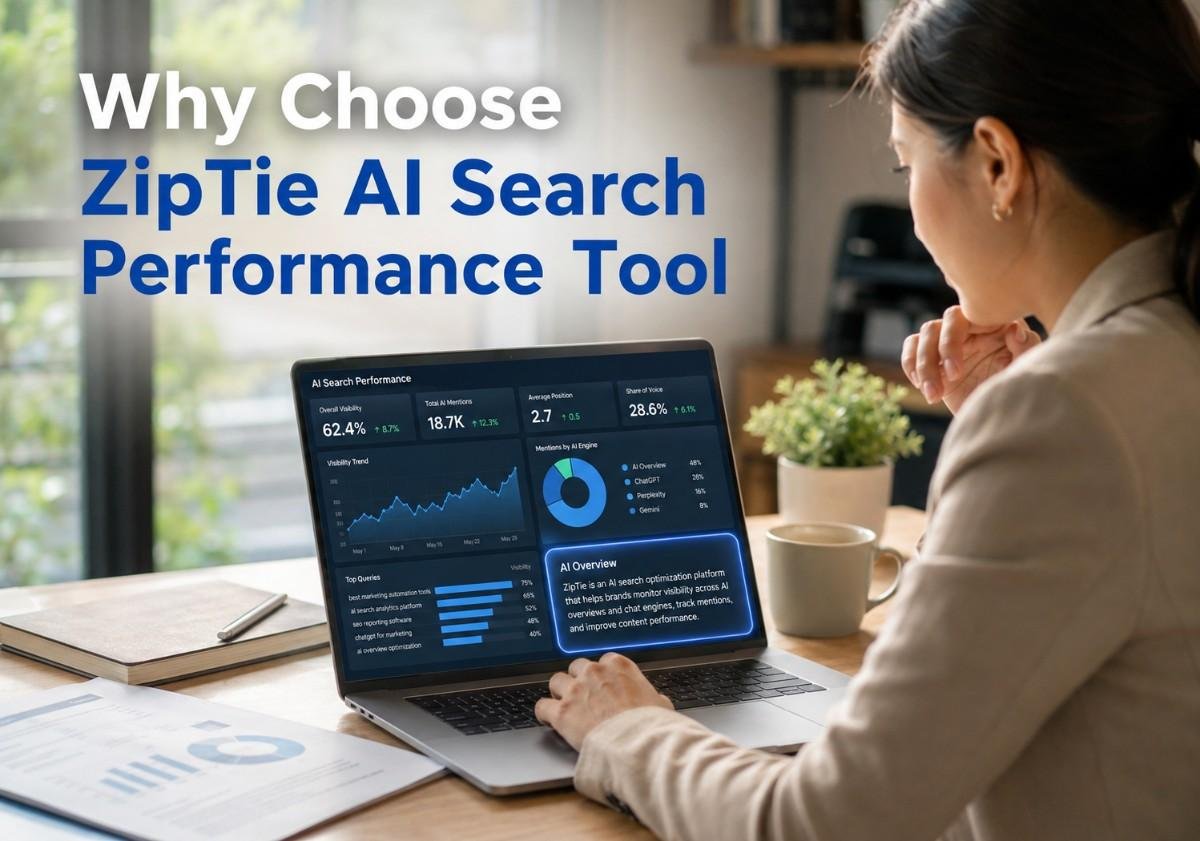
ZipTie is a dedicated AI search monitoring and generative engine optimization platform, usually shortened to GEO. The team behind Onely, a technical SEO agency with a long track record, built ZipTie, so the product feels shaped by people who actually run audits for a living rather than by a spreadsheet of feature ideas. ZipTie checks whether, how, and how favorably three of the most used AI answer engines, Google AI Overviews, ChatGPT, and Perplexity, mention your brand.
Here is a useful way to picture it. ZipTie is less like a rank tracker and more like a listening system built for AI-generated answers. It does not just tell you whether you got mentioned. It tells you what tone that mention carried and who got recommended instead of you.
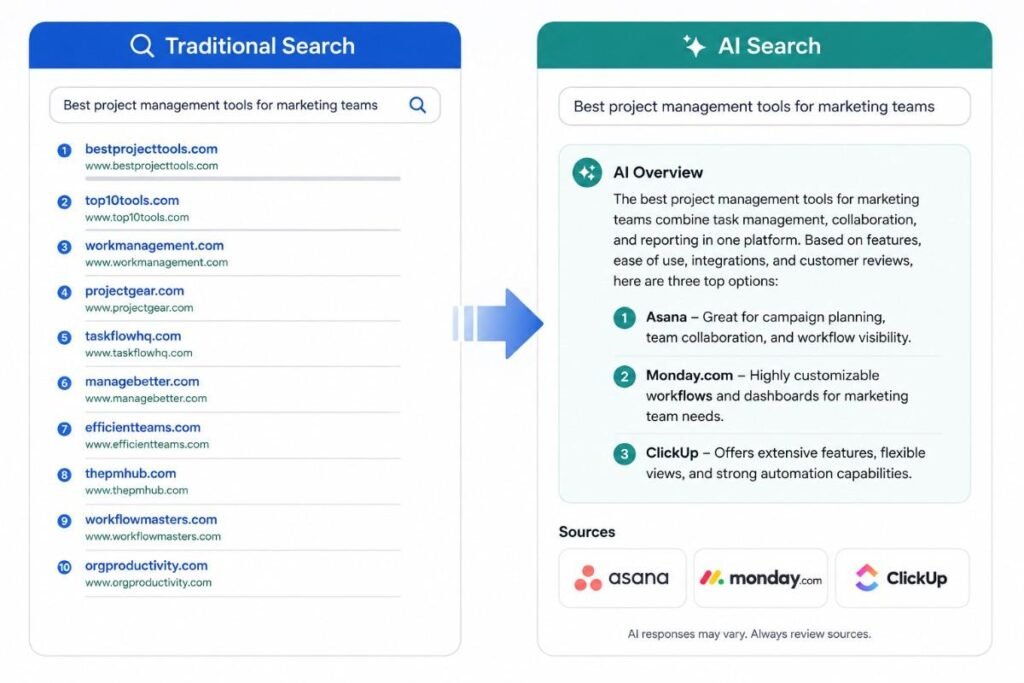
The Shift From SERP Rankings to AI Answer Visibility
A lot of AI search optimization tools got built by bolting AI monitoring onto an existing SEO platform almost as an afterthought. ZipTie went the other way. It assumed from day one that AI answers behave nothing like a normal results page. The same question asked in two different cities, at two different times, worded two slightly different ways, can pull back two very different AI answers. That is precisely why consistent, structured monitoring beats an occasional manual check.
Who ZipTie Is Actually Built For
ZipTie tends to suit SEO teams, GEO specialists, brand and PR teams, and agencies that already have a working content process and just need a dedicated layer of AI search visibility tools on top of it. It was never meant to replace your writers, your technical audit software, or your link-building work. Think of it as the missing piece that answers one question none of your other tools can answer well: What is AI actually saying about your brand right now, today?
How ZipTie Works: Monitoring, Optimization, and Insights
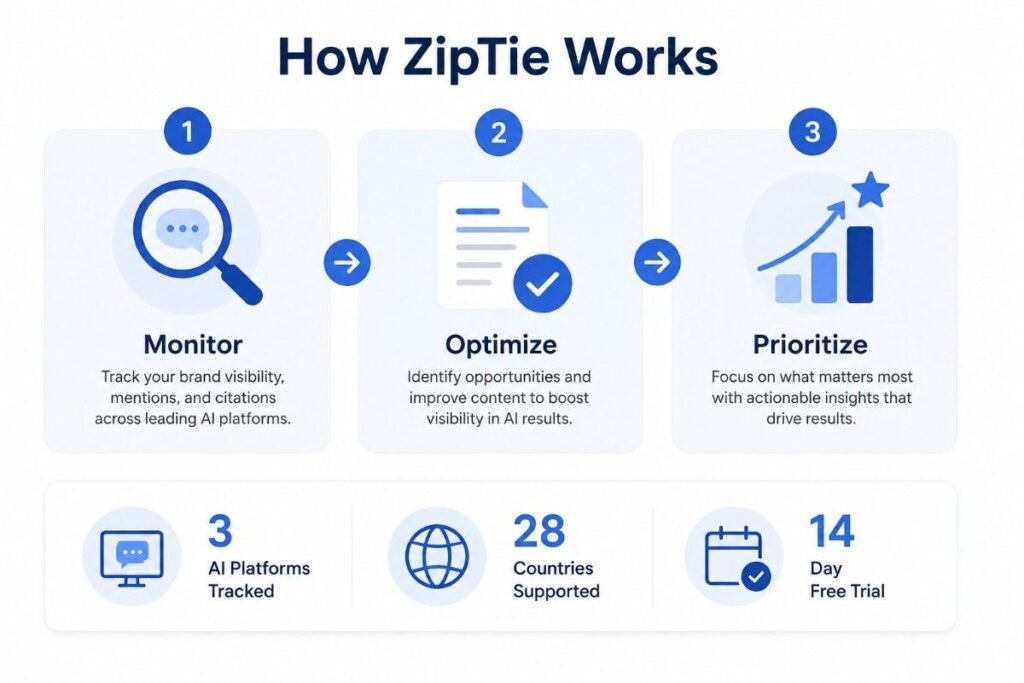
ZipTie splits its functionality into three modules, and once you understand that split, the whole platform makes a lot more sense.
Module one is AI search monitoring. You choose the prompts that matter, either by typing them in yourself, using the built-in query generator, or pulling them straight from Google Search Console. ZipTie then checks how your brand performs across all three engines for every one of those prompts. Instead of leaning only on API calls, which sometimes return results that differ from what a real person actually sees, ZipTie mimics genuine browsing behavior so it captures what customers really encounter.
Module two is content optimization. Once a gap turns up, ZipTie does not stop at flagging the problem. It looks at the relevant page and suggests specific topics, sections, or structural fixes that could raise your odds of getting a mention or citation next time.
Module three covers Insights, and this is where the AI Success Score comes in. Every tracked query gets a score that blends current visibility with the commercial weight of that query. That scoring is what lets a team prioritize sensibly instead of chasing every possible prompt at once.
A quick note worth remembering: teams that skip prioritization tools like this one often end up spreading their effort across dozens of low-value queries while the handful that actually drive purchases sit ignored.
Core Features That Set ZipTie Apart
Multiplatform coverage across Google AI Overviews, ChatGPT, and Perplexity lives in a single dashboard, so you are not jumping between three separate tabs.
Brand mention and citation tracking show whether your domain earns citation as an actual source, not just a passing reference.
Sentiment analysis tells you whether those mentions read as positive, neutral, or negative.
Competitive benchmarking shows which competitors keep getting recommended in your place.
Automated query generation surfaces the questions real customers are likely typing, without you guessing.
Category and project-level reporting lets you zoom into a single query or pull back and view an entire brand at once.
Coverage currently reaches checks across 28 countries, including the United States, Canada, the United Kingdom, and India. That matters if your brand sells internationally and needs region-specific data instead of one blended global number. This is also where ZipTie Dev, the platform’s own name for its core dashboard, shows its depth compared with lighter-weight trackers.
ZipTie Pricing: What You Actually Get at Each Tier
Pricing tends to be the first thing people search for with any AI search tracking tool, so here is the current breakdown. For teams weighing this against other LLM SEO tools, cost per check and cost per content optimization are usually the numbers that matter most.
Basic runs 69 dollars a month and includes 500 AI search checks and 10 content optimizations monthly. It suits solo consultants or small sites just testing the waters.
Standard runs 99 dollars a month with 1,000 checks and 100 content optimizations. This is the plan most growing SEO teams and small agencies land on.
Pro runs 159 dollars a month with 2,000 checks and 200 content optimizations, built for established agencies juggling multiple brands.
Enterprise pricing is custom, aimed at large brands that need custom volume and hands-on consulting.
Every paid tier covers Google AI Overviews, ChatGPT, and Perplexity, and every plan opens with a 14-day free trial, so you can test the workflow against your own brand’s queries before spending anything.
Even the entry-level Basic plan gives you 500 monthly checks, which usually covers a small business tracking 15 to 20 core queries on a weekly schedule comfortably.
ZipTie vs Alternatives: How It Really Compares
Choosing between AI search monitoring platforms usually comes down to a tradeoff between breadth and depth, and this is often where a Ziptie SEO workflow starts to look different from a generic competitor. ZipTie deliberately watches three platforms instead of ten, on the logic that Google AI Overviews, ChatGPT, and Perplexity already account for the bulk of AI-driven search volume for most B2B and e-commerce brands.
This focuses its platform coverage on Google AI Overviews, ChatGPT, and Perplexity, while many broader competitors stretch across additional engines such as Gemini, Copilot, and Grok. ZipTie leans on real browser simulation for its monitoring method, whereas a lot of rivals rely purely on API calls. Content optimization comes built directly into ZipTie rather than sold as a separate add-on, which is common elsewhere. ZipTie was built by a technical SEO agency, Onely, which shapes its practical focus, while origin stories vary a lot across the broader market. ZipTie fits best for teams that already run a content workflow and want deep insight, while a wider multi-engine tool suits brand teams chasing the widest possible coverage.
If your priority is the deepest, most actionable insight across the three engines that matter most right now, ZipTie tends to win that comparison. If you need visibility across every emerging AI engine on the market, including newer entrants still gaining traction, a broader tool might complement it well.
Limitations You Should Know Before Buying
No single tool covers everything, and to its credit, ZipTie is fairly upfront about where its scope ends. It spots visibility and content gaps effectively, but it is not a full content creation platform, a backlink audit tool, or a technical SEO crawler. Most teams still need separate software for long-form writing, internal linking audits, and publishing. It helps to think of ZipTie as the missing measurement layer sitting on top of your existing SEO stack, not a full replacement for it.
It is also worth knowing that AI search results are often personalized. Someone manually checking ChatGPT or Perplexity by hand may see slightly different answers than what ZipTie’s tracker logs. That is normal behavior across the entire AI search industry, not something unique to this platform.
Getting Started With ZipTie
Setting up a project comes first. You add your brand information and pick which queries and regions you want tracked.
Monitoring comes next. ZipTie checks your visibility across all three engines on whatever schedule you set, weekly or daily depending on how active your optimization work is.
Optimizing with insights comes last. You use the AI Success Score and the content recommendations to decide what to fix first.
That same workflow scales from a single freelancer tracking a handful of branded terms all the way up to an agency running dozens of client accounts across different categories.
Conclusion
Picking an AI search visibility tool really comes down to one question that traditional SEO software cannot answer on its own. What is AI actually saying about your brand today? ZipTie earns its spot in that conversation because it blends real browser accuracy, a genuinely useful AI success score for prioritizing work, and content optimization built directly into the platform rather than tacked on separately. If your team already produces content but has zero visibility into how ChatGPT, Perplexity, and Google AI Overviews describe you, ZipTie fills that exact gap.
Start with the 14-day free trial. Load in your five or ten most important brand and category queries and see exactly where you stand before committing to anything paid.
Frequently Asked Questions
What does ZipTie track?
ZipTie tracks brand mentions, citations, sentiment, and competitive visibility across Google AI Overviews, ChatGPT, and Perplexity. It shows whether your brand shows up in AI-generated answers and how favorably it gets described next to competitors.
How much does ZipTie cost?
Plans start at 69 dollars a month for Basic, with Standard at 99 dollars and Pro at 159 dollars. Enterprise pricing is custom. Every plan includes a 14-day free trial before any charge applies.
Is ZipTie worth it for a small business?
If your business already ranks well organically but has no idea what AI engines say about you, ZipTie is often worth it, since it reveals a blind spot that Google Search Console and standard SEO tools simply cannot show.
What is the difference between SEO and GEO?
Traditional SEO chases ranking position on a results page. Generative Engine Optimization, or GEO, focuses on getting mentioned and cited inside an AI-generated answer, where there is no fixed list of ten results to fight over.
Does ZipTie replace traditional SEO tools?
No. ZipTie is a specialized AI search visibility tool, not a full SEO suite. Most teams still need separate tools for keyword research, technical audits, and long-form content production.
How accurate is ZipTie’s data?
ZipTie leans on real browser simulation instead of relying only on API calls, specifically to capture what actual users see rather than results that can drift due to API-only sampling.
Which AI platforms does ZipTie support?
ZipTie currently covers Google AI Overviews, ChatGPT, and Perplexity, with monitoring available across 28 countries, including the United States, United Kingdom, Canada, and Australia.
Can agencies use ZipTie for multiple clients?
Yes. The project and category structure lets agencies track each client separately while still rolling everything up into brand level or category level reporting.