
Product hunt profile optimization academic ai writing tool
Here’s a number worth sitting with: the average Product Hunt visitor spends less than five seconds deciding whether to upvote a listing. Five seconds to read a tagline, glance at a screenshot, and decide your months of building were worth a click. That is not a formatting problem. It is a value proposition problem, and it is the single biggest lever available before you ever hit “Launch.”
Product Hunt profile optimization for an academic AI writing tool is the work of compressing everything your product does—draft, cite, check originality, and tighten prose—into one sentence a stranger can evaluate in under five seconds. In this guide you’ll learn how to build that sentence, score it before you publish, write a maker comment that actually gets read, and keep the listing working for months after launch day ends.
What a Value Proposition Actually Is, and Why “AI-Powered” Isn’t One
A value proposition is not a slogan. As the general marketing concept is described on Wikipedia’s overview of value propositions, it names who a product is for, what problem it removes, and why it beats the alternative in one sentence, without decoration.
For an academic AI writing tool specifically, “AI-powered” tells a voter nothing. Every listing on the page that day says it. The words that do work are the ones naming the exact pain: a graduate student who has lost an afternoon reformatting citations, a non-native English speaker whose journal submission got desk-rejected for phrasing, and a writing-center director drowning in plagiarism-check backlogs.
Pro tip: Write the value proposition as a full sentence first: [User] struggles with [problem] because [reason], and [tool] fixes it by [mechanism] before you touch the tagline field. The tagline is a compression of that sentence. It is not a separate creative exercise.
Score Your Value Proposition Before You Publish It
Most founders write one tagline and ship it. A better approach is to write three or four candidates and score them against the same rubric, because what feels clever to you rarely tests the same way against a stranger scrolling fast.
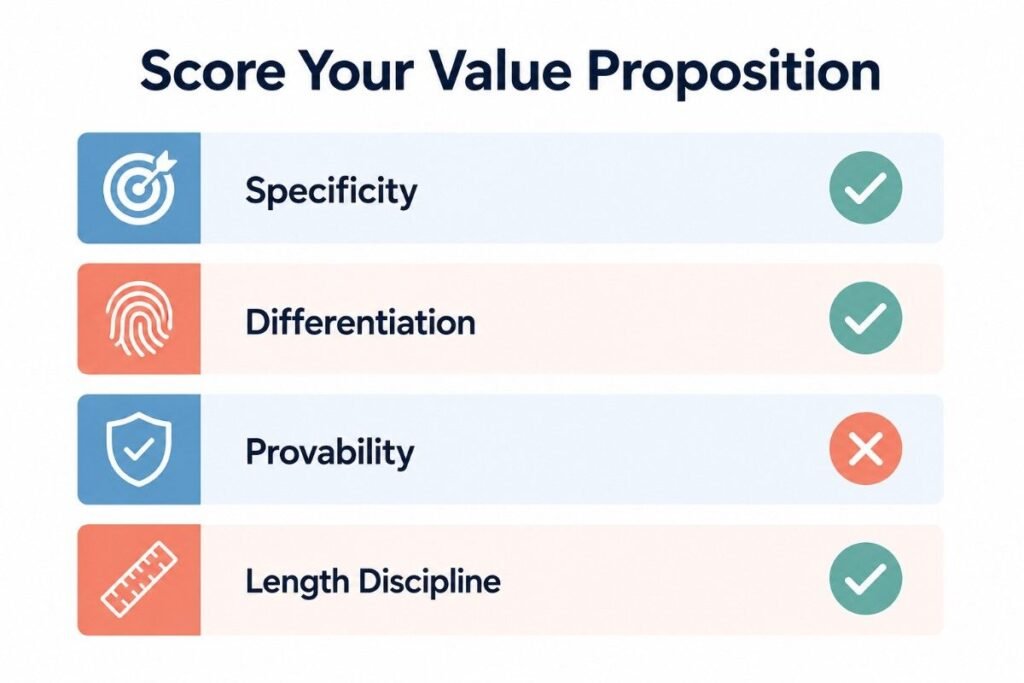
Run each candidate through these four checks:
- Specificity: Does it name a real user, not “everyone”? For PhD candidates writing their first paper” beats “for writers.”
- Differentiation: Could a competitor’s listing use this exact sentence? If yes, rewrite it.
- Provability: Could you defend the claim in a comment thread with a screenshot or a number? Vague superlatives collapse under one follow-up question.
- Length discipline: Under 60 characters for the tagline field. Product Hunt truncates longer text in feed view, which is where the five-second decision happens.
A quick worked example: “AI writing assistant for everyone” fails specificity and differentiation. “Citation-accurate drafting for graduate researchers” passes all four; it names the user, states a provable mechanism (citation-accurate), and fits comfortably under the character limit.
Expert note: If your tool sits on a fine-tuned open model, linking to the model card documentation on Hugging Face inside your gallery or maker comment gives technically literate voters something concrete to evaluate. This matters more in the academic category than almost any other, because your audience is trained to distrust unverified claims.
The Two Buyers Hiding Inside “Academic AI Writing Tool”
This is the split most positioning guides skip, and it changes everything about the sentence you write.
Individual researchers and students buy based on speed and personal frustration relief. They respond to persona-led framing: “Built for PhD candidates writing their first paper.” Their five-second decision is emotional. Does this describe my exact situation right now?
Institutional buyers, writing centers, library systems, and university procurement respond to outcome-led and integrity-led framing instead. They are evaluating risk as much as benefit, and a listing that leads with a raw feature list reads as unvetted software to this audience.
If your tool genuinely serves both, don’t try to write one tagline for both. Lead your Product Hunt tagline with the individual-user angle; that’s who upvotes and holds the institutional framing for the description’s second paragraph and your maker comment’s credibility section.
Four Positioning Angles, Matched to Real Pain Points
Different problems call for different sentences. Match yours to the user who actually feels the pain, rather than writing one pitch that tries to cover all four:
- Citation and source grounding for research-heavy writers who need retrieval-backed citations instead of a model inventing sources.
- Plagiarism and originality checking are positioned against Grammarly- and Turnitin-style detection but rely on transparency rather than raw accuracy claims.
- Draft-to-structure speed for students turning scattered research notes into an organized paper draft.
- Clarity editing for non-native English writers for authors publishing in English-language journals who need tone and register fixed, not just grammar.
Did you know? Listings that name a specific user segment in the tagline consistently generate longer first-comment threads than generic ones, because the right audience self-selects into the conversation instead of scrolling past.
Positioning around angle two carries a specific obligation: be explicit about how the tool respects academic integrity standards. Silence on plagiarism or hallucination risk reads as evasive to this audience; not confidently naming the risk directly and explaining your safeguard is what earns trust.
Comparing the Four Framing Approaches
| Framing approach | Best for | Main risk |
|---|---|---|
| Feature-led (“AI grammar, citations, plagiarism check”) | Broad first impressions | Undifferentiated — sounds identical to every competitor |
| Persona-led (“Built for PhD candidates writing their first paper”) | Focused early-adopter launches | Smaller addressable audience, but far higher relevance per voter |
| Outcome-led (“Cut your literature review time in half”) | Conversion-focused, second or third launch | Needs a number you can actually defend if challenged |
| Contrast-led (“Grammarly for citations, not just grammar”) | Fast comprehension, crowded categories | Only works if the comparison is instantly recognizable |
Pro tip: Persona-led and outcome-led framing stack well together. Name the user first, then attach one measurable outcome to them “PhD candidates who cut source-formatting time by half” do more work than either half alone.
Writing a Maker Comment That Gets Read
The founder’s first comment functions as a landing page above the fold; it’s read before most people scroll to the description. Yet most maker comments open with “Hey Product Hunt!” and lose the five-second window immediately.
Use this structure, in order:
- Who you are in one line, real name, real credibility marker (former researcher, built X before, etc.)
- The problem you saw was specific and personal, not generic market sizing
- Why now? What changed that made this the right time to ship
- What feedback do you want, a specific question, not “Let me know what you think”?
Here’s a full worked example for a citation-focused tool:
Hi Product Hunt I’m Sam, and I spent three years as a research assistant reformatting citations by hand for every journal my lab submitted to. Every reference manager I tried either hallucinated sources or made me verify each one manually anyway, which defeated the point. We built [Tool] to pull citations directly from the source document, not generate them from memory, so what you see is what’s actually in the paper. I’d love feedback specifically from anyone who has fought with Zotero or Mendeley on formatting edge cases. What broke for you?
That comment names a real problem, states a mechanism (pulls from source, doesn’t generate from memory), and asks a question specific enough that someone will actually answer it.
Step-by-Step: Building the Full Profile
Follow this sequence; each step depends on the one before it:
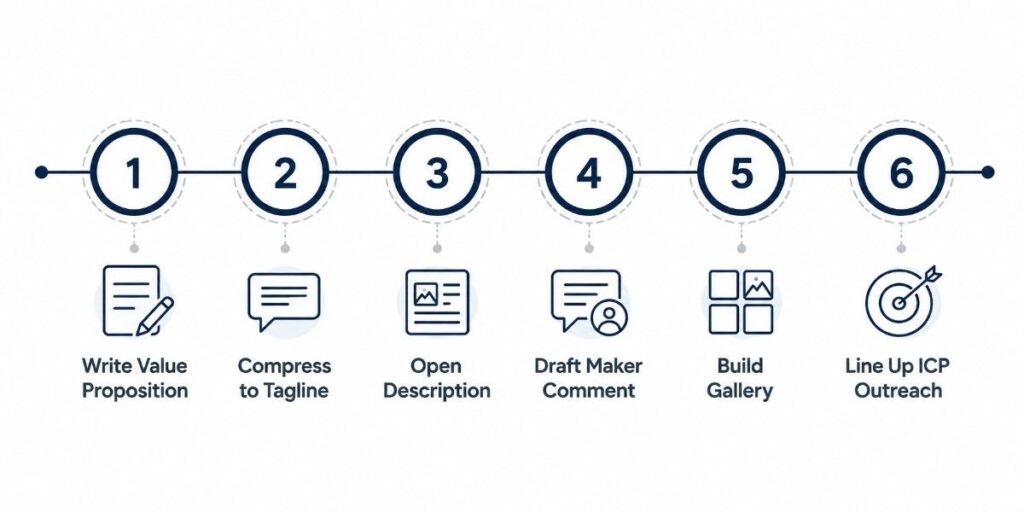
- Write the raw value proposition as a complete sentence: user + problem + outcome + differentiator.
- Compress it into a tagline under 60 characters.
- Open the description with that same sentence, then expand into three supporting points tied to outcomes, not a bare feature list.
- Write the maker comment using the four-part structure above.
- Build the gallery so the first screenshot restates the value proposition visually and shows the output the user gets, not a settings screen.
- Line up ICP outreach two to three weeks ahead of launch. Voters who match your actual ideal customer profile drive higher-quality discussion than a broad ask for upvotes.
Launch-Day Hour-by-Hour Playbook
This is the piece most guides skip entirely. According to Product Hunt’s own help documentation, the first several hours of a launch carry disproportionate weight for category placement, so treat the day as a schedule, not a single post-and-wait event:
- 12:01 AM PT: Listing goes live. Post your maker comment immediately; don’t wait for the first upvote to arrive.
- First 2 hours: Personally message your warmest ICP contacts, the people you lined up two to three weeks earlier, with a direct link, not a mass blast.
- Hours 3–6: Respond to every comment individually. Generic thanks read as bot replies; specific answers keep threads alive, and alive threads rank.
- Hours 6–12: Share progress in relevant communities where self-promotion is welcomed, not spammed. A machine learning subreddit thread discussing writing-assistant benchmarks is a very different audience than a general marketing forum.
- End of day: Thank commenters by name in a follow-up comment. This costs two minutes and measurably increases return engagement on your next launch.
What Happens After Launch Day Ends
Follower compounding is the part of Product Hunt that keeps paying off long after the ranking resets. Every “notify me” click becomes a permanent audience for your next release, and an embedded launch badge on your own site continues to drive discovery traffic for months. If academic integrity or citation grounding were your core value proposition, keep publishing evidence of it in a changelog entry or a benchmark update because that audience specifically rewards proof over time, not just on day one.
Common Mistakes to Avoid
- Leading with “AI-powered” instead of the actual outcome: Every listing says this, so it signals nothing.
- Listing features instead of stating the value proposition: a bullet list of capabilities doesn’t tell a voter why to care.
- Skipping the maker comment structure and opening with a greeting instead of substance.
- Staying silent on academic integrity or hallucination risk, which this audience reads as evasive rather than confident.
- Treating launch day as the only day the listing matters, when follower compounding means it keeps working for months.
Conclusion
Getting product hunt profile optimization right for an academic AI writing tool comes down to three things: write and score the value proposition before touching the tagline field, structure the maker comment around a real problem instead of a greeting, and keep working the listing after launch day instead of treating it as a one-day event. Do those three well, and the five-second decision window stops being a threat and starts being the whole game plan.
If you’re preparing a launch, start today: draft your raw value-proposition sentence, run it through the four-point scoring rubric above, and line up your ICP outreach list before you touch the Ship page.
FAQ / People Also Ask
What is a value proposition on a Product Hunt listing?
It’s the single sentence explaining who the product is for, what problem it solves, and why it beats the alternative. On Product Hunt specifically, this sentence needs to be recoverable from the tagline alone, since most voters never read past it in the first five seconds.
How do you optimize a Product Hunt profile before launch?
Start with the value proposition, compress it into the tagline, structure the maker comment around problem and credibility rather than a greeting, and build a gallery that visually restates the outcome instead of showing a settings screen.
What makes an academic AI writing tool different from a general writing assistant?
It has to directly address citation accuracy, source grounding, and plagiarism risk. General writing assistants can stop at grammar and tone, but academic tools get evaluated on research integrity just as much as prose quality.
Do you need a hunter to launch successfully?
No. A well-known hunter adds initial visibility, but a sharp value proposition and an engaged maker comment matter more for sustained upvotes than who technically posted the launch.
How long should a Product Hunt tagline be?
Keep it under 60 characters. Product Hunt truncates longer taglines in feed view, which is exactly where most voters make their five-second decision.
What happens to a Product Hunt listing after launch day ends?
It keeps working. Every follower gained becomes a permanent audience for future releases, and an embedded launch badge continues driving discovery traffic to your site for months afterward.
Should institutional buyers and individual users get the same tagline?
No. Lead the tagline with the individual-user angle, since that’s who upvotes, and save outcome- or integrity-led framing for the description and maker comment where institutional evaluators are more likely to read closely.
Is a feature list ever the right approach for the tagline?
Rarely. Feature-led framing works for broad first impressions but reads as undifferentiated in a crowded category; it’s usually better as supporting detail under a persona- or outcome-led headline sentence.