
AI Productivity Tools Updates March 2026: Full Guide
In March 2026 alone, Google’s AI developer tools were processing roughly half a trillion tokens a day internally, a number that would double again within weeks. That single statistic captures how fast the AI productivity tools updates march 2026 cycle moved and why so many professionals felt like they blinked and missed a launch. This was not a quiet month. Google rolled Search Live out to more than two hundred countries, Microsoft reorganized its entire Copilot leadership structure, Notion shipped cross-page AI blocks, and Perplexity pushed its Comet browser to iOS. If you run a business, manage a team, write code, or simply want your daily tools to work smarter without extra effort, this month mattered.
In this guide you’ll learn what actually shipped in March 2026 across the biggest AI productivity platforms, how each update changes daily workflows, which tools are worth adopting first, what the pricing shifts mean for your budget, and how to build a realistic AI stack for the rest of the year. We pulled information directly from official changelogs, company blogs, and verified release notes so you get facts, not guesses.
Why March 2026 Was a Turning Point for AI Productivity Tools
Every year brings incremental AI releases, but March 2026 stood out because four separate companies shipped platform-level changes in the same thirty-day window. This is unusual. Typically, major vendors stagger releases to avoid competing for headlines. Instead, Google, Microsoft, Notion, and Perplexity all treated March as a launch month, which suggests a coordinated response to rising competitive pressure in the AI productivity tools updates category.
The Shift From Assistants to Agents
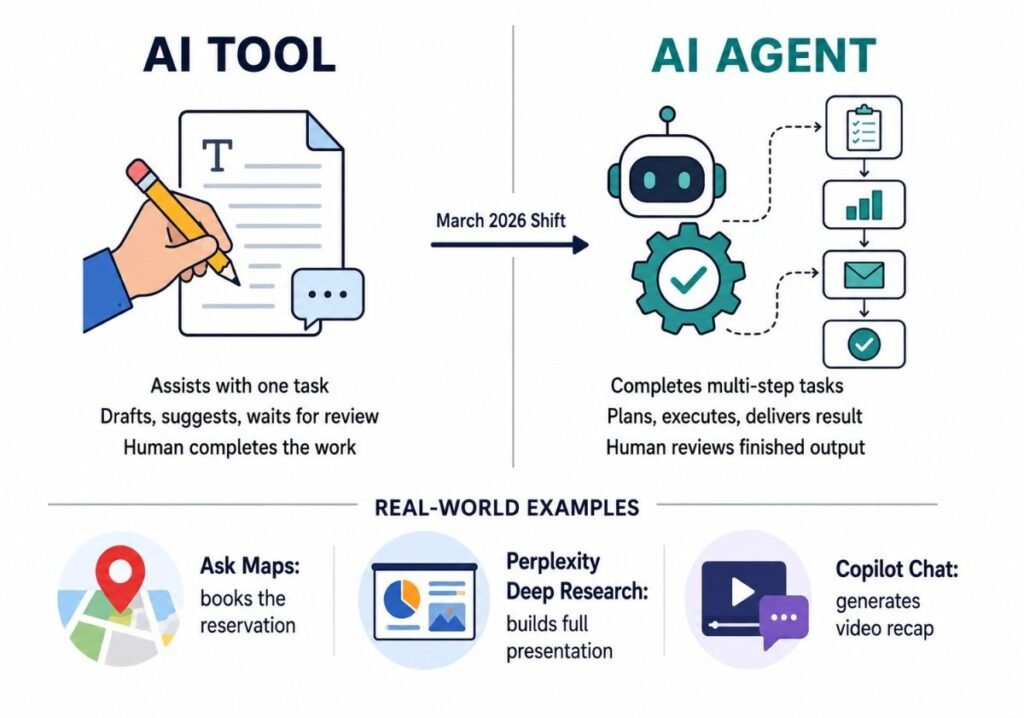
The clearest theme running through March 2026 announcements was the move from AI that helps you do work to AI that does the work itself. This is not marketing language; it shows up consistently across vendor recaps and independent coverage, all pointing to autonomous, multistep task execution replacing single-shot assistance.
Why This Matters for the Average Professional
If you are a marketer, developer, project manager, or small business owner, this shift means fewer copy-paste workflows and more automated handoffs. Instead of asking an AI tool to draft a paragraph, you increasingly ask it to complete a task end-to-end, then review the result. That distinction, between AI agents that finish jobs and AI tools that assist with parts of jobs, is becoming the single most important decision when building a productivity stack.
The Competitive Pressure Behind the Timing
Part of the reason for the March 2026 surge was competitive positioning ahead of major spring developer conferences. Companies wanted fresh features in users’ hands before Google I/O and Microsoft Build season, and the result was a genuinely dense month of AI update activity across nearly every major platform.
Google’s AI Developer News and Gemini Updates
Google’s March 2026 push was the most comprehensive of the month, spanning Search, Maps, Workspace, health, and its developer-facing Gemini API. If you are searching for Google video AI updates or general Google AI yesterday-style recaps, March 2026 is a foundational month to understand.
Search Live Goes Global
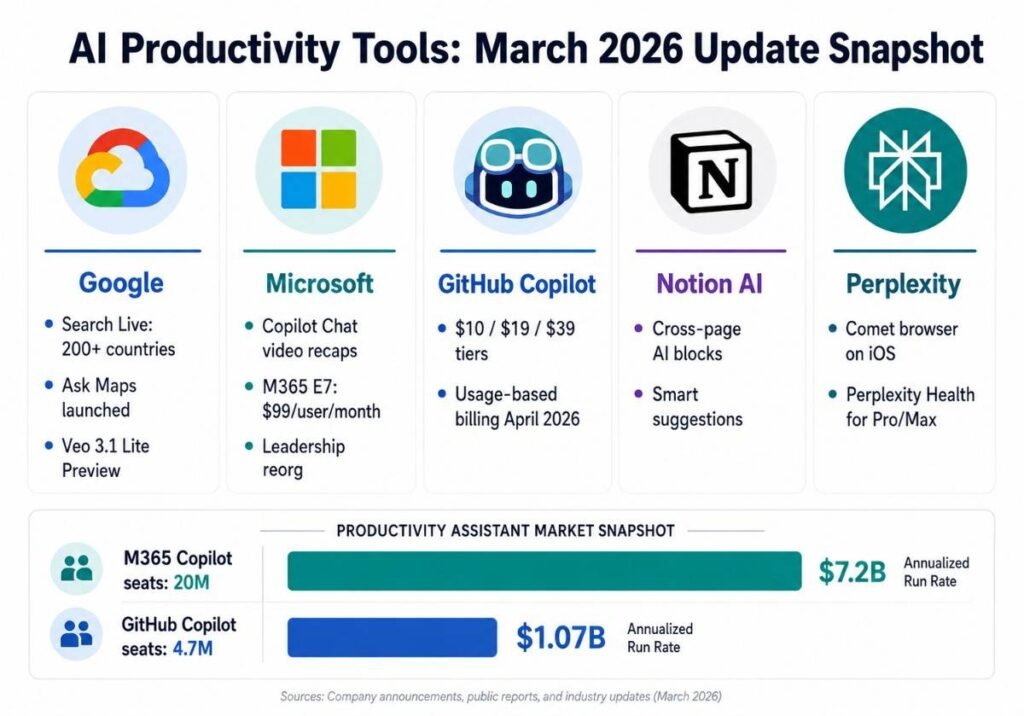
Google expanded Search Live to over 200 countries, letting users tap the Live icon in the Google app to hold a back-and-forth voice or video conversation for tasks like troubleshooting a car engine or identifying a plant in real time. This turns Google Search from a query and results interface into something closer to a live conversation, which matters for anyone who searches for hands-on help while out and about.
Ask Maps and Everyday AI Utility
Navigation also got smarter. Google introduced Ask Maps, a feature that lets drivers ask complex, layered questions and reportedly can answer specifics like where to charge a phone without a long coffee shop wait and even handle the reservation itself. This is a small but telling example of the agent trend described earlier: the tool does not just answer, it acts.
Google Video AI Updates: Veo 3.1 and Beyond
For anyone tracking Google video AI updates, March brought concrete changes to the Veo model family. Google’s developer changelog confirms the launch of Veo 3.1 Lite Preview, described as the company’s most cost-efficient video generation model, built for rapid iteration and high-volume applications. On the enterprise side, Google Cloud highlighted updates that let creators use simple inputs, such as reference images, to generate precise, mobile-ready video. The company also shipped Gemini Embedding 2 and brought the Wiz security team into Google Cloud, signaling a broader push into AI security alongside creative tooling.
Gemini Model Changes Developers Need to Know
The Gemini API changelog lists several important shifts affecting anyone building on Google’s models. Gemini 3 Pro Preview was scheduled for shutdown on March 9, 2026, replaced by Gemini 3.1 Pro Preview as the newest model in the Gemini 3 family. Google also released Nano Banana 2 and Nano Banana Pro, the general availability versions of its native visual models, alongside new Flex and Priority inference tiers for optimizing cost or latency. If your team relies on the Gemini API for AI developer news, these deprecation dates directly affect production stability.
Health, Wellness, and the Pixel Drop
Google also extended AI into wellness. At its annual health event, the company committed $10 million to help train clinicians for the AI era, while Fitbit users began seeing a personal health coach in public preview, capable of connecting to medical records to provide sleep and nutrition advice. The monthly Pixel software drop added Circle to Search improvements that can break down an entire outfit from a single photo, plus a Magic Cue feature that surfaces restaurant recommendations directly inside chat threads.
Microsoft Copilot and GitHub Developer News
Microsoft’s March 2026 was defined less by flashy features and more by structural change, though there were meaningful product updates too. This section is essential reading for anyone following AI developer news tied to enterprise software.
A Major Leadership Reorganization
The most consequential Microsoft news in March had nothing to do with a feature launch. On March 12, 2026, Microsoft announced that Rajesh Jha, Executive Vice President of Experiences and Devices, would retire after 35 years at the company, stepping down on July 1, 2026. His responsibilities, which had covered Microsoft 365 Copilot, Windows, and Office, were divided among four EVPs reporting directly to Nadella, with Jeff Teper promoted to EVP as well. This kind of reorganization typically signals where a company plans to invest engineering resources next, and Copilot was clearly central to the reshuffle.
Microsoft 365 E7 and Enterprise Pricing
Alongside the leadership change, Microsoft announced a new premium bundle. Microsoft 365 E7, announced March 9, 2026, is a new $99 per user per month tier set to launch in May 2026. This positions Copilot even more firmly as core Microsoft 365 infrastructure rather than an optional add-on, and it signals that AI features are being bundled deeper into enterprise licensing.
Copilot Chat and Copilot Notebooks Get Smarter
On the product side, Microsoft detailed several concrete March upgrades. Meeting summaries got a visual upgrade: when users ask Copilot Chat to summarize a meeting, they now receive a video recap alongside the written recap, essentially a narrated highlight reel combining key takeaways with short clips. Copilot Notebooks also received a redesign, bringing references, Copilot Pages content, and Copilot chats into one seamless, side-by-side view. Separately, a quality roadmap update improved Code Interpreter localization, correcting how non-Latin characters render in generated charts and files.
GitHub Copilot Pricing Shift on the Horizon
For developers tracking AI developer news, one pricing change from this period is worth flagging early. GitHub announced a shift to usage-based billing for April 2026, exposing token-metered pricing alongside its existing flat $10, $19, and $39 monthly tiers. Industry analysis notes that GitHub Copilot’s developer subscription base sits at roughly a quarter of Microsoft 365 Copilot’s paid seat count, despite a smaller addressable market. If your team budgets around GitHub Copilot, this shift toward consumption-based pricing deserves close attention through the rest of 2026.
Notion AI, Perplexity, and Workspace Automation Updates
Beyond the two giants, smaller but fast-moving platforms shipped changes that directly affect daily workflow automation. These are especially relevant if you searched for “AI productivity tools updates, March 2026, GitHub” or “AI productivity tool updates, March 2026, free,” since several of these updates expanded free tier functionality.
Notion AI’s Cross Page Breakthrough
Notion solved one of its longest-standing limitations this month. March 2026 brought cross-page AI blocks, resolving a major 2025 limitation, since AI blocks could now reference and synthesize content from linked pages, making dashboard-style summary pages significantly more useful. The same update introduced smart suggestions, offering proactive contextual edits while writing. For teams that build internal wikis or project dashboards in Notion, this is arguably the single most useful workspace update of the month.
Perplexity’s Comet Browser Reaches iOS
Perplexity extended its Comet browser to mobile in March, with the iOS version launching March 18, 2026, following earlier Windows, macOS, and Android releases. Perplexity’s own end-of-month changelog also confirmed that Perplexity Health began rolling out to Pro and Max subscribers, letting users securely connect health data sources in one place, including medical records from over one million providers and apps like Fitbit, Google Fit, Cronometer, and Clue. Perplexity also expanded what its Deep Research mode can do, allowing users to prompt something like “create a presentation analyzing the AI agent market” and receive the full workflow, research, synthesis, formatting, and presentation in one place instead of stitching tools together manually.
The Rise of Multimodel Routing
A broader trend across smaller productivity platforms is combining multiple AI models under one interface rather than locking users into a single provider. Some tools now run multiple models simultaneously, routing each task to whichever model performs best for that job. This multimodule approach reduces the need to juggle separate subscriptions and is quickly becoming a baseline expectation rather than a premium feature.
Zapier and the Automation Layer
Zapier continued its role as connective tissue between AI tools and everyday business software, with ongoing enhancements to its AI by Zapier app alongside integration updates across Google AI Studio, Google Vertex AI, and Anthropic’s Claude. This reflects how automation platforms are racing to keep pace with underlying model providers rather than the other way around.
Free vs Paid: The Real Cost of AI Productivity Tool Updates
One of the most searched angles around this topic is straightforward: which of these updates are actually free, and which require an upgrade?
| Tool | March 2026 Update | Free Tier Access | Paid Tier Starting Price |
|---|---|---|---|
| Google Gemini / Search Live | Search Live global expansion, Ask Maps, Nano Banana image models | Yes, core features free in the Google app | Google AI Pro and Ultra plans for higher usage limits |
| Microsoft 365 Copilot | Video meeting recaps, Copilot Notebooks redesign | Limited, requires qualifying Microsoft 365 license | Enterprise plan at $30 per user per month annually, roughly $31.50 monthly |
| GitHub Copilot | Shift toward usage-based, token-metered billing | Free tier for students and limited use cases | $10 per month individual, up to $39 for business tiers |
| Notion AI | Cross-page AI blocks, smart writing suggestions | Basic AI features included in most plans | AI features bundled into paid plans per late 2025 pricing restructure |
| Perplexity Comet and Health | iOS browser launch, Perplexity Health rollout | Comet browser is free to download | Perplexity Health rollout limited to Pro and Max subscribers |
What Free Really Means in 2026
A useful mental model here is that most companies now give away conversational chat and basic drafting for free, while reserving deep automation, cross-app agents, and specialized data connections like health records for paid tiers. If your priority is AI productivity tool updates, free in March 2026, focus on Google’s Search Live and Notion’s core AI writing tools, both of which remain broadly accessible without a paid plan.
Where the Money Actually Goes
Enterprise pricing tells a slightly different story. Analysis of Microsoft’s numbers estimates that 20 million M365 Copilot seats at $30 imply roughly $7.2 billion in annualized list price run rate, compared with 4.7 million GitHub Copilot developer seats at a blended $19, implying roughly $1.07 billion annualized. This gap shows how much larger the general knowledge worker market is compared to the developer-specific market, even though developer tools tend to dominate tech headlines.
How to Build Your AI Productivity Stack After March 2026
With so many updates landing at once, the practical question becomes how to actually use them without becoming overwhelmed. A widely cited research finding puts the underlying problem in perspective: knowledge workers spend a large share of their day on work about work, and US workers reportedly miss 36 percent of all deadlines each week, largely due to coordination overhead rather than a lack of effort.
Start With One Workflow, Not One Tool
Rather than adopting five new tools at once, pick a single recurring task, such as meeting summaries, email drafting, or status reporting, and apply one AI update to it fully before layering on another. Industry guidance consistently recommends picking one use case, trying one tool, and building from there instead of transforming an entire workflow overnight.
Match the Tool to the Task Type
Not every AI feature suits every job. Video recaps and notebook updates suit meeting-heavy roles. Cross-page AI blocks suit anyone managing shared documentation. Search Live and Ask Maps suit field-based or mobile-first workers. Matching the specific March 2026 update to your actual daily bottleneck, rather than adopting whatever is trending, produces far better return on time invested.
Watch for the Manager Adoption Gap
Adoption data is worth factoring into any team rollout plan. Research cited in industry coverage found that within organizations that have rolled out AI tools, 67 percent of leaders use AI frequently compared to just 46 percent of individual contributors. If you are rolling out any of the tools covered in this guide to a team, budget time for hands-on training, not just a feature announcement email, since adoption support matters as much as tool selection.
Keep a Regular Audit Habit
Because release cycles like March 2026 happen every few months now, build a quarterly habit of reviewing what you are paying for against what you are actually using. Cancel subscriptions for tools that duplicate functionality already included free in a platform you already pay for, such as Gemini’s expanding free feature set inside Google Search and Workspace.
Conclusion
March 2026 was not a quiet month for anyone following AI productivity tool updates in March 2026 across the industry. Google pushed Search Live and Ask Maps to a global audience while quietly overhauling its Gemini model lineup for developers. Microsoft paired genuinely useful Copilot Chat upgrades with a major leadership reorganization that will shape its AI roadmap for the rest of the year. Notion finally solved cross page context limitations, and Perplexity brought its Comet browser and new health features to a wider mobile audience.
Three takeaways matter most. First, the industry has clearly shifted from AI that assists to AI that acts, so evaluate new tools by what they can finish, not just what they can draft. Second, free tiers are more capable than ever for everyday tasks, but specialized features like health data connections and enterprise automation still sit behind paid plans. Third, successful adoption depends far more on picking one workflow and mastering it than on chasing every new release.
If you want to stay current on the next wave of AI developer news and workspace tool changes, bookmark this guide and revisit it each quarter, since the pace of updates shows no sign of slowing down.
Frequently Asked Questions
What were the biggest AI productivity tool updates in March 2026?
The biggest updates included Google’s global expansion of Search Live and Ask Maps, Microsoft’s Copilot Chat video recaps and leadership reorganization, Notion’s cross-page AI blocks, and Perplexity’s Comet browser launch on iOS. Each update pushed AI further toward completing tasks automatically rather than just assisting with drafts.
Are the March 2026 Google AI updates free to use?
Yes, most of Google’s March updates, including Search Live, Ask Maps, and Circle to Search improvements, are available free within the Google app. Higher usage limits and advanced Gemini API access still require a paid Google AI subscription tier.
What changed with GitHub Copilot pricing after March 2026?
GitHub announced a shift toward usage-based, token-metered pricing that layers on top of its existing flat monthly tiers. This change was confirmed for April 2026, so anyone using GitHub Copilot should review upcoming billing details to avoid surprise costs.
Is Notion AI’s cross-page feature available on the free plan?
Notion’s cross-page AI blocks and smart suggestions rolled out broadly, but full AI functionality now sits within Notion’s paid plans following a late 2025 pricing restructure. Basic AI writing assistance remains accessible on lower tiers.
What is the difference between an AI tool and an AI agent?
An AI tool typically assists with part of a task, such as drafting text, while an AI agent completes an entire multistep workflow with minimal human input. Most March 2026 updates, from Ask Maps to Perplexity’s presentation builder, pushed products further into the agent category.
Did Microsoft’s Copilot reorganization affect product features?
The March 2026 leadership changes primarily affected internal structure, splitting responsibilities among four executive vice presidents. However, it coincided with the announcement of Microsoft 365 E7, a new premium bundle, suggesting the reorg was tied to future AI investment plans.
What is Perplexity Health, and who can use it?
Perplexity Health is a feature that connects medical records and health app data, including Fitbit and Google Fit, into Perplexity’s AI assistant for personalized insights. It rolled out in March 2026 exclusively to Perplexity Pro and Max subscribers.
How can I keep up with future AI developer news and productivity tool updates?
Following official changelogs from Google, Microsoft, Notion, and Perplexity directly is the most reliable method, since third-party summaries can lag behind real release dates. Setting a quarterly reminder to review your AI tool stack also helps you catch major shifts like the ones covered in this guide.